
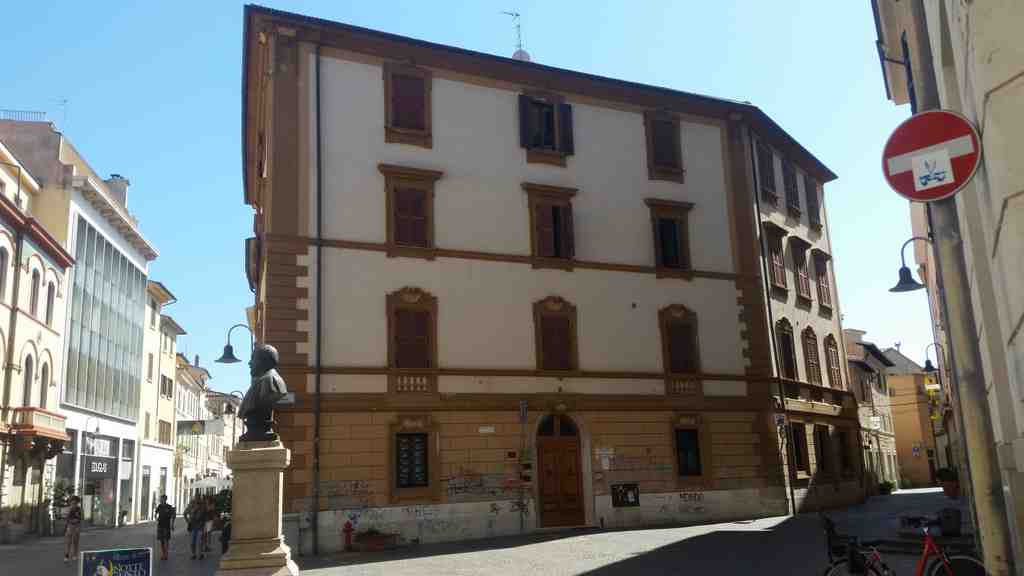
Just ahead, you'll see a grand four-story building with sturdy tan stonework at street-level, elegant brown shutters, and a rounded-arch doorway right in the center-look to where the square opens up and the stone meets the soft sunlight.
Ah, you’ve made it to the Former Bank of Italy building! If these walls could talk, they’d ask you for your savings-and probably your secrets, too! Just imagine yourself here when this spot buzzed with the whispers of old Grosseto, right at the crossroads of piazza Socci and Corso Carducci-a place where fortunes changed hands, and maybe even a scandal or two!
But rewind the clock a bit further, all the way to the end of the 1700s, and you’d find not this elegant palazzo, but a pair of narrow old houses squeezed together and peering out over the town’s main street. Fast-forward into the 1800s and voilà-the scene changes to a bustling inn: the Stella d’Italia. The locals still tell tales of its legendary mistress, the widow Palandri, who broke every rule-living in Grosseto through every sweltering summer and chilly winter, robust as a horse and cheerful as a songbird, a real-life marvel of Tuscan resilience. Her successor, Oreste Civinini, ran an inn so fine that even George Dennis, the famed English explorer, praised it as the best between Pisa and Rome-a compliment that still makes the local inns blush.
After a glittering run, Stella d’Italia packed up and moved to fancier digs, and here’s where the real transformation began. The land was snapped up by the Bank of Italy in 1896, right when Grosseto was on the move-new squares taking shape, grand boulevards springing up, a city striding confidently into the modern age! The building became the bank’s Tycoon HQ, and by 1925, it was given its striking Liberty-meets-neoclassical make-over, all curvy lines and clever details, with a little baroque panache just for fun. The grand entrance you see today frames a door that guarded the local treasures for decades. Imagine the bustle in 1930: stern bankers, chattering townsfolk, and perhaps the odd mischievous child peeking in, hoping for a glimpse of lucchetti d’oro-golden locks!
Even Marcello Piacentini, the maestro of modern Italian architecture, nearly put his stamp on it-almost. Instead, local architects made sure the building fit Grosseto’s unique style: stately but never stiff, stylish but always welcoming.
By 1977, the Bank moved on, craving a shiny new home beyond the city walls. Now, offices and studios fill these halls, but the building keeps its secrets. Remember: in Grosseto, nothing ever really disappears-it just gets another story! Now, shall we stroll onward to the next piece of our living history?


