
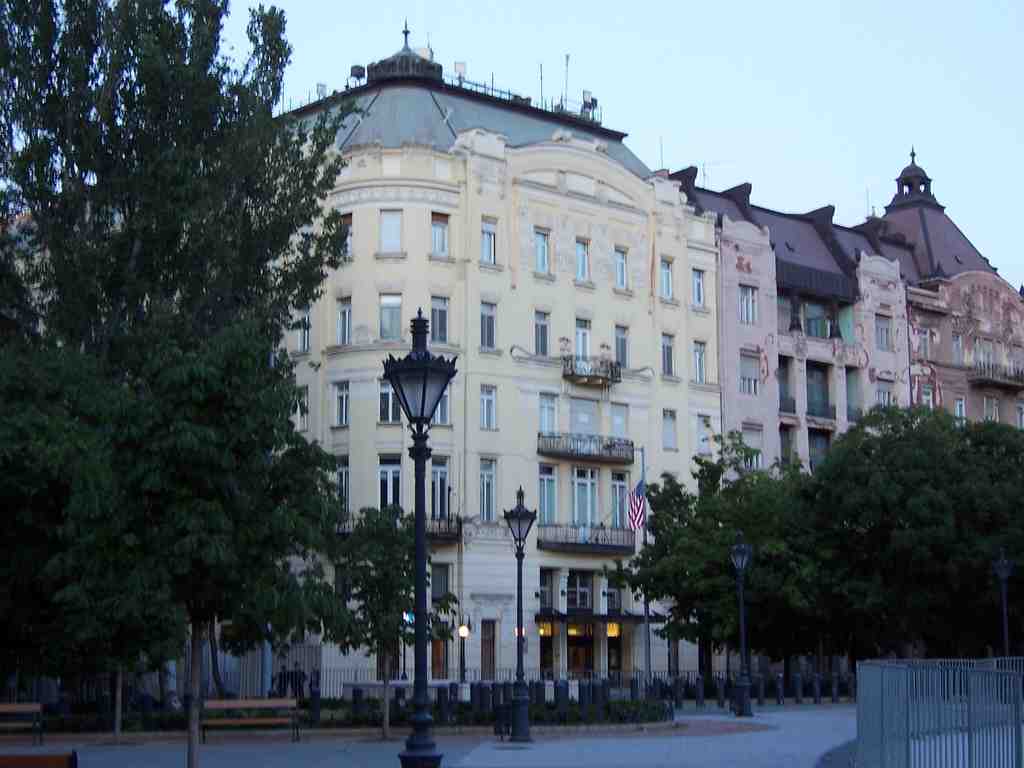
To spot the U.S. Embassy, look for a grand cream-colored historic building with intricate iron balconies, a rounded corner facing Szabadság Square, and an American flag peeking out just above the entrance, framed by trees and old-fashioned street lamps.
Standing here, you might be surprised to learn that the story of this building is like something out of a spy novel-with a few diplomats, a little heroism, a dash of political drama, and one or two Americans who might have wished for a superhero cape! The U.S. Embassy in Budapest sits at Szabadság tér 12, and before the stars and stripes ever hung from the balcony, the building itself was constructed in 1901 as the headquarters of the Hungarian Chamber of Commerce. If these walls could talk, they’d probably have quite a few secrets to spill.
Let’s roll back to the 1800s, when Hungarian-American diplomacy was just a twinkle in someone’s eye. The first connection was made as far away as Vienna, back when Hungary was still part of the Austro-Hungarian Empire, and the first American ambassador presented credentials there in 1838. Fast forward to the shadowy years after World War I, when connections were broken off, then stitched back together. It wasn’t until 1921, after a formal peace was signed, that Hungary and the United States were able to set up direct diplomatic ties. Before that, the American presence was a sort of ‘pop-up embassy’ (although with much less coffee and artisan pastries), and the first official U.S. representative operated out of a house on Lendvay Street.
Now, diplomatic hot potato is something Budapest knows well. By 1934, the American legation (as it was called then) landed right here, gradually taking over more space from its prior tenants-one by one, the building became less about old trade deals and more about new world politics. At one point, the Budapest Post Office was in the building, too, but after the U.S. became the actual owner in 1947, stamps took a back seat to stamps in passports.
And yet, the Embassy’s true test came with the storms of World War II. In a period thick with tension and fear, this building became an unexpected stage for heroism. When Hungary declared war on the U.S., the Embassy’s doors were shuttered, but not entirely locked. The Swiss diplomats, led by the legendary Carl Lutz, took over responsibility for the building. Here, under a fluttering neutral flag, Lutz issued Swiss “protection papers” and declared various buildings around the city to be Swiss territory. He and his allies-including famous figures like Sweden’s Raoul Wallenberg-saved over 62,000 Hungarian Jews from the Nazi death camps. Imagine, in this very place, frightened families and desperate individuals waiting in crowded upstairs rooms, hoping that a piece of paper could change their fate. Today, you can find a statue just outside, honoring Lutz’s courage, and the Embassy itself reminds everyone of that dramatic slice of history.
But drama was never in short supply. In 1956, as the city shook with revolution and Soviet tanks rolled through, Hungary’s Cardinal Mindszenty dashed into the Embassy seeking asylum. For nearly fifteen years, he couldn’t leave the building, at risk of immediate arrest-a prisoner with the world right outside his window. I like to think he got to know every creak in the floorboards a little too well.
The Cold War years were a diplomatic rollercoaster. At times, countries didn’t exchange ambassadors at all, just “temporary representatives”-kind of like having someone tend your garden, but never actually move in. Relations warmed up with the swinging ‘60s: the Embassy finally got a proper ambassador again, and the building itself grew busier, filling with the kind of cloak-and-dagger conversations, paperwork, and press briefings you might expect from a Hollywood film.
By the way, if you spot a statue of a mustachioed soldier gripping a riding crop nearby, that would be Harry Hill Bandholtz, an American general who in 1919 used nothing but bravado (and his famous riding crop) to save the Hungarian National Museum from being looted by Romanian troops. His statue stood proud, was hidden away, and then finally returned-making for another chapter in the “never a dull moment” saga of the square.
So as you stand here, look up at the windows and imagine the clatter of typewriters in the 1930s, the whispers of refugees in the 1940s, and maybe the occasional sigh from someone wondering how to deal with diplomatic drama, Hungarian weather, and an endless mountain of paperwork. The U.S. Embassy at Szabadság tér isn’t just a building-it’s a slice of 20th-century world history, where courage, diplomacy, and a little bit of luck have shaped events time and again. And who knows? Maybe today, another story is being written behind those doors.
Seeking more information about the history, former ambassadors and ambassadors or the carl lutz monument? Ask away in the chat section and I'll fill you in.




