
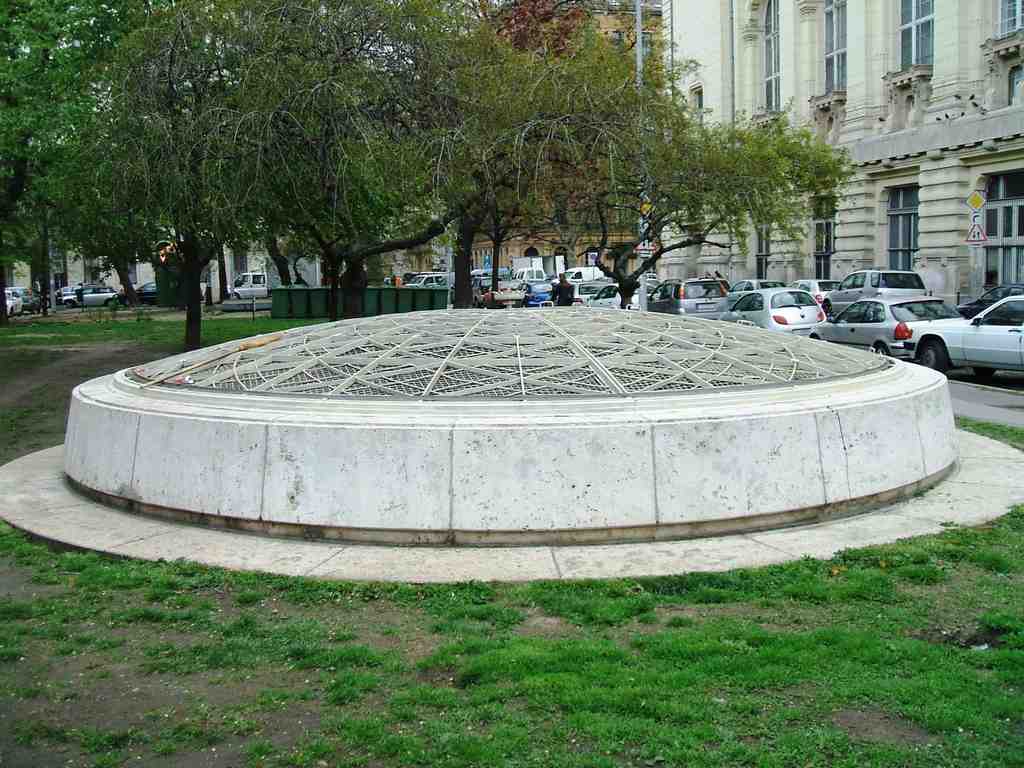
Right in front of you, you’ll spot a low, circular concrete structure with a web-like metal dome set into the ground-a bit like a giant manhole cover on steroids-surrounded by grass and just steps from the nearby boulevard.
Now, get ready for a real Cold War secret-because you’re standing above one of Budapest’s most mysterious and jaw-dropping relics: the F4 Object, better known to locals as the “Rákosi-bunker.” While it looks unassuming from up here, if you could somehow shrink to the size of a mouse and slip through its grates, you’d find yourself on the edge of a chilling underground labyrinth, buried about 39 meters below your feet.
Picture Budapest in the early 1950s-a city still scarred by war, tense with suspicion, and ruled by the iron-fisted communist leader, Mátyás Rákosi. Now imagine the paranoia of the time: what if the West decided to push a big red nuclear button? Rákosi wanted to make sure that he-and his most trusted party bosses-had a place to hide. Not just any hiding place, though. It had to be as secret as your grandma’s goulash recipe, and as strong as Hungarian paprika!
So, in December 1951, work began on a bunker that would become the stuff of urban legend-a sprawling underground shelter shaped a bit like a stretched-out letter “H,” running somewhere between Kossuth Square and Szabadság Square. Its main entrance was sneakily tucked away inside a stately courtyard of a party headquarters building at 17 Akadémia Street. Just south of here, near the old Hungarian Television headquarters, there was even an emergency exit doubling as a ventilation shaft-so the party bigwigs could breathe easy while planning, well, whatever communists planned back then.
Here’s a wild detail: the workers, shipped in from the Hungarian countryside, actually thought they were building Budapest’s new metro lines. Surprise! They were digging secret tunnels where the country’s elite could be spirited away at a moment’s notice. No direct line to the Parliament building, despite the rumors-but there was a direct connection to the party headquarters and, later, the 2nd metro line. Some even say the bunker could hold up to 2,200 people! That’s a lot of nervous VIPs in one place.
Inside, imagine a world cut off from the chaos above: meeting rooms where top government officials could decide the fate of the nation, all while hidden from nuclear fallout. Picture 3500-3800 square meters of halls and rooms, with special hiding spots for a handful of “top-level minds” who’d get their own private rooms, city telephones, and bathrooms. The rest? Well, it was more like an ultimate group sleepover-minus the fun.
To keep everyone breathing, the place had a monster air-filtration system capable of filtering radioactive dust, and its walls were built from metro tunnel linings. There were diesel generators for power, tanks for 150,000 liters of water, and even a labyrinth of more than 50 toilets for those sudden emergencies-nobody wants to run out of toilet paper during an atomic attack, after all.
But, get this: the bunker was never actually used for its original, apocalyptic purpose. It sat there through the tense chapters of the Cold War, always “at the ready,” but never called into action. By the 1970s, it was physically linked to the metro by a passage off the main tunnel between Deák Ferenc Square and Kossuth Lajos Square-though you wouldn’t want to stroll down there unless you love darkness and dust.
In the 1980s, Budapest’s public transit company (BKV) took over, opening it up for ventilation once a week and sparking rumors and curiosity among the public. It wasn’t until the ‘90s, and a documentary cheekily titled “Pincebörtön” (“Cellar Prison”), that the public really found out there was a Cold War bunker in the heart of the city.
Today, the story of the F4 Object is part mystery, part monument. The original entrance has been sealed due to safety and construction work, and the bunker itself is empty-stripped of furniture, silent, its secret strategic function just a memory. But as you stand above this odd concrete and steel lid, let your imagination wander: how many footsteps, secrets, and silent worries must have echoed through its halls? If walls could talk, this bunker would have the juiciest gossip in Budapest!
If you're keen on discovering more about the history, description or the current status, head down to the chat section and engage with me.




