
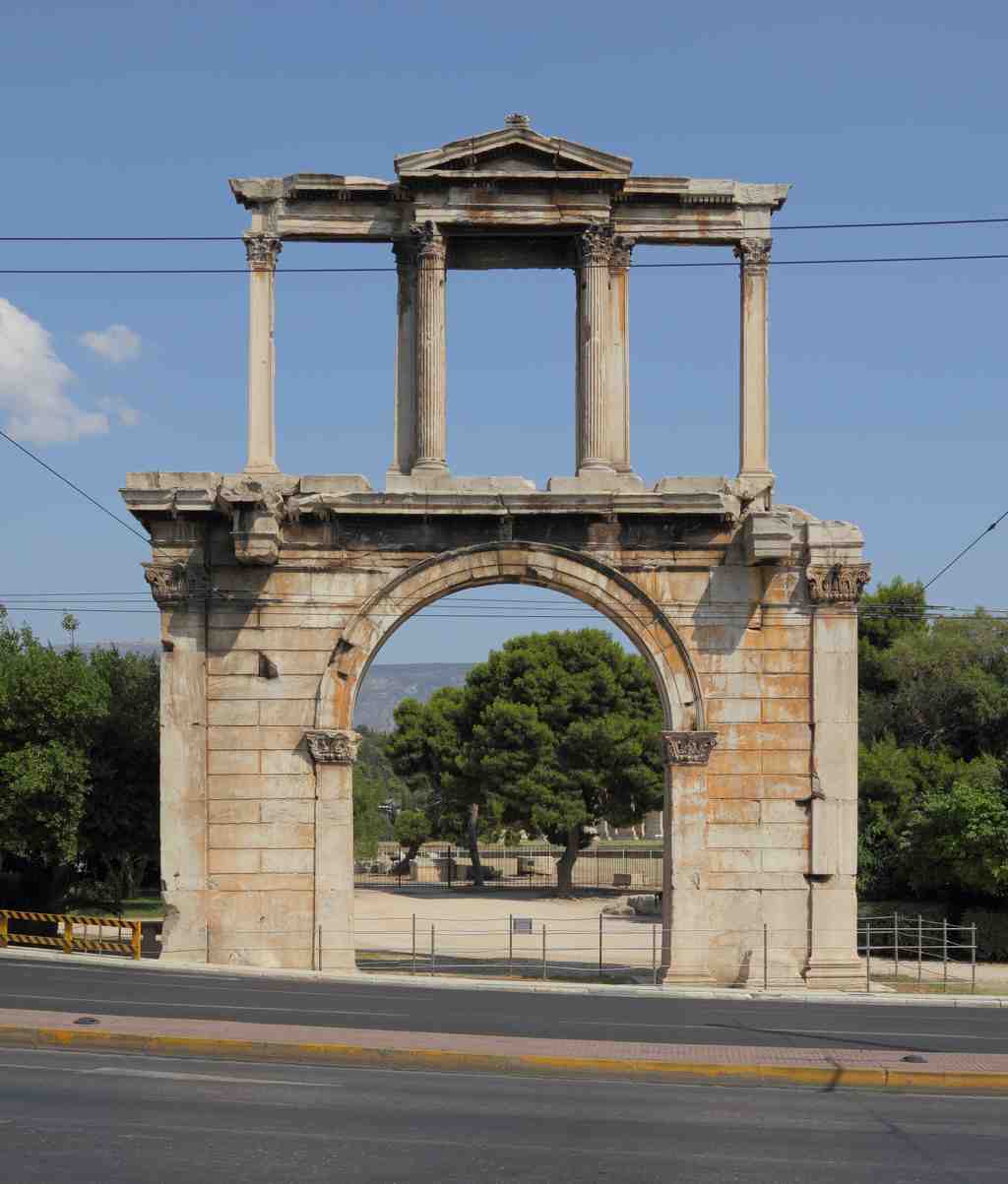
If you’re wondering how to spot the Arch of Hadrian, just look ahead for a grand marble gateway, perfectly symmetrical, standing tall above the road with a single, massive arched opening below and a second tier of columns above-it’s almost as if a Roman emperor expected to drive his chariot straight through!
Here we are, standing before the Arch of Hadrian-also known as Hadrian’s Gate. Imagine the scene nearly 1900 years ago: the noise of ancient traffic, the shouts of merchants, and the distant scent of incense floating from nearby temples. Now, right in front of you, this marble arch stretches 18 meters into the sky. Even the marble’s color tells a story-it’s not the dazzling white of the Parthenon, but a softer, almost golden tone, full of ancient scars and city dust, bearing countless years under the Athenian sun.
Built without cement or mortar, each piece of marble was locked in place with clever clamps. You’re standing where an ancient road once linked the heart of Athens to the grand Temple of Olympian Zeus. Picture crowds gathering here in 131 AD, the city buzzing with excitement, because today was no ordinary day: Emperor Hadrian himself, Rome’s most enthusiastic admirer of Greek culture, was making his grand entrance. To greet him, the people of Athens-or perhaps the powerful Panhellenes, an association of all Greek cities-constructed this monumental gateway to honor his love for their city and his generous gifts.
The arch has two fascinating inscriptions, each on opposite sides. Facing the Acropolis, the carved letters declare, “This is Athens, the city of Theseus”-the mythical founder. But, take a few steps through and read the other side, where it boldly proclaims, “This is the city of Hadrian, and not of Theseus.” Well, talk about stepping up your name game! Some ancient Athenians must have raised their eyebrows at that confidence.
For years, people puzzled over these plaques. Did the arch divide old Athens from a new section founded by Hadrian-something like a city expansion plan, Roman-style? Archaeologists discovered otherwise: the city's true ancient wall isn’t here, but 140 meters away. Instead, Hadrian’s arch claims all of Athens as the emperor’s to refound-a grand gesture if ever there was one. You can decide if that’s humble bragging, or just the bold flair of a man who really wanted his name remembered.
This arch isn’t just a doorway. Its details are lush: fluted pillars, ornate Corinthian capitals, and a top level where columns and pilasters divide the space like a stage set-except instead of actors, there may once have been statues of Theseus and Hadrian themselves, gazing at each other from opposite ends. Some think the upper central opening once held painted reliefs or even thin screens-Queen Amalia, much later, reportedly ordered their removal for a better view. That’s royal redecorating for you!
The arch survived centuries exposed to wind, rain, and the slow creep of car exhaust, coming into our era impressively intact-much of it untouched, at full height, while Athens hummed and changed all around it. The debate over who paid for this gateway is almost as lively as ancient Athenian democracy itself. Was it built by proud local Athenians with less than top-quality marble as a sign of community spirit, or by the Panhellenes, showing off their unity and love for the emperor? The answer still lies somewhere in the city’s memory.
So, as cars whizz by and modern Athens carries on, this mighty arch stands like a marble time machine-still watching over every traveler entering or leaving, just as it has for nearly two millennia. Just imagine passing beneath it; in ancient times, you might be entering one city or another, and today, you’re stepping straight into history’s spotlight under the marble gaze of Hadrian himself.




