
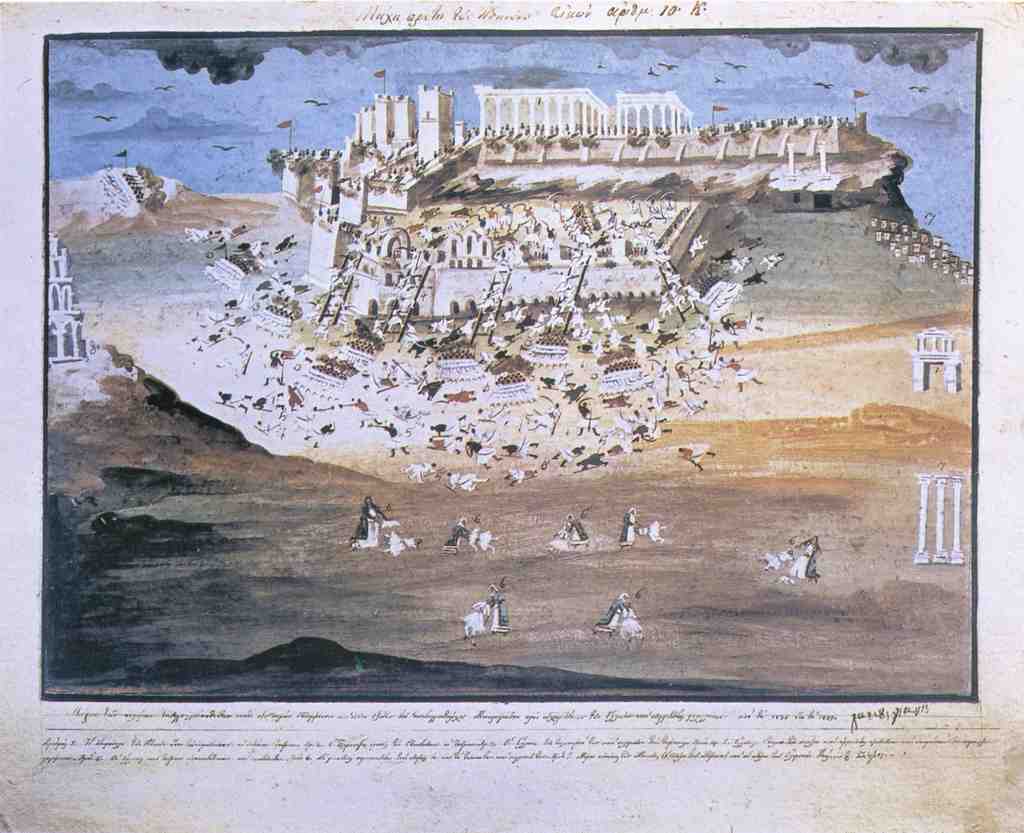
To spot the scene of the Fall of the Acropolis, look ahead for a dramatic piece of artwork showing the imposing rocky hill of the Acropolis crowned with ancient temples, surrounded by high defensive walls and tiny figures scrambling all around-almost as if you’ve stumbled right into the middle of a battlefield from centuries past.
Now, let’s step straight into the shoes-well, the sandals-of those who stood here in the summer of 1822. Imagine a hot, dusty June morning. The city of Athens sprawls beneath you, quiet but charged with an energy you can almost feel vibrating in the stone. For 366 years, this mighty fortress has sat under Turkish control, its white marble glowing under countless sunrises, flags fluttering where once the Parthenon sparkled under Athenian glory. But on this day, the echoes of liberation are about to ring louder than any anthem.
Let’s rewind just a little, to 1821. Athens is under Ottoman rule, and the Acropolis is held tightly by a small Turkish garrison. It all changes when Hurşit Pasha, the Ottoman commander, summons his lieutenant Omer Vrioni away from Athens, dragging most of the Turkish army with him. The town itself is almost abandoned-just enough defenders to close the gates but barely enough to keep guard. Greek revolutionaries, scattered among the nearby islands and mountains, smell opportunity in the dry summer breeze. They surge back, retaking the city streets, and set their sights straight up-toward the hill where the Acropolis stands. Just imagine them, filling the narrow lanes, eyeing that ancient fortress every minute, waiting for their moment.
Then, the real siege begins. In November of 1821, Greek fighters try a daring assault, but the fortress holds strong. So, what do you do when you can’t storm a castle? You surround it, of course! And that’s just what the Greeks do, wrapping the Acropolis in a tightening ring, cutting off the wells, blockading every gate. The Turks are trapped, and the noose grows tighter by the day. Winter sets in. Water is scarce. By spring, reinforcements arrive-not just Greeks, but friends from across Europe. Among them: Philhellenes like Olivier Voutier, who helps roll up the cannons to the rocky Pnyx nearby, aiming them straight at these ancient stones.
And if you think being on the receiving end of cannonballs was bad, just wait until you hear about the next move: a secret tunnel dug beneath the mighty Third Gate. Constantine Chormovas, an expert in undermining, spends weeks in the darkness, scraping earth and laying explosives. The Greeks offer the Turks a chance to surrender-no dice. Then, on a crackling April day, the tunnel is filled with gunpowder and-kaboom! The gate erupts in fire and stone. The Turks rush to defend the breach, Greeks charge forward, and a brutal clash unfolds, echoing off those marble columns. Even the Philhellenes distinguish themselves with wild courage, fighting shoulder to shoulder for freedom.
But the siege grows even harsher. Starvation and thirst spread misery among the Turkish defenders, isolated now in the heart of their beloved Acropolis. All their wells are poisoned, and disease prowls the narrow courtyards, while women and children huddle in fear. By June, desperation outweighs pride. Through the efforts of French and Austrian consuls, negotiations begin. On June 9th, a treaty is signed. The next morning, in a procession led by the city’s archbishop, the Greeks enter the Acropolis at last, reclaiming its stones for the first time since 1456.
The Turkish commandant hands over the keys-imagine the thrill, keys that unlock centuries-old doors, passed to the hands of an Athenian bishop who then gives them to Ioannis Vlachos, the Greek military overseer. The Greek flag unfurls over the old walls, while cannons thunder in celebration. But not everything goes smoothly-during the joyous salute, Panagiotis Ktenas, the new Greek commandant, accidentally sets off a cannon, tumbles from the wall, and meets his end in tragic (and slightly slapstick) fashion. His brother, Spyridon, quickly takes his place as the city regroups.
Despite the losses-about 200 Greeks lost their lives-the capture of the Acropolis marks the true rebirth of Athens. Those who want to leave are sent safely away; others, Turkish families once so isolated, now choose to stay, calling this rock home, just as Athenians always have. The Acropolis stands tall once again, a symbol of freedom echoing across history, from the marbled ruins at your feet to every stone beneath your shoes. And all this, right where you stand, beneath the warm, relentless Athenian sky. Now, who said history was boring?
Fascinated by the the liberation of athens - the beginning of the siege of the acropolis, the evolution of the siege in 1822 or the the fall of the acropolis? Let's chat about it




