
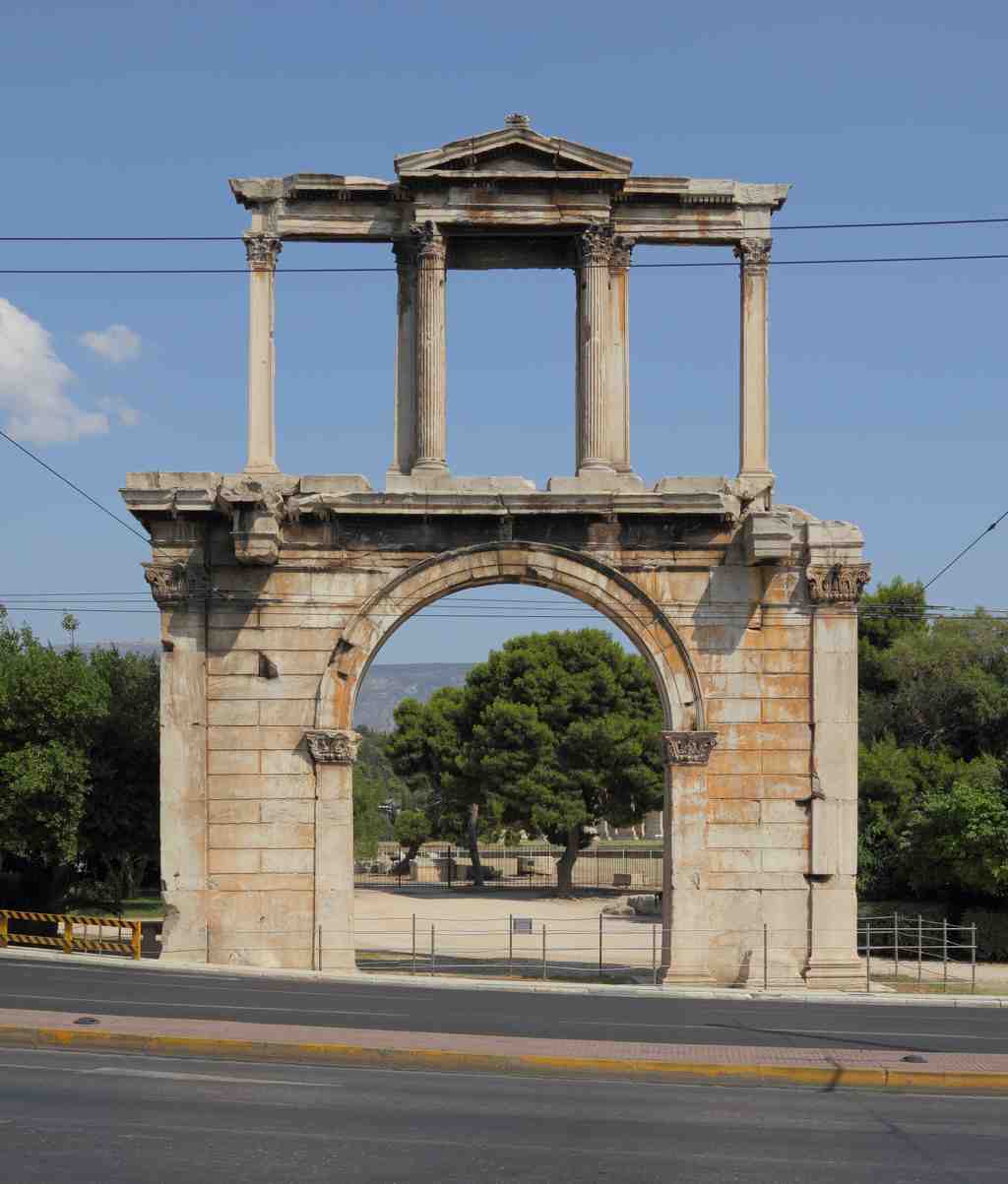
Standing before you is the Arch of Hadrian: look for a tall, elegant marble gateway with a single grand arch topped by columns and a small triangular pediment, rising just beside the busy avenue.
Picture yourself in Athens, 1,900 years ago. There’s excitement in the air as locals line the road where you’re standing, eager to lay eyes on the Roman Emperor Hadrian-a man so fond of Athens, he practically tried to outdo the ancient Greeks at their own game! Right where cars now zip by, imagine a bustling parade, the sound of sandals and trumpets, and the glint of sunlight bouncing off fresh marble.
Hadrian’s Arch wasn’t just any old entrance; it was the marble VIP gateway to a sparkling new Athens. You’re looking at 18 meters of Pentelic marble, fresh from the same quarries as the Parthenon-though, rumor has it, the arch got a modest batch with a few extra “character marks.” While many Roman triumphal arches were built as boisterous billboards for emperor’s egos, Hadrian’s Gate took on a more refined look: instead of statues of galloping horses and roaring emperors on top, this one stands gracefully simple, its arched opening crowned with Corinthian columns and topped by an airy upper story that feels more like a balcony awaiting a heroic curtain call than a platform for heavy bronzes.
Whatever the architectural debate, this much is clear: in 131 AD, Hadrian got the ultimate thank-you gift from the people of Athens. Or maybe from the Panhellenes, a super club made of all Greek cities (the ancient world’s version of Eurovision, except with less singing and more marble). Whoever paid the builder’s bill, they carved not one but two mysterious inscriptions on the arch. Facing the old city and the Acropolis, the words boasted, “This is Athens, the ancient city of Theseus”-a big tribute to the city’s mythical founder. But face the other direction, toward the Temple of Olympian Zeus, and the story flips: “This is the city of Hadrian, not of Theseus.” Talk about splitting the vote!
For ages, scholars imagined the arch separated old-school Greek Athens and Hadrian’s brand-new Roman district-a kind of ancient “you are now leaving the historical district” sign. But after some determined digging, archaeologists found the ancient wall was actually a bit further away, so instead of splitting the city, the arch tied it all together, honoring Athens as a place reborn by Hadrian’s hand.
Listen to the traffic rolling by now and think about the thousands of years this marble has watched people come and go. The marble’s a bit worn and discolored these days-centuries of weather and pollution can do that-but the arch survives almost at its full, original height. The columns on the lower part have gone missing, possibly out sightseeing, but the structure towers just as it did when Queen Amalia supposedly ordered a cosmetic makeover, having stone screens removed for a clearer view down Amalias Avenue.
Now, here’s one more twist: we don’t know for certain if grand statues of Hadrian or Theseus once perched on the arch, waving to the crowds like ancient celebrities, or if there were ever painted reliefs covering the central upper niche. There just isn’t enough evidence left-though that’s probably for the best, or else art historians would still be up there with measuring tapes arguing about it.
So, as you stand in Hadrian’s shadow and picture the Roman emperor arriving in a swirl of togas and cheers, take a moment to glance through the archway-one side for mythical Theseus, the other for ambitious Hadrian. Though empires rise and fall, it’s these rare, beautiful monuments that keep the great stories alive, even if they do get caught in a bit of city traffic along the way.




