
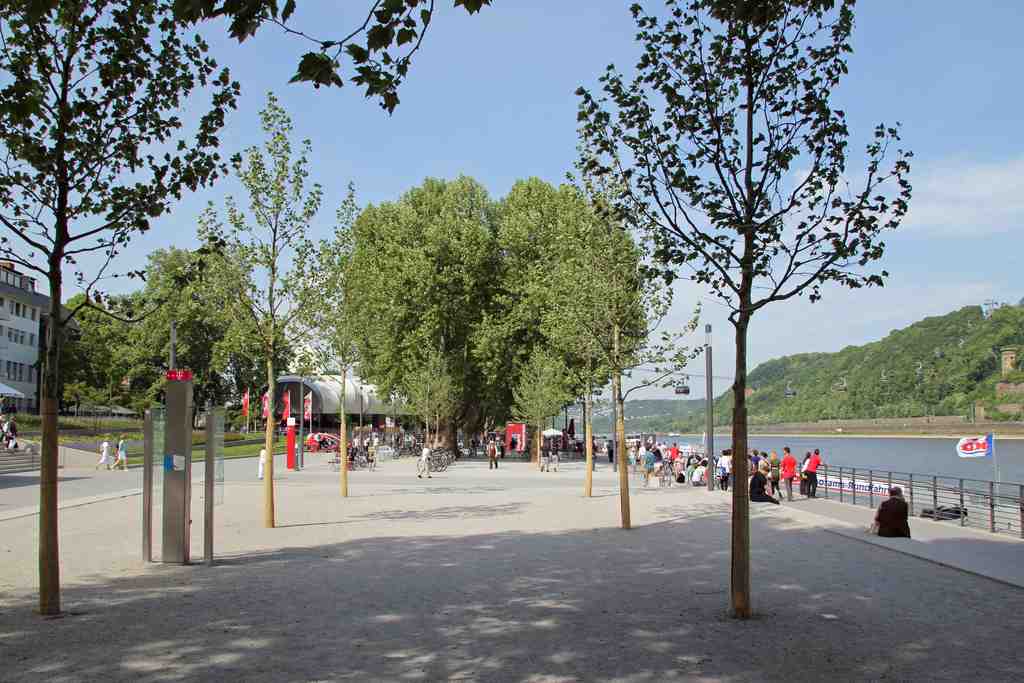
In front of you, the Rhine Facilities stretch out as a long riverside promenade lined with young and old trees, where sunlight flickers through leaves onto wide walkways filled with people enjoying the open air and views of the flowing river-just look toward the water, under the shade of those leafy canopies, and you’ll spot it right away.
Imagine yourself here nearly two hundred years ago: instead of busy joggers and families, horses struggled along a dusty path as they hauled heavy ships upstream, and wild poplar trees crouched at the water’s edge. What you’re seeing now is the result of history’s gardening project, stretching a whopping 3.5 kilometers along Koblenz’s left bank. The Rhine Facilities began with big dreams, royal ambitions, and a dash of French flair. It was back in 1809, during the French occupation, that the idea of transforming this bank into a park first took root-literally. Adrien de Lezay-Marnésia, an energetic French administrator, filled the area with nurseries for fruit trees and decorative shrubs, and suddenly the city’s kitchen garden became a tiny Eden. For a while, well-to-do Koblenzers could stroll among magnolias, hawthorns, and winding paths that made the garden feel bigger than it really was. Just don’t ask who had to prune all those bushes!
But, like any good garden tale, disaster (and a few city council meetings) intervened. Lezay-Marnésia was transferred away, funds dried up, and “Parc Lezay” soon found itself sold off and used for firewood storage. For decades, the area languished-until the Prussians arrived. By the mid-1800s, Princess Augusta, an avid fan of English gardens, decided her young daughter deserved a royal playground. She commissioned the superstar garden architect Peter Lenné, who had a knack for making gardens look effortlessly natural. Lenné ditched the ruler-straight flowerbeds and instead gave Koblenz sweeping lawns, twisting paths, flowering trees, and lawn benches just begging for gossip.
Thanks to Princess Augusta’s obsession and Lenné’s green thumb, the Rhine Facilities were transformed into a landscape park fit for a queen-and, eventually, everyone else. The park kept growing as the city’s old fortress walls were finally taken down in 1902, offering even more room for grand promenades and eye-catching statues. Speaking of which, when the Germans felt especially patriotic after the Franco-Prussian War, they just couldn’t resist decorating the riverbank with bold monuments to emperors and national poets. One might say they took “bigger is better” as their gardening motto!
Flash forward to the twentieth century, and this riverside haven was not always in bloom. Bombs during World War II hammered Koblenz, flattening trees, pavilions, and elegant hotels alike. Once-peaceful lawns turned to ruins, and much of the park’s fancy furniture was carted away or destroyed. Still, the Koblenzers rolled up their sleeves-literally and figuratively!-to replant, re-pave, and restore the park, gradually transforming debris into greenery.
By the time the Bundesgartenschau arrived in 2011, the Rhine Facilities got their latest makeover. The modern promenade you see today gleams with new walkways, riverside staircases perfect for people-watching, and rows of young trees. Old meets new as you stroll past lush green lawns, towering plane trees, artful flowerbeds, and the gentle buzz of riverside life. These grounds have hosted everything from royal picnics to international flower festivals-and if you’re lucky, you’ll catch the scent of linden blossoms drifting on the breeze.
From royal fantasy garden to lively modern boulevard, the Rhine Facilities are a testament to Koblenz’s ability to survive, adapt, and add a bit of natural charm to every generation. So take a stroll, pick your favorite tree, and think of all those city gardeners and royal visionaries who’ve kept this riverbank so full of life and stories.
Ready to delve deeper into the layer, konrad-adenauer-ufer or the empress augusta grounds? Join me in the chat section for an enriching discussion.




