
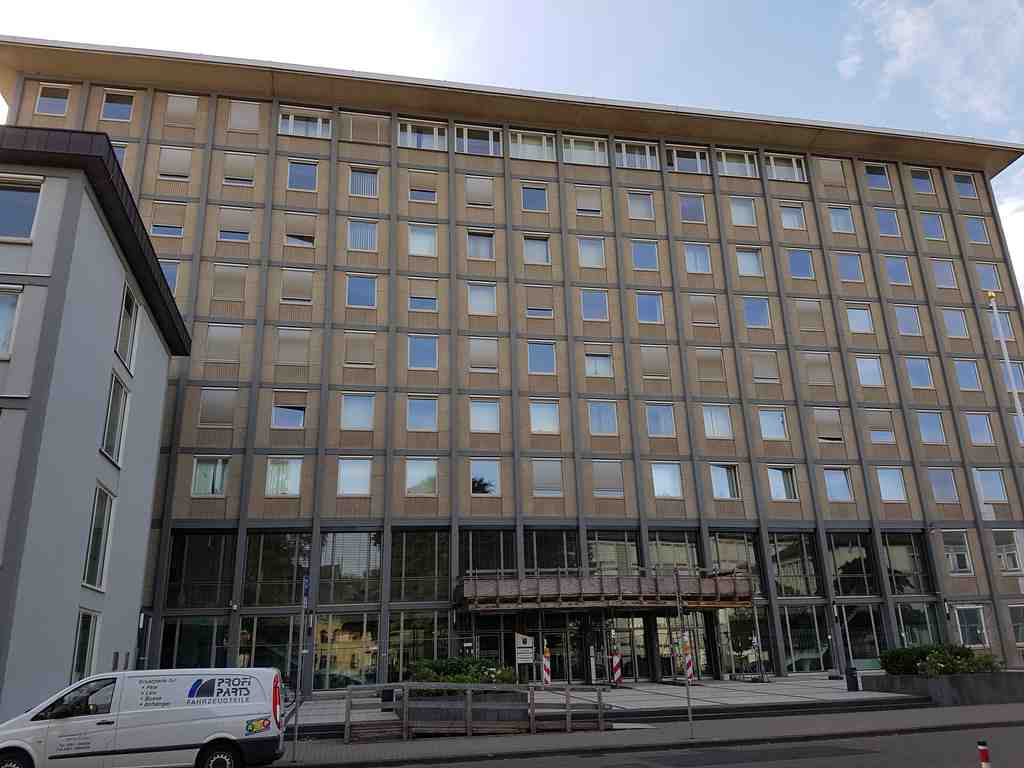
You’re facing the District Court of Koblenz-a tall, modern building dressed in a grid of beige panels and rows upon rows of shiny square windows; just look up and slightly to your right and you can’t possibly miss its broad, official facade.
Now, let’s bring this place to life! Imagine dusty cobblestone streets in the early 19th century, carriages trundling by, and a sense of anticipation in the air-because back in 1820, as Napoleon’s laws still echoed through the Rhineland, the “Landgericht Koblenz” first opened its doors, ready for justice with a French twist. Back then, instead of what you might expect, there were “Landgerichte,” not called district courts but by their grander French names, all ready to sort out everything from neighborly squabbles to high drama in the region.
Under the looming clouds of history, fast forward to 1879-imagine clerks fussing with inkwells as the grand German court reforms swept in! The Landgericht Koblenz was reborn, reorganized, and tasked with watching over an impressive patchwork of nearby towns, where, frankly, you can just picture judges looking a little overwhelmed by paperwork. In 1888 this court was bustling, handling the legal business of well over 380,000 souls, with a president, two directors, and a hefty team of judges delivering verdicts-perhaps over lunch, if you believe the rumors.
Here’s a fun sound for you:
But the story doesn’t end there-oh no! Through wars, upheaval, and new laws, the District Court was tested by countless storms. During the Nazi era, it became the seat of a “special court”-grim times, with tense silence in the corridors, and perhaps, if these walls could talk, some secrets left buried in the echoing halls.
After World War II, it was curtains down for a while-all courts closed, the air thick with uncertainty. But justice, like a stubborn detective in a cozy crime novel, found its way back. Soon, the ordinary courts reopened, governing livelihoods, land, and-of course-marital disputes, like whose mother-in-law gets to visit for Christmas! Not forgetting the Labor Courts: in 1927, the court even hosted one of only three “Landesarbeitsgerichte” labor courts in the entire regional jurisdiction.
Nowadays, if you listen closely, you might sense the building buzzing with the footsteps of 250 busy people, with 75 seasoned judges orchestrating affairs across 14 sections for civil law, 16 for criminal law, and more departments than you can shake a legal textbook at. There are special teams tackling topics like medical malpractice and cyber law-yes, it’s not all wigs and scrolls anymore! And don’t worry, there’s still a chamber just for youthful mischief-makers.
Who’s in charge? Currently, President Stephan Rüll and Vice President Andrea Mannweiler steer the ship, while there’s a whole relay team of presidents stretching back to the time of top hats.
So, as you look up at those many windows, think of the millions of stories, disputes, and decisions that have shaped the city from within these modern walls. They say a good courthouse hears more secrets than any café in town-so maybe, just maybe, the next big story here is only a gavel pound away!




