
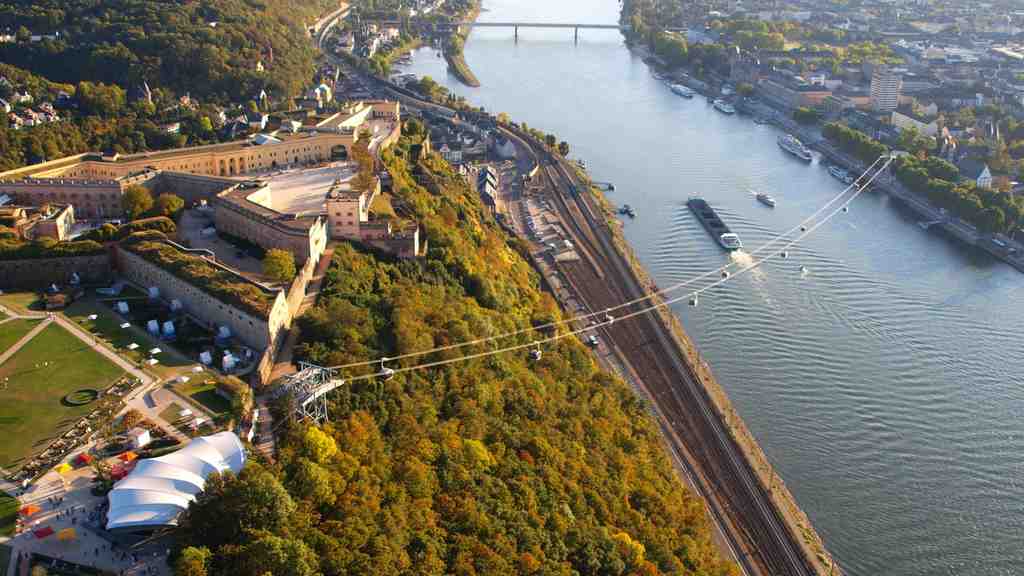
Straight ahead, you’ll spot the Koblenz cable car by looking up to see a thin line of glassy cabins gliding high above the Rhine river, stretching from the leafy green at your feet all the way over to the grand Ehrenbreitstein Fortress.
Imagine it’s a sunny morning in 2011, crowds are buzzing, the river is sparkling, and-suddenly-this spectacular cable car swoops into Koblenz’s skyline. But wait, let’s rewind to before the swooping. Koblenz faced a classic problem: how do you get thousands of visitors from the Rhine’s riverbank up to Ehrenbreitstein Fortress for the big garden show, the Bundesgartenschau, without clogging the streets with buses? Cue the big debate: should they go for a bus connection or risk something a bit more… uplifting? Thankfully, someone said, “Let’s do a cable car!” Why not float through the air like a superhero?
So, in April 2009, construction starts-with a few trees sacrificed but, in fairytale style, for every tree cut, three new ones were planted. Giant steel cables are strung across the water, sometimes with the help of a helicopter, making locals crane their necks in awe. By June 2010, glittering cabins dangle from those cables, and the people of Koblenz are finally invited to step inside.
It’s quite an engineering feat: nearly 900 meters of cable stretch across the Rhine, swooping passengers up about 112 meters in altitude. It’s not just Germany’s first three-cable circulating ropeway, it’s also a champion in moving crowds-7,600 people per hour if you count both directions. Inside the glass cabins, as you float over ships chugging below, you get a 360-degree view of the dramatic Rhine Valley-history, nature, and a dash of vertigo all at once.
But not everyone was thrilled. UNESCO worried the cable car might spoil historic views between the Basilica of St. Castor and the river valley. Originally, the plan was to take it down after three years. Local folks said, “We love this ride! Over 100,000 signatures and massive demonstrations!” Imagine Koblenz’s city square packed with people, kids waving signs-maybe one that says, “Don’t cut our cable!” After much back-and-forth (and more paperwork than you’d need to lasso those cables), UNESCO finally says, “Okay, the cable car can stay-at least until 2030.”
Technically speaking, this cable car is a beast in the ropeway world. Powered by a big electric motor, each cabin (built in Switzerland) can carry 35 passengers. One even has a glass floor-so if you ever fancied walking on air above the Rhine, there’s literally a seat for that. The ride takes just a few minutes, smoothly gliding up to the fortress. Statistically, it’s as safe as they come: even on days when storm winds blast at over 140 km/h, the double cable design makes these cabins nearly immune to swaying. Worst-case, there are backup motors ready to bring every cabin safely in.
It’s more than a shortcut or a tourist gimmick-it’s a lifeline between old and new Koblenz, between river and fortress, between city festivals and the wild slopes above. Thirty-five people in every cabin, thousands every hour, and somehow, you still get the feeling you’re on your own, flying just a little bit.
Now, standing here, you can almost picture that first day of operation: politicians giving speeches, excited passengers taking selfies before anyone knew what a selfie was, and the city holding its breath as the first cabin drifts out over the water. From controversy to celebration, this cable car has become Koblenz’s moving lookout-a sky-high blend of invention, persistence, and a healthy dose of Rhine-side ambition!




