
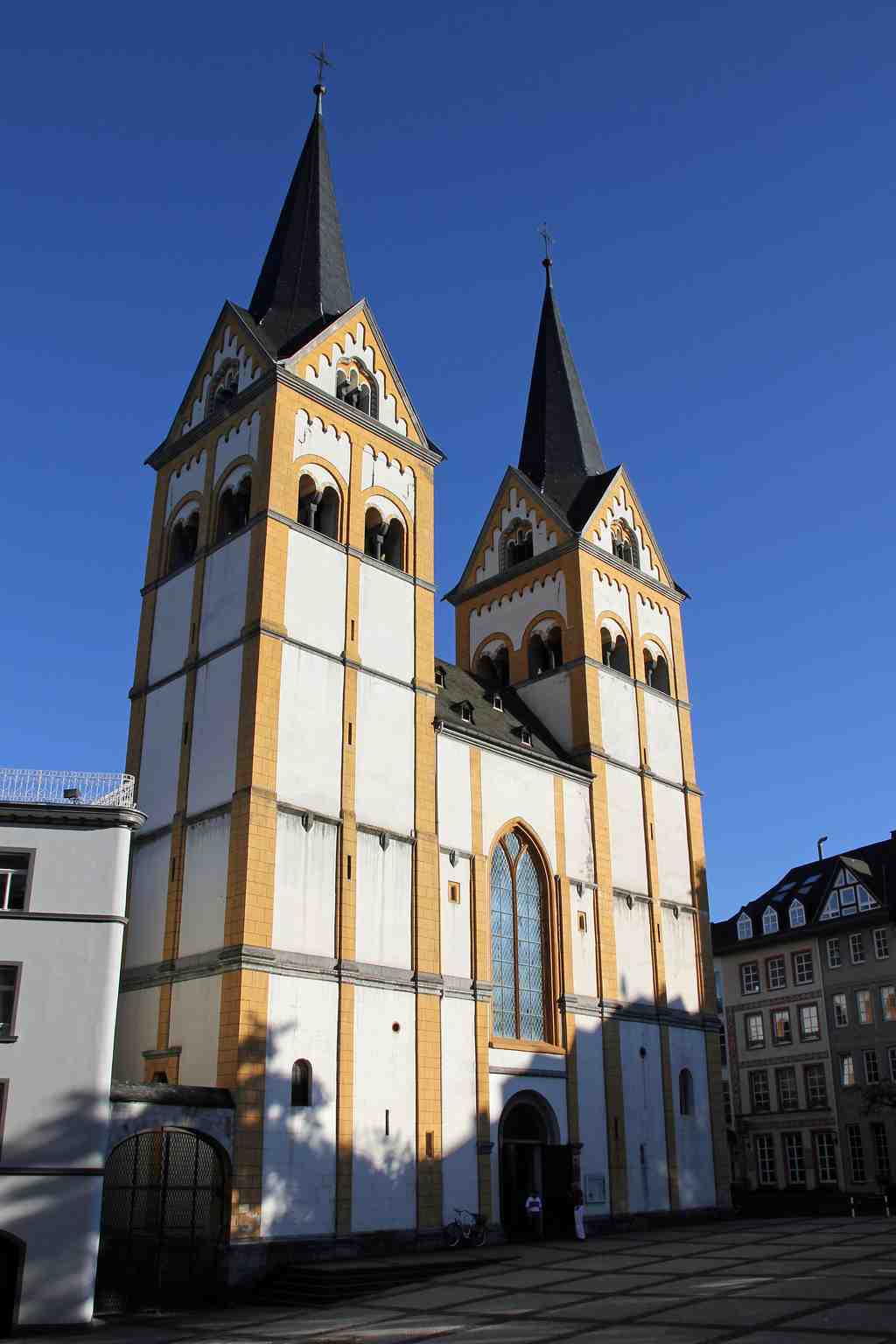
To spot St. Florin's Church, look for two mighty square towers with pointy slate spires and white walls edged with warm yellow stone, rising straight ahead out of the Florinsmarkt-this towering duo truly dominates the square.
Alright, now let’s step back in time and imagine ourselves nearly a thousand years ago, right here on this spot in the heart of Koblenz’s Altstadt. The air is thick with the scent of burning candles, incense, and maybe-just maybe-a whiff of mossy stone from the cool, ancient walls. In the beginning, this wasn’t even St. Florin’s Church but a small Marian chapel tied to a Frankish royal court, where legends say King Childebert himself might have held court in 586. If you listen closely, you might imagine the soft shuffle of monks’ feet under heavy robes, working and praying from dawn to dusk.
But the church’s big transformation came around the year 1100, when Bruno von Lauffen, later archbishop of Trier, decided it was time to up the grand factor and ordered a brand-new church in the bold Romanesque style. The church was so sturdy it actually incorporated parts of the old Roman-Franconian city wall-talk about recycling! With its three naves and huge pillars, it set the architectural standard for the Middle Rhine region’s sacred buildings.
Over the centuries, this place saw more twists and turns than a medieval detective novel. The original Marian church became dedicated to St. Florin once his relics arrived from Switzerland. Generous donations from archbishops meant land, chapels, and even a hospital sprang from church resources, although I promise no leeches as souvenirs! In the Middle Ages, this bustling site wasn’t just a church-it was the heart of a vibrant complex, alongside the Bürresheimer Hof, Altes Kaufhaus, and Schöffenhaus, four grand historic siblings around the Florinsmarkt.
The church has seen more engineering overhauls than a racing car. By the mid-1300s, gothic fever swept inside and the old apse was swapped for a dramatic gothic one. Vaults rose overhead, tall and proud; tower roofs came and went, with their current sharp spires dating back to 1899.
Of course, the drama didn’t stop there. In 1688, during the Palatinate War, French armies bombarded Koblenz, and the very spot you’re standing on was rocked by cannonballs, shattering the central nave’s vault. Repairs were swift, and a few years later, a statue of St. Florin himself was installed above the south door, perhaps eyeing up who made a mess of his church.
Then came the centuries of change: in the Napoleonic era, the church was seized and nearly turned into a slaughterhouse, though the locals managed to dodge that particular bullet (phew!). In 1820, it reopened as the city’s first Protestant church, and since then, has shared its ownership between the church and the state of Rhineland-Palatinate.
Inside, you’d find a grand Romanesque hall washed in white, punctuated by pillars of gray quarry stone, and splashed with stained glass from the 14th century-plus a truly mighty pipe organ, a modern marvel with nearly four thousand pipes! There’s even a cannonball in the baptismal chapel ceiling, just to keep history close at hand, and you might spot ancient gravestones of archbishops who now rest in peace beneath these stones.
Five bells ring in the south tower, the eldest cast in 1511-imagine their sound floating out above Koblenz for centuries. Today, St. Florin’s Church stands not just as a monument, but as a living, ringing piece of UNESCO World Heritage, protected and cherished. And don’t forget-should you ever fear getting lost in Altstadt, just look for these twin towers standing tall like two big yellow bookends on the city’s rich story.




