
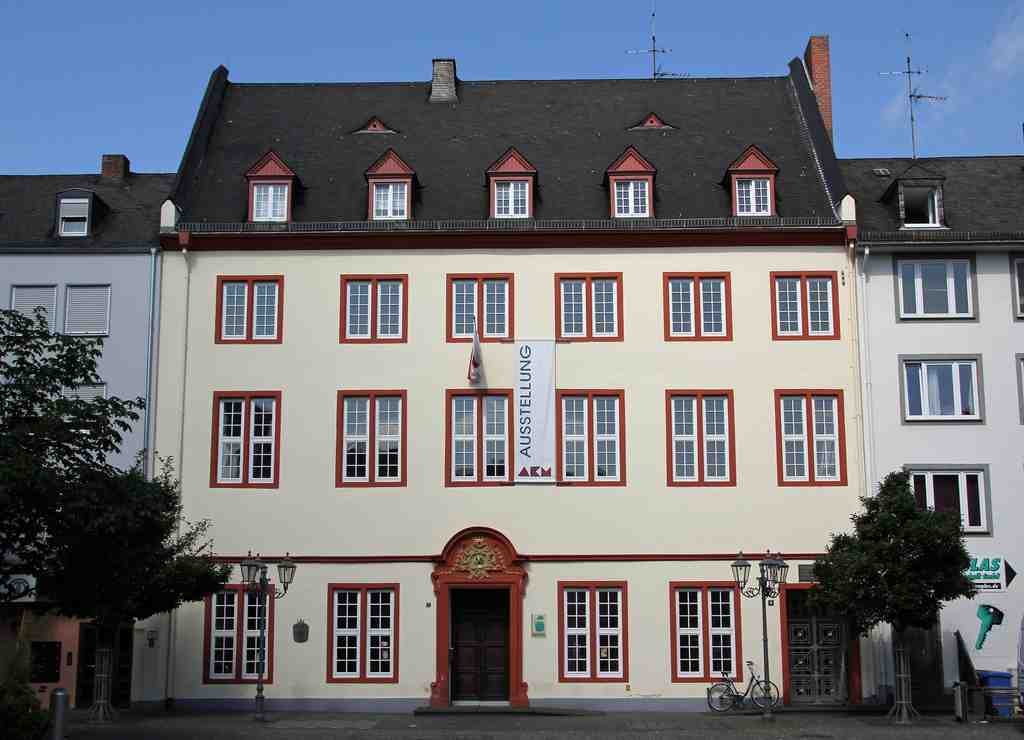
Look for a simple but grand three-story building with a creamy façade, tall red-trimmed windows, and a row of charming dormers peeking from a dark, sloping roof-right in front of you on Münzplatz.
Now, as you stand before the House Metternich, let your imagination transport you back over 700 years. Picture the busy medieval streets, the distant clang of a blacksmith’s hammer, and maybe, if you listen closely, the whispers of centuries tangled in the city air. This stately three-story building might look calm and collected now, but it’s been through enough drama for an entire opera! Originally, in the 1200s, this spot wasn’t even a house, but a medieval residence tower-like a stone fortress with a perfect view of both gossip and invaders.
The estate belonged first to the Bachem family and sprawled right up to the ancient city wall. Now, here’s a fun twist: the House Metternich literally stands on the shoulders of giants… Roman ones! They built it over three Roman towers, so you’ve got layers of history under your feet-a medieval skyscraper, Roman-style. By 1388, Koblenz owned this whole area, and by the 1400s, it changed hands like a hot potato. In the 1600s, it was in such bad shape that the city had to force its owners to repair it. You could say property-in-need-of-renovation is a timeless tradition.
Then came the Metternichs, with a family name as long as their titles: Wilhelm and Lothar von Metternich-Winneburg-Beilstein. In 1674, they rebuilt the place, and that’s pretty much what you see now-or, at least, the shell of it. Imagine yourself in the late 1600s, walking past grand figures in wigs and fancy hats, as carriages rattled across the square. Among them, a baby would one day grow up to be one of Europe’s most important diplomats: Klemens Wenzel Lothar von Metternich, born right here in 1773. The man’s job was to manage empires, but as a child, he might have splashed through puddles just outside where you’re standing.
Of course, history loves a plot twist. In 1794, the French revolutionaries swept into town, and the Metternichs lost their beloved house. Goodbye family estate, hello soldiers! The French packed in their troops, then turned the building into a university for law students-imagine hundreds of future lawyers learning the new “Code Civil” inside these walls, maybe dreaming of a world without homework.
But wait, things only get busier in the 1800s. When Metternich himself visited his birth house after years in exile, he found the place a total mess-he wrote to his mother that it was much dirtier than he ever remembered. He apparently wasn’t that sentimental, because he sold it back to the Prussians after the king gave it back to him. The people of Koblenz, determined not to let some bossy official take over their market square, bought it together and split up the old estate into parcels. Teamwork, Koblenz style!
Through the years, the building became smaller and cozier, housing everything from a bustling wine tavern to a courthouse and even a student dormitory. After World War II, the house was left a burnt-out shell-hard to believe as you see it today. For a while, it was patched up just enough to keep working, and locals gathered again for a glass of wine in the “Winninger Weinstube.” Finally, in the 1970s, it was carefully restored to its current form, balancing old stones and modern life. Today, you’ll notice the creative buzz of an art museum and even a youth meeting center inside, proof that this house is always ready for another chapter.
So take a moment to look up at those windows and imagine Roman soldiers marching by, medieval market carts rattling across the square, and a young Metternich peeking out to watch history unfold-right here, where you’re standing. If only these walls could talk! But really, would they ever stop?




