
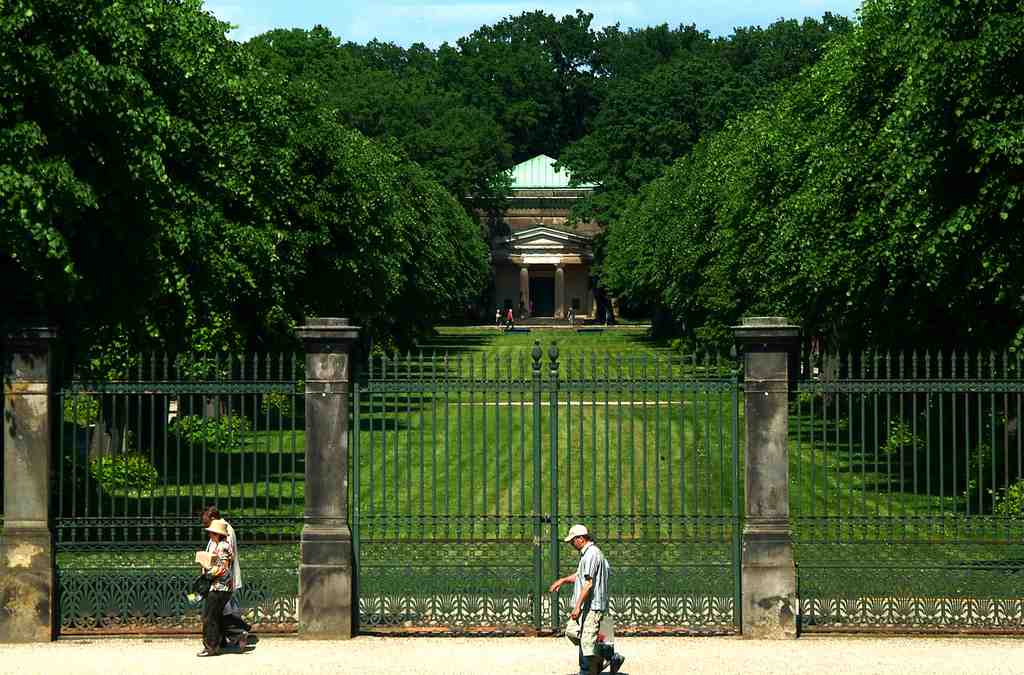
To spot the Guelph Mausoleum, look through the grand iron gates straight ahead, and you’ll see a classical stone building with columns tucked beneath a crown of ancient oak trees at the end of a perfectly straight green avenue.
Now, let’s step back in time-imagine yourself surrounded by the hush of towering oaks, the sunlight dappling through branches that have stood here since the age of powdered wigs and royal carriages. It’s 1841, and the air is thick with the scent of earth and blooming spring. Suddenly, the peace is broken not by a ghost of a long-lost duke, but by urgent royal business-a queen has died. King Ernst August, with a heart both heavy and practical, orders up plans for a fitting final home for his beloved Friederike. Picture the king, perhaps with a dramatic sigh, hastily instructing his architect Herr Laves to whip up plans for a mausoleum-no time for procrastination here, royal schedules wait for no one!
Laves doesn’t just draw one plan, he brings the king options, even sketching out a temple in the style of ancient Egypt. Yet, after a flurry of ideas, the final design lands in the style of ancient Greece-dignified Doric columns, sturdy and timeless, because nothing says “eternal rest” like borrowing from the ancient philosophers. King Ernst August picks a spot in the Berggarten, just at the end of a beautiful avenue, where the building can peek out as a secret viewpoint from the palace.
Construction, of course, takes a marathon, not a sprint. The king keeps nudging everyone along, probably asking, “Is it finished yet?” like a child on a long carriage ride. By May 1842, the building begins, not in flashy granite like its Berlin cousin, but in the gentle embrace of sandstone, with a dome built in wood and saucily covered in white plaster to hurry things along.
As the walls rise, another delight unfolds-King Ernst August wants his mausoleum shaded by mighty trees, and not just any saplings. “Bring me BIG trees!” he says, and so they did. Imagine the spectacle: sixty-year-old oaks, giant root balls bundled gently on giant wagons, drawn by sixteen horses clip-clopping along, bridges reinforced, and smaller trees cleared from the path. Locals gawked at the leafy parade-who needs a circus when you’ve got an oak-tree caravan? Under these leafy canopies, spring flowers boldly poke their heads out each year, celebrating new life right above this house of the dearly departed.
But the story deepens inside. Christian Daniel Rauch, the superstar sculptor who had just finished working on the sarcophagus for a royal in Charlottenburg, is called in for this project. He spends three years crafting the queen’s final resting place-a labor of art and love.
When King Ernst August himself passes on, the city mourns him with all the respect due a monarch famous for compromise and for surviving the revolutions of his time. His impressive sarcophagus is also the work of Rauch’s students, showing off Hannoveran pride in marble and skill.
Over the years, the mausoleum becomes more than a resting place for a royal couple-it grows into the family archive! When bombers flatten the Leineschloss during World War II, the royal coffins are rescued and moved respectfully here. The mausoleum fills with generations: tiny princes and princesses who never saw adulthood, proud electors and kings of Britain and Hannover, and the only daughter of Kaiser Wilhelm II, Victoria Luise, whose story ends here in 1980, laid tenderly beside her husband.
Today, you stand at the gates, perhaps hearing a faint whisper of hooves on cobblestones or the gentle rustle of old leaves. Visitors come to honor, reflect, and admire what’s been called the most beautiful mausoleum in Hanover. It’s history in stone and wood, shaded by monarchs of the forest, waiting quietly in the heart of the garden to share its secrets and silent stories with you.
Curious about the specifications, the oak grove or the resting place of the family? Don't hesitate to reach out in the chat section for additional details.


