
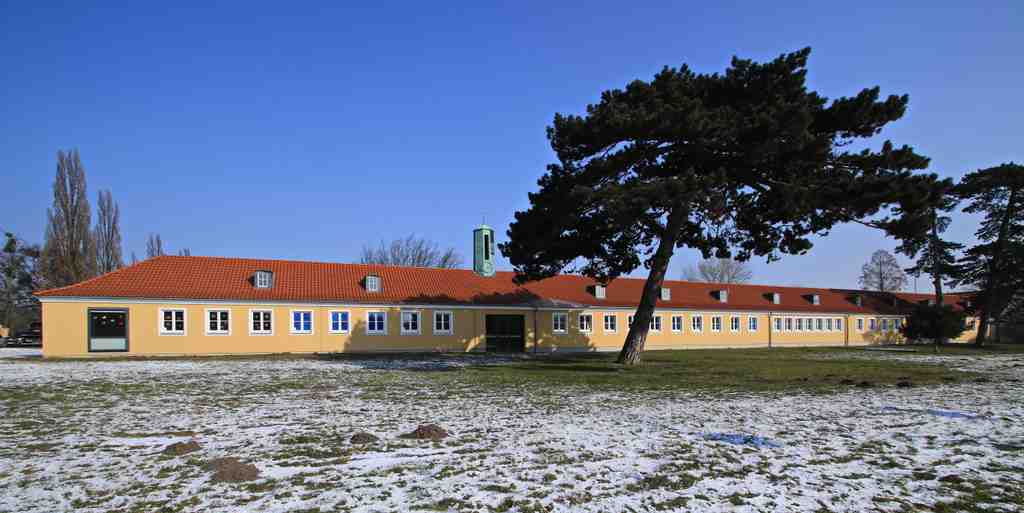
In front of you is a long, yellow-painted building with a red-tiled roof and small white-framed windows, set off by a large pine tree standing to the right on a patchy, snow-dusted lawn-just keep your eyes straight ahead and you'll spot it easily!
Now, take a deep breath and let your imagination travel back in time-because you’re standing at a place where the sweet scent of apples and the gentle rustle of mulberry leaves once filled the air: welcome to the historic Royal Fruit Tree Plantation. But this isn’t just any old orchard. If you listen closely, you might almost hear the whispers of silk worms munching on leaves-yes, silk worms!-because back in the 17th century, this spot was at the heart of a rather grand plan. The man behind it all? None other than the brilliant Gottfried Wilhelm Leibniz, the local genius who wasn’t content just thinking big-he planted big too.
Leibniz’s dream was nothing less than turning sand into silk-literally! He thought, “Why not fill these sandy Hanoverian plains with thousands of mulberry trees, feed silk worms, and clothe Europe’s nobles in fine silk woven right here?” And off he went. By 1680, his vision started blossoming. Gardeners experimented, scientists poked at leaves, and soon, fluffy white silk was being spun right in Hannover.
But silk wasn’t the only thing growing. This place became a wonderland of trees. By 1780, imagine rows upon rows of tiny saplings-40,000 of them-stretching their roots, eager to become grand fruit trees with apples, pears, plums, and more. Thousands of strong fruit trees would be grown and then-here’s the best part-sometimes given away for free to local farmers and citizens. Talk about a generous VIP fruit club.
Yet, the fashion world is fickle-just as everyone was getting used to the idea of silken socks, the French Revolution hit and, poof! The silk craze vanished. Suddenly, apples and plums were in, and mulberries were out. Half of the plantation became a treasure trove of kitchen gardens and orchards, bursting with every kind of fruit you can imagine. At its peak in the mid-1800s, there were a jaw-dropping 700 types of apples, 500 varieties of pears, and cherries, peaches, and apricots galore. Fruit everywhere-honestly, if Snow White had wandered in, she’d have abandoned her dwarves!
Each year, trees were sold and distributed across the kingdom-there were even protective walls built just to keep peach and apricot thieves at bay! Of course, history had its storms. During Napoleon’s occupation, the plantation nearly vanished-most of the trees had to be sold to rescue the local economy.
But resilience is Hanover’s middle name. Once the kingdom was back on its feet, new trees were planted, new varieties introduced, and by the late 19th century, this was the region’s horticultural heart. If these walls could talk, they’d tell you about wax fruit models, eccentric botanists, and the laughter of gardeners as they dodged wayward geese and fruit lovers sneaking extra apples.
So as you stand here, imagine the soft bloom of spring and a patchwork of trees heavy with their orchard treasures. The Royal Fruit Tree Plantation isn’t just a place-it’s a living memory of Hanover’s enduring love affair with nature, science, and, perhaps most importantly, a juicy apple.


