
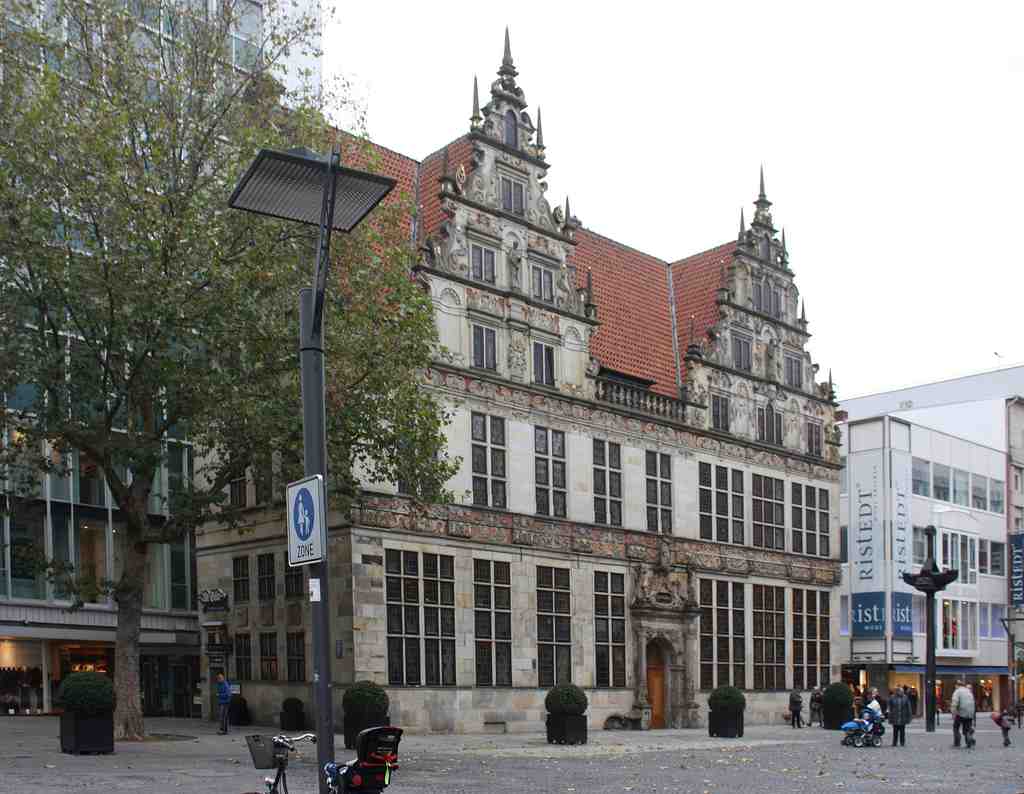
Look ahead to your right for an ornate Renaissance building with tall gables and decorative details - that’s the Gewerbehaus, facing out onto the open square of the Ansgarikirchhof.
Alright, you’ve made it to the Ansgarikirchhof - a place where if cobblestones could talk, they’d definitely have stories to tell! Look around you: today, the square is surrounded by shops, offices, and the stately Gewerbehaus with its striking twin gables, but hidden just beneath the surface is a history packed with drama, triumph, and even a touch of mathematical genius.
Let’s rewind to the Middle Ages. Right where you’re standing once stood the grand St. Ansgarii Church, a towering Gothic marvel built back in the 13th century and dedicated to Ansgar - the so-called “Apostle of the North.” It was a familiar sight in Bremen for centuries and its spire soared higher than any other in the city. The church wasn’t just a pretty face, either. In 1522, it became the stage for one of the most spine-tingling religious shake-ups Bremen had ever seen: the monk Heinrich von Zütphen delivered a stirring Reformation sermon right here, firing up the city’s move toward Protestantism.
But this place isn’t only about sermons and high drama. The Ansgarikirchhof played a part in science too. Imagine Carl Friedrich Gauß-the “prince of mathematicians”-hauling his equipment up the church’s dizzyingly high tower. In the 1800s, Gauß used that very spire as a vital measuring point for the first full survey of Bremen’s lands. There’s even a plaque here to remind us of his achievement, just in front of the modern Bremer Carrée.
Yet fate is never kind for too long to any one building. During World War II, air raids razed the St. Ansgarii Church to the ground, leaving only rubble and echoes where the faithful once gathered. In the 1950s, even the ruins disappeared-carted away as the city rebuilt itself. If you’re curious where the church once stood, you can spot the tall Ansgar Column, erected in 1965 in tribute to the archbishop and as a marker for the lost church.
But don’t think Ansgarikirchhof was left in ruins. Oh no, it dusted itself off and got a makeover. In the early 1960s, a Hertie department store rose from the ashes. For years, it bustled with shoppers-until it was itself replaced in the 1980s by the Bremer Carrée, the glassy modern block you see to the east. Around you, the Lloydhof to the north and the Hanseatenhof close by created new corners for shops, life, and all the little everyday dramas that make a city tick.
Now, swing your gaze west to the Gewerbehaus. Doesn’t it look like something out of a fairy tale? This Renaissance gem was built way back in the early 1600s as a guild hall for the city’s cloth merchants-no medieval textiles, no party! It became so well-known for celebrations that folks even called it the “house for weddings and feasts.” Over time, it passed from the merchants’ hands to those of Bremen’s craftsmen. Today, it’s the proud home of the Handwerkskammer-the Chamber of Crafts. During the war, almost the whole building was destroyed, except for its impressive arched portal; but Bremen’s spirit is stubborn, and the house was beautifully reconstructed.
As you stand here, take in the layers of history packed into the Ansgarikirchhof. Each side street-Obernstraße, Hutfilterstraße, Wandschneiderstraße, and Ansgaritorstraße-used to be bustling arteries of medieval Bremen, closed now to cars as if just waiting for another parade of guildsmen or a festival to light up the square. The Ansgar Column, the craft guild’s splendor, memories of a lost church, and the ghosts of mathematicians on rooftops… It’s enough to make anyone wish these stones really could talk!
Ready for the next stop? Let's keep exploring-because the next tale is just around the corner.




