
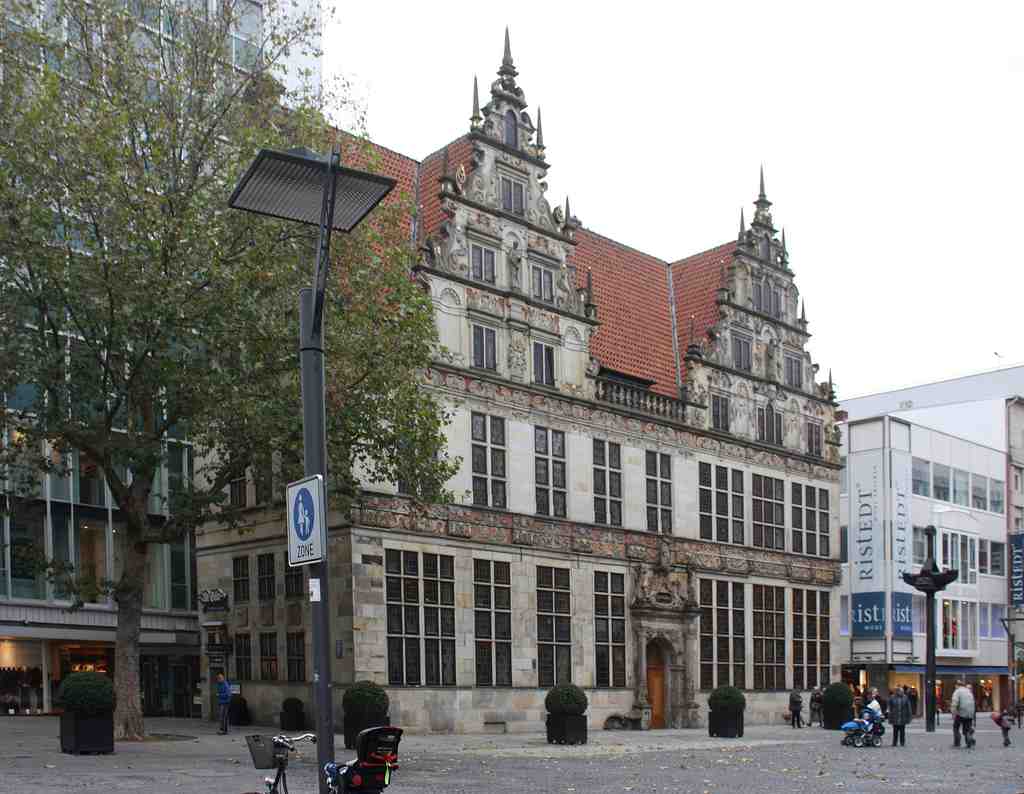
To spot the Ansgarikirchhof, look for an open square surrounded by shops and modern buildings, with a grand Renaissance-style building-the Gewerbehaus-with decorative gables and a richly ornamented façade standing proudly on the west side.
Now, as you stand here, picture the square not as it is today, but how it once was-a vibrant heart of Bremen’s old town. Imagine the bustling sound of merchants, tailors, and townsfolk echoing from stone to timber, as if the buildings themselves still remember every footstep.
But the name-Ansgarikirchhof-carries a whisper from the deep past, a memory of something lost. For centuries, right here stood the majestic St. Ansgarii Church. It was a gothic beauty, with its spire stretching higher than any other in Bremen, almost poking the sky like it wanted directions to somewhere holier. Founded all the way back in 1243, people worked stone and sweat to create a peaceful haven and gathering point. Later on, in the swirling drama of the 14th century, builders transformed it into a grand hall church. Maybe they just wanted more space for all the prayers, or maybe Bremeners, even then, loved a little bit of showmanship.
The church had quite the spotlight moment! In 1522, as the Reformation swept through Europe, an Augustinian monk named Heinrich von Zütphen took to the pulpit and thundered new ideas that would change Bremen forever. It was less of a “Sermon on the Mount” and more of a “Sermon that set the city abuzz”-from here, people poured out, filled with excitement, questions, and probably a bit of Lutheran confusion about what to do next at Sunday dinner.
This church was more than just bricks and sermons, though. Its impressive spire made it the perfect spot for one of history’s great science stories. In the 1800s, the mathematician Carl Friedrich Gauss used it as a measuring point-think of him up there with his gear, mapping the land like Bremen’s own Sherlock Holmes, but instead of solving crimes, he solved angles and distances. You can find a little marker here today, near the Bremer Carrée, honoring his clever calculations and his teamwork with the astronomer Friedrich Wilhelm Bessel-clever lads, both of them.
But nothing lasts forever, and here’s where the story takes a turn. The hammering and wailing of World War II struck Bremen hard. In 1944, the mighty Ansgarii Church was destroyed. The ruins lingered for a decade, a ghostly reminder of what once was, until they finally disappeared in the 1950s. Yet the square did not remain empty for long; first a bustling department store replaced the sacred site, and later on, the modern Bremer Carrée rose in its place.
And then, at the heart of the square, you’ll spot another piece of the past-the Ansgar Column, a slender bronze sculpture reaching up like a candle in the wind. In 1965, sculptor Kurt-Wolf von Borries created it to honor the 1100th anniversary of St. Ansgar himself, Bremen’s first archbishop, who once spread the gospel across the north.
On the west side, you face the proud Gewerbehaus-the guild house of Bremen’s craftsmen, a living relic with its two gabled wings glinting with late-Renaissance flair. Built by cloth merchants in the 1600s, it was the ultimate party venue for the coolest guild in town. By 1861, it was in the hands of the Chamber of Crafts, and even the Second World War couldn’t quite finish it off-the great doorway you see there is a survivor, rebuilt into today’s historic showpiece. Below, in the beer-scented vaults, Bremen’s “Alte Gilde” restaurant has held its own since 1957.
The square itself is a maze of stories-streets like Obernstraße and Hutfilterstraße, closed to pesky cars, just for you and your fellow wanderers. Modern shops and offices buzz under the watchful gaze of centuries past. Take a moment, fill your lungs with Bremen’s air, and imagine you are standing in a place where faith, science, joy, and sacrifice all come together-one spectacular square, built on hundreds of years of memories. And who knows, maybe you’ll make a memory of your own today, right here in Ansgarikirchhof.




