
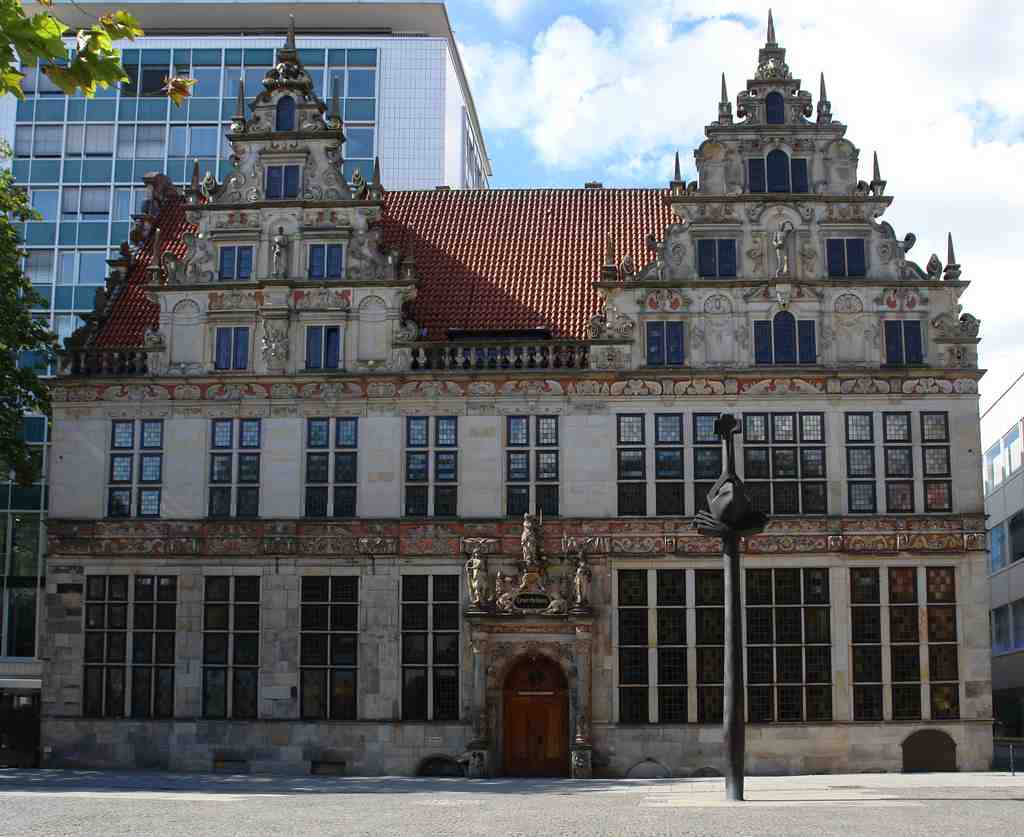
To spot the Gewerbehaus, look for a striking Renaissance building right in front of you, with two ornate stone gables and rows of large windows lining its sand-colored facade-just across the open square.
Welcome to the Gewerbehaus-one of Bremen’s most dazzling survivors from centuries past. Take a breath, and let your eyes wander up and down this majestic landmark. Feel the cobblestones beneath your feet-once, silk merchants, craftsmen, and city leaders hurried over them, their footsteps echoing against this beautifully sculpted stonework. Imagine the gleam of nearly 400 years of history-but watch out, if these statues start talking, we might be here all day!
Now, let’s set the scene. In the bustling 1600s, Bremen's streets were alive with merchants and master tailors in colorful garb, bolts of imported cloth slung over their shoulders. That’s when the wealthy “Wandschneider” guild-cloth dealers-decided it was time to show off a little. They wanted a grand hall, fit for their feasts and full of guild pride. So in 1619, craftsmen began carving and stacking stone, building not one but two winged houses at a dramatic right angle, with showstopping gables and an entrance decorated with figures from myth: Justitia for justice, Minerva for wisdom, and the muscle-bound Hercules for, well, just in case any troublemakers turned up at a wedding.
If you close your eyes, you might sense the laughter and music of old wedding guests here. See those gables above? Originally, one sported the winged god Mercury, the other Venus. Guests in silks and ruffs paraded up, perhaps nervously eyeing the marble columns-they say if the statues frown, your party will be rained out! The halls inside-one stretching an enormous 25 meters, with a gorgeous beamed ceiling-saw not only guild meetings and lavish receptions, but the odd “Cana Wedding” painting gracing the wall (yes, that painting now hangs in the Focke Museum nearby).
But no feast lasts forever. By the late 1600s, the tailors’ guild found itself in financial hot water. Repairs, parties, and a very large mortgage took their toll-turns out, even Renaissance bankers weren’t forgiving! To raise money, Bremen’s city council even commanded that all city weddings be held here, though judging by the noise, that only led to more expense. Eventually, in 1685, the proud Wandschneider sold the place to the Kramer, the rival merchants’ guild, who made the building their headquarters-so much competition, the very stones under your feet might still be whispering secrets.
And if you think only local celebrities graced these halls-think again! In 1709, none other than Tsar Peter the Great spent the night right here. Imagine the excitement-Russian bodyguards bustling about, kettles boiling in the kitchen, Bremen’s dignitaries lining up for a quick handshake. The building, by now lovingly nicknamed “Kramer-Amtshaus,” was a place for auctions, concerts-even tightrope walkers, who gave Bremen’s stuffy elders a run for their money.
As centuries rolled by, wars came and went, and one cold night in 1944, bombs shattered the Gewerbehaus almost to ruin. Miraculously, the statue-heavy entrance survived, protected by thick emergency walls. Can you picture the city’s heartbreak, seeing the Renaissance masterpiece smoldering in the moonlight? Yet, Bremen’s spirit wasn’t broken. By 1948, reconstruction had begun, with workers chiseling new stones, guided by old plans and anything salvaged from the rubble.
Over the next decade, the Gewerbehaus was stitched back together, carefully blending rescued baroque elements with new craftsmanship, much like a tailor mending a precious cloak. The southern gable was reimagined from fragments of bombed-out townhouses. Little by little, mosaic by mosaic, Bremen’s guild house regained its grandeur. By 1959, it stood proudly once more-housing Germany’s oldest chamber of crafts, the Handwerkskammer Bremen, fiercely protecting the spirit of Bremen’s artisans to this very day.
So as you stand here, look up: the stone figures high on the facade represent not only ancient gods but Bremen’s enduring virtues-justice, wisdom, and strength. Even the statues of a stonemason and a bricklayer, gazing back at you, are a nod to the city’s tenacious builders. The square out front holds the Ansgar column, honoring both a lost medieval church and the city’s memory.
All told, the Gewerbehaus isn't just a building; it's a living storybook of triumphs, parties, bankruptcies, and rebirth. It teaches us that even if the world shakes your foundation, with enough stubborn Bremen spirit-and maybe a little help from Hercules-you can always build yourself back up again.




