
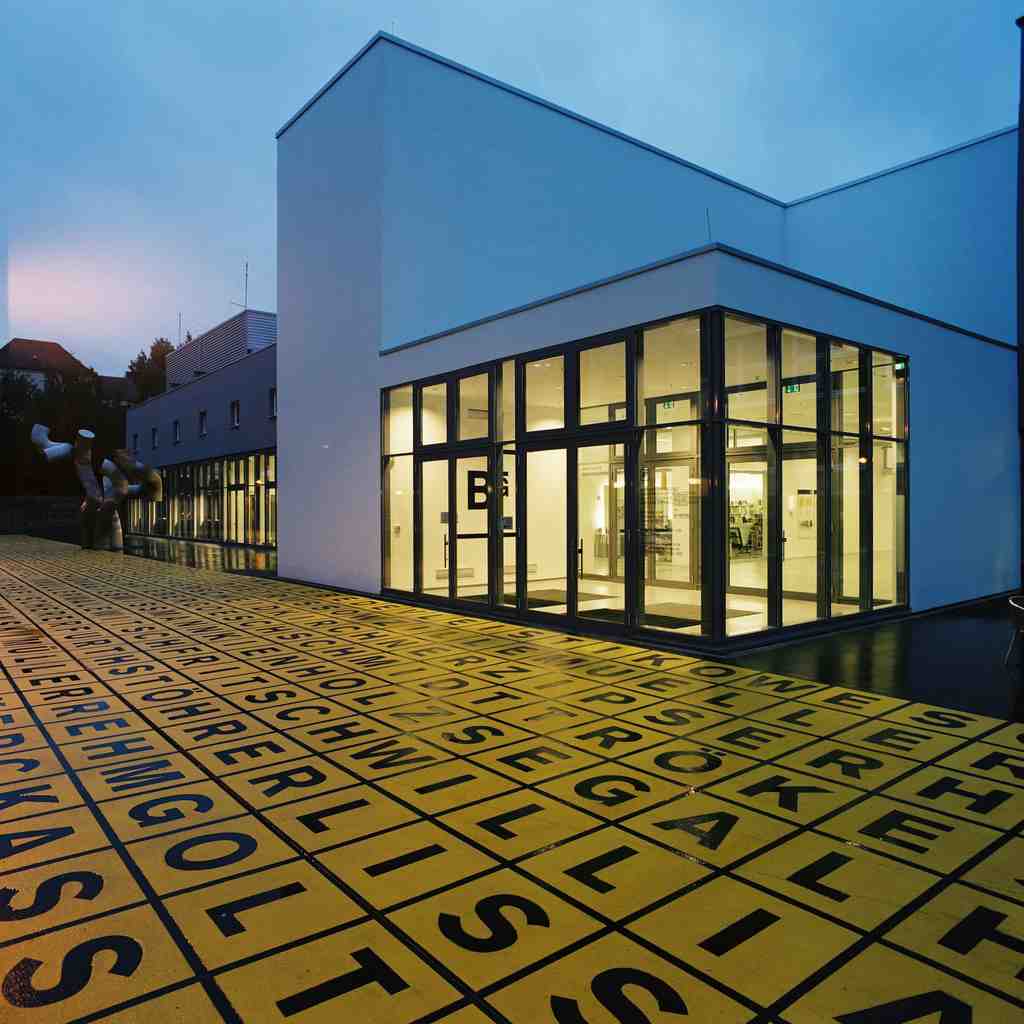
On your left, look for a long white concrete-and-glass block, low and rectangular, with a jagged warehouse roofline that still admits its industrial past.
This is the Berlinische Galerie, Berlin’s museum for modern art, photography, and architecture... which sounds tidy now, but the institution spent decades behaving like the city itself: moving, adapting, refusing to stay in one box for long.
It began in nineteen seventy-five as a society devoted to art made in Berlin since eighteen seventy. At first it had an office in Charlottenburg and borrowed space from other institutions, including the Akademie der Künste and the New National Gallery. Then it moved near Zoo Station, into a former officers’ mess. In nineteen eighty-six, it landed in the Martin-Gropius-Bau. And then reconstruction pushed it out in nineteen ninety-eight. Six years without a permanent home... very Berlin, really.
This building solved that problem in two thousand and four. It started life in nineteen sixty-five as a glass warehouse. Architect Jörg Fricke turned the industrial shell into a museum, and the redesign treated the building almost like an exhibit in its own right. Fritz Balthaus added a building-wide intervention called marked space, unmarked space, and Kuehn Malvezzi created an eighty meter field of letters naming artists. In other words, even the old warehouse got a curatorial concept. No one escapes interpretation here.
If you glance at the image in the app, you can see how blunt and practical the exterior remains. That restraint matters. The building does not pretend it was always a museum. It remembers the labor it once held, and now it stores a different kind of production: Berlin thinking out loud.
Inside, the collection reaches across painting, sculpture, installation, prints, photography, architecture, and artists’ archives. It holds around five thousand fine art works, fifteen thousand prints and drawings, seventy-three thousand photographs, and about three hundred thousand architectural plans. The museum also guards Berlin Dada especially well. Hannah Höch’s archive alone contains around twelve thousand documents and works, a whole life preserved in fragments, arguments, friendships, and photomontage. That matters in a city where public memory often favors uniforms, ministries, and men with plaques.
The museum has had its own institutional melodrama. In two thousand and ten, after a record year of one hundred and eleven thousand, five hundred and forty-three visitors, director Jörn Merkert retired abruptly, the exhibition budget vanished, and a planned Kurt Schwitters show had to be canceled. Thomas Köhler took over and argued that the museum should lean harder on its own holdings, show its international weight, and sharpen its contemporary edge. Practical reinvention, again.
Then even this home had to pause. The museum closed in two thousand and fourteen for a six million euro technical overhaul, mostly fire safety and equipment, and reopened in two thousand and fifteen.
That is the pattern here: damage, displacement, repair, and then something new gets made anyway. In about ten minutes, we’ll continue to the Bundesdruckerei, where culture meets the machinery of the state. If you want to come back, the museum opens from ten to six every day except Tuesday.




