
Look for a pale stone plaque, rectangular and flush to the wall, with engraved lettering that marks the former site of Berlin’s vanished observatory.
This stop asks you to imagine a building that once tried to measure both Berlin and the universe... which is a modest ambition, really.
The story starts in seventeen hundred, when Gottfried Leibniz pushed for a Brandenburg society of science. It had no proper observatory yet, but it did have an astronomer, Gottfried Kirch, and a clever way to pay the bills: calendar calculations. In fact, Prussia’s “improved calendar” skipped straight from the eighteenth of February to the first of March in seventeen hundred. Astronomy and administration got along beautifully when money was involved.
And Maria Margarethe Kirch deserves to stand in this story at full height. She was not just helping her husband at the telescope. She made observations herself and discovered the comet of seventeen oh two, the first woman known to do that. The institution gladly used her work... but recognition came through doors built for men.
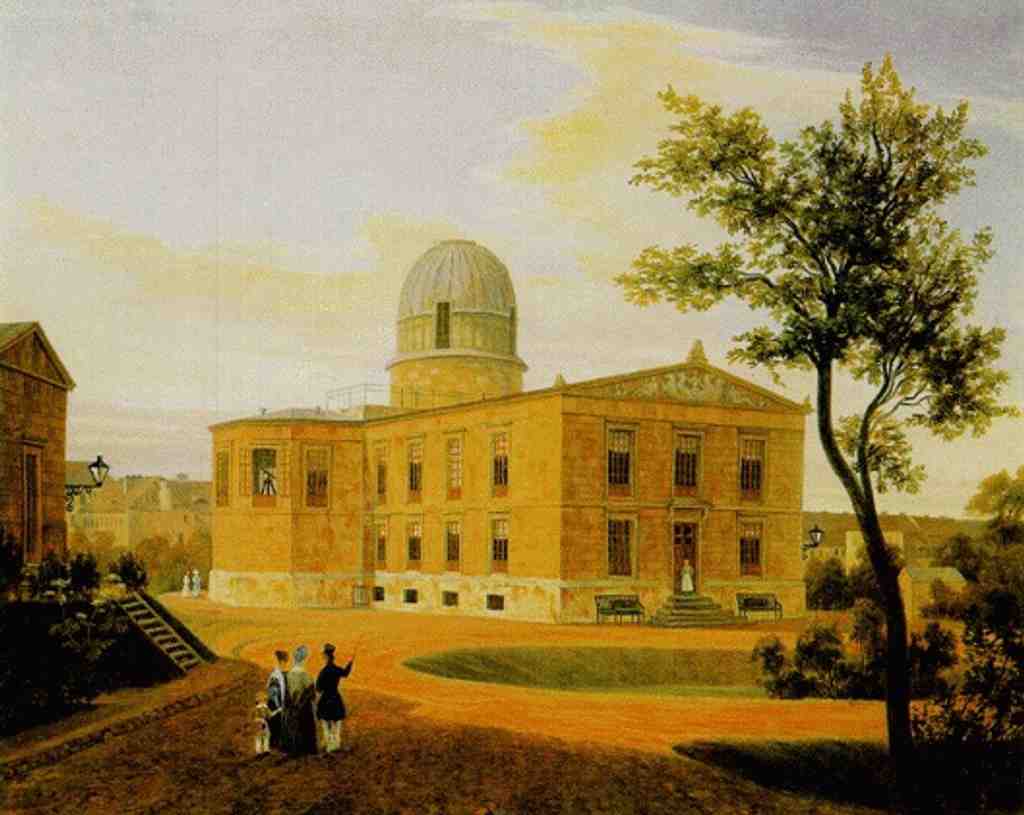
The first real Berlin observatory opened as a tower in seventeen eleven. Then, in eighteen twenty-five, Johann Franz Encke took over, with Alexander von Humboldt lobbying the king for something better. The king agreed to fund a true observatory on one condition: the public had to get access two nights a week. A fine idea - science, but with visiting hours.
If you check the app, Schinkel’s design shows the new Kreuzberg building that opened in eighteen thirty-five: a plastered, cross-shaped structure in a restrained Greek style, with a rotating iron dome at its center. Its foundations stood separate from the rest of the building so vibrations would not spoil observations. Even then, precision needed engineering, not just genius.
This place did serious work. Encke identified the gap now called the Encke Division in Saturn’s rings. On the twenty-third of September, eighteen forty-six, Johann Gottfried Galle and the student Heinrich Louis d’Arrest found Neptune here, using calculations from Urbain Le Verrier and a Berlin star chart. Not a lone-hero tale, despite history’s bad habit of simplifying everything until it fits on a pedestal.
And this observatory also helped define the ground beneath your feet. Its north side carried Prussia’s official height reference, Normalnull - the agreed zero for measuring elevation. Surveying the earth and surveying the sky rely on the same fragile bargain: trusted observation.
Then Berlin grew. Streets, buildings, smoke, vibration, light... all the usual urban compliments to astronomy. By the late nineteenth century, the city had surrounded the observatory so thoroughly that serious observation became nearly impossible. In nineteen thirteen, the institution moved to Babelsberg.
So even the stars become part of a city’s story: who gets funded, who gets named, who gets forgotten, and what a growing capital allows people to see. In about a minute, we’ll continue to Jerusalem Church. If you want a practical note, the public hours listed in the app are fairly limited, which feels on brand for astronomy.




