
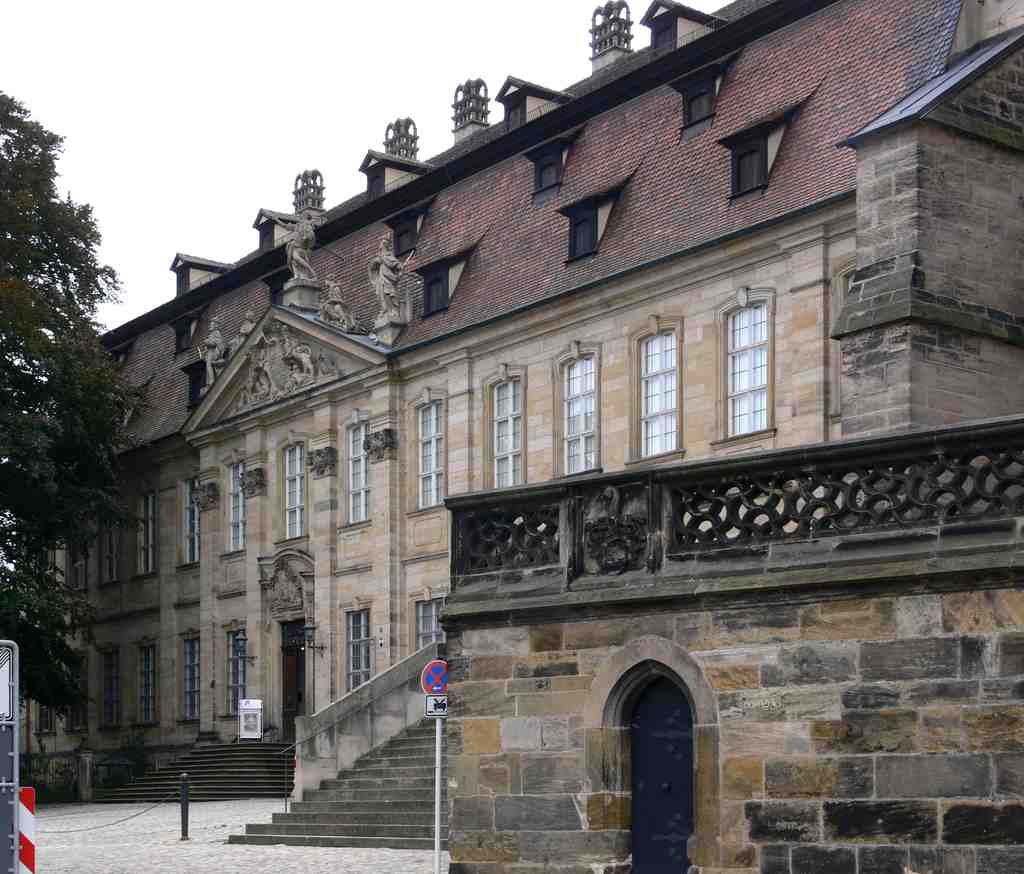
On your left, look for the long, pale-stone Baroque building with a steep red-tile roof, a carved triangular pediment, and a broad staircase leading up to the entrance.
This is the Diocesan Museum of Bamberg, tucked into the cathedral’s chapter house… basically the place where the cathedral’s leadership did the serious work of running the show. And the building itself? It was designed by Balthasar Neumann and built from 1731 to 1733, which means you’re standing beside a piece of architecture with very confident “yes, I’m important” energy.
The funny thing is, people wanted a museum here as early as 1907, but it didn’t actually open until 1966. Classic institutional timing: everyone agrees it’s a good idea… and then several decades pass. Since then, the display rooms were refreshed in the early 1990s, and the museum expanded again in 2005, because once you start pulling treasures out of cupboards, you run out of cupboards.
And “treasures” isn’t marketing fluff here. The core collection comes from the old cathedral treasury and from across the archdiocese. The headliners are the Imperial Vestments… six luxurious garments tied to Emperor Henry II and Empress Kunigunde. We’re talking embroidered silks from the first quarter of the 1000s: a starry cloak for Henry, blue and white cloaks for Kunigunde, plus pieces like a rider’s cloak, a tunic, and a richly worked chest piece called a rationale. They’re so rare that museums elsewhere would happily trade a small castle for them… though the paperwork would be a nightmare.
Then there’s the jaw-dropper: the vestments from Pope Clement II, taken from the only preserved pope’s grave north of the Alps. That’s the kind of fact that makes historians sit up straighter. Add the Gunthertuch, a massive Byzantine silk textile from around 975, and you’re looking at a textile collection with worldwide bragging rights.
The treasury section goes heavy on sacred objects: reliquaries, incense burners, altar crosses, and the Eucharistic gear that actually touches the ritual itself-chalices, patens, little spoons, cruets, monstrances, ciboria. The superstar is the “cathedral cross,” a monumental gem-studded cross-reliquary that still gets carried through Bamberg during the Corpus Christi procession. It’s not retired behind glass; it’s still on the job.
And don’t miss the cloister area: original stone sculptures from the cathedral-figures from grand portals like the Adam’s Gate and the Princes’ Portal, made by sculptors who likely came from Reims around 1220 or 1230. You’re face-to-face with the cathedral’s original skin.
When you’re set, Bamberg Cathedral is a 2-minute walk heading northwest.


