
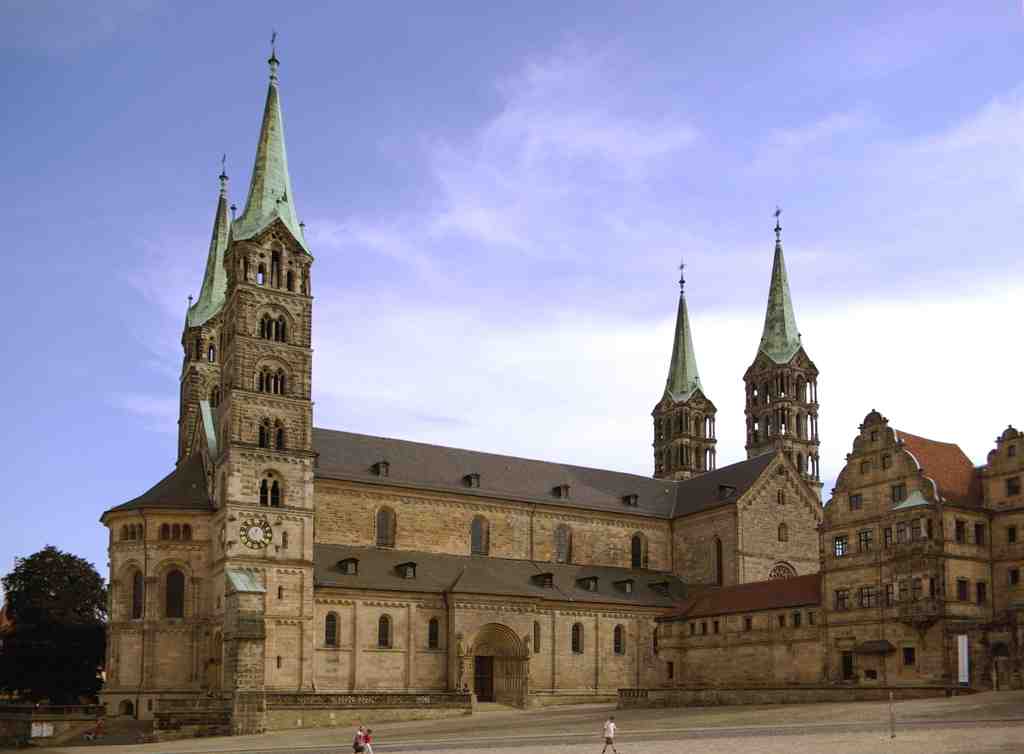
On your left, look for the long, honey-colored stone cathedral with FOUR tall towers and greenish copper spires, stretching wide across the Domberg like it owns the skyline... because it kind of does.
Alright, welcome to Bamberg Cathedral: officially St. Peter and St. George, one of Germany’s “imperial cathedrals,” and the sort of building that makes you instinctively lower your voice, even outside. Not because you have to... it’s just the vibe.
This hilltop, the Domberg, has been settled since around the year 600, and by 902 there’s already mention of a fortress here. But the cathedral story really kicks off in 1004, when King Henry II lays the foundation stone. Three years later, in 1007, he creates the Diocese of Bamberg-more like a strategic power move than a casual church project. Henry was unusually educated for a medieval ruler-many of his peers couldn’t even read. He could. Which, at the time, was basically a superpower.
The first cathedral was dedicated in 1012 on Henry’s birthday, with a jaw-dropping crowd: 45 bishops and top church officials. That’s not a normal dedication... that’s a medieval VIP summit. The patrons were chosen with intent: Peter for Rome and the Western Church, George for the Byzantine East, and Mary as the shared bridge between them. A spiritual diplomacy package, carved in stone.
Then came fire... twice. A major blaze in 1081, a patch-up, then another catastrophe in 1185 that led to demolition and a fresh start. The building you’re looking at is essentially the “second attempt,” dedicated in 1237-again on Henry II’s birthday, because if you’re founding a cathedral, you might as well schedule the party on-brand.
Inside are some heavyweight residents: the tomb of Henry II and his wife Kunigunde-THE only canonized imperial couple of the Holy Roman Empire, which is an extremely specific category to win. And there’s also the tomb of Pope Clement II, originally Bamberg’s bishop Suidger, crowned pope in 1046. It’s the only surviving papal grave in Germany and north of the Alps. Bamberg doesn’t do subtle flexes.
Take in the towers. The eastern pair mixes Romanesque roots with later Gothic touches, and the copper tops you see today come from an 18th-century redesign. The western towers borrow ideas from northern France-Laon Cathedral-down to the little animal figures up high. Locals call them the “cathedral cows,” though they’re more like mules... a stone thank-you note to the animals that hauled building materials upward. Finally, some workplace recognition.
And if you hear bells later, know this: some of them are medieval giants. The “Henry bell,” over five tons, is rung Fridays at 3 p.m. The cathedral even served as the city’s timekeeper for centuries-its tower clock used to set Bamberg’s rhythm.
Just stand here a moment... four towers, a thousand years of ambition, disasters, redesigns, and a couple of saints who used to be emperors. Bamberg’s big stone reminder that history doesn’t retire-it just echoes.


