
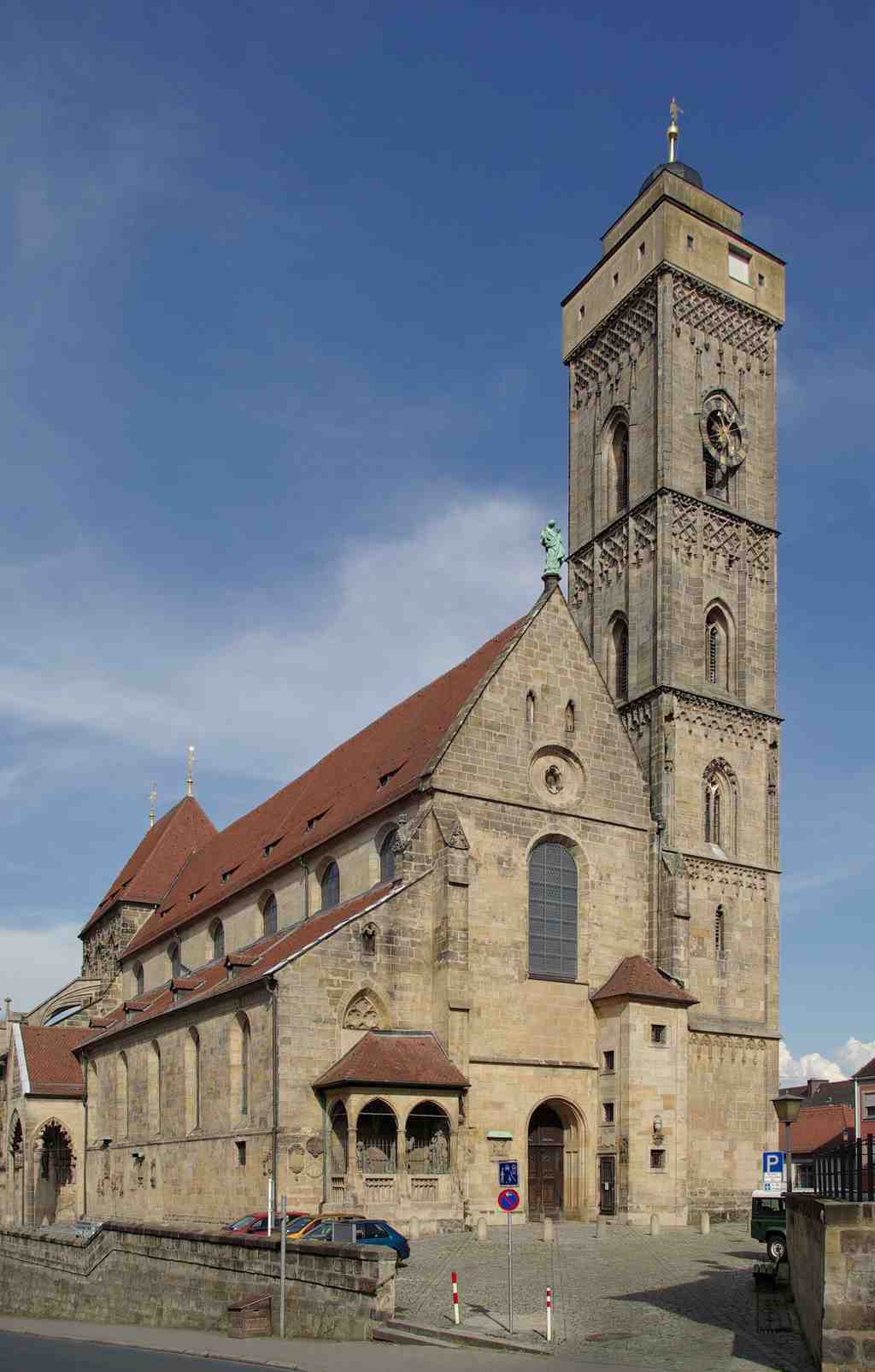
Look to your right for a big, honey-colored stone church with a long red-tiled roof and a tall square tower wearing a pale, boxy “cap,” plus a clock face halfway up.
You’re standing by Bamberg’s Obere Pfarre, officially “Our Dear Lady”... but locals went with the far more practical nickname: “Upper Parish.” It’s called that because it sits up here on the Kaulberg hill, the high counterpart to the old “Lower Parish” church that once stood down on today’s Maximiliansplatz and was later torn down. Bamberg does romance, sure. It also does GPS-before-GPS.
This place has deep roots. The parish may trace back to an early private church tied to the old Counts of Babenberg, though the first solid written mention shows up around 1140 in a document from Bishop Egilbert. By the early 1300s, it belonged to the cathedral chapter. There were disputes-because of course there were-and in 1401 the chapter’s claim got re-confirmed. Medieval paperwork was basically a contact sport.
Now, take in the building itself. It’s a three-aisled High Gothic basilica-serious, upright, and a little stern-started in 1338, though planning probably began earlier. There’s even a specific foundation date recorded: June 16. The main body took ages; it wasn’t consecrated until 1387. Then came the ambitious choir, begun around 1392, soaring up like it’s trying to out-Gothic its neighbors. That choir is one of the showpieces of Franconian Gothic, and the whole church has that “ship of stone” feel, especially from certain angles on the hill.
The tower? Slim, tall, and once doubled as part of the city’s defenses-a church that could also keep an eye on trouble. Bamberg loved efficiency. A watchman lived up there until 1923, in the upper two-story structure. Imagine your job being: “stand in the wind and tell everyone if something’s on fire.” Character-building, they’d call it.
Through the centuries, the church got patched, tweaked, and occasionally humbled. Around 1606 to 1607, it needed major repairs-and in 1608 a scaffold collapsed, killing one worker and badly injuring three others. It’s a sharp reminder that these grand buildings weren’t “built,” like ordering furniture... they were wrestled into existence.
In the early 1700s, the interior went Baroque-funded by a benefactor’s will-so the plain Gothic bones got dressed up in stucco and drama. Yet the builders showed surprising restraint: parts like the Gothic ambulatory and ribs stayed visible, as if even Baroque craftsmen knew when the old work didn’t need “improving.” A rare moment of self-control in the Baroque era.
If you step inside later, keep an eye out for the star: the Madonna and Child, a walnut sculpture from a Cologne workshop around 1250, later revered as a miracle-working image and eventually placed at the heart of the high altar. And there’s also a major painting of Mary’s Assumption by Tintoretto-yes, that Tintoretto-originally connected to the cathedral’s great Marian altar, now here on loan. Bamberg quietly collects masterpieces the way some people collect fridge magnets.
One more charming detail: the “wedding portal” on the north side, decorated with wise and foolish virgins. It wasn’t just pretty-it served a wedding ritual where the priest blessed the couple and gave the rings outside, before everyone processed in for Mass. Practical, symbolic, and less awkward than squeezing a whole crowd through a narrow doorway.
When you’re set, the Diocesan Museum Bamberg is about a 4-minute walk heading west.


