
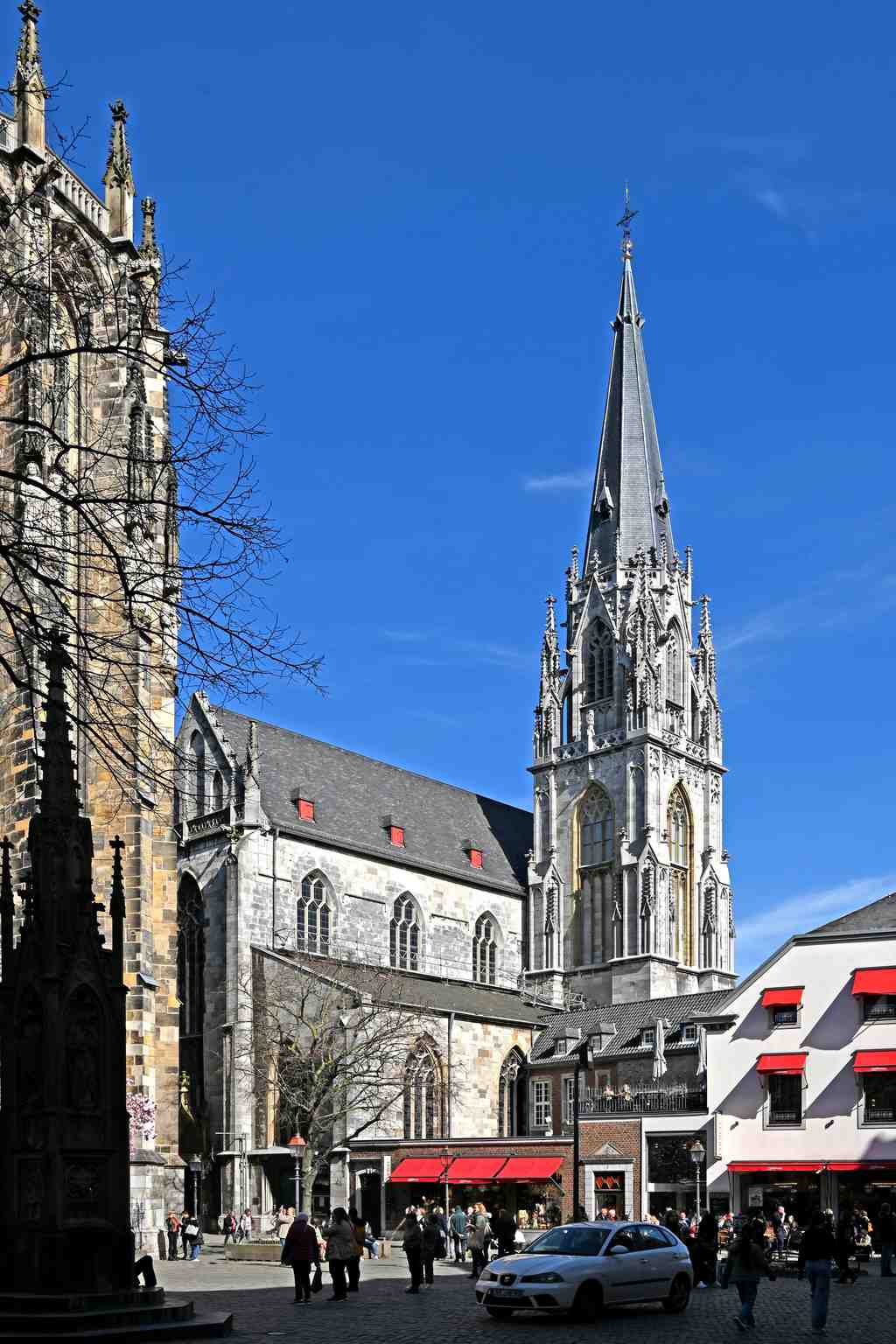
Look to your left to find Saint Foillan, a commanding gray stone church distinguished by its tall pointed gothic windows and a soaring, intricately carved spire crowning its southern side.
For centuries, the magnificent Cathedral next door was the exclusive domain of emperors and the elite clergy, leaving the everyday citizens of the city with nowhere to worship. These were the common burghers, the hardworking merchants and craftsmen whose hands actually built and sustained this city, and they demanded a spiritual home of their own. Refusing to be sidelined by the royal court, they pooled their resources and built Saint Foillan right here around the year 1180, claiming their own sacred space just a stone's throw from the imperial center.
You can feel the quiet defiance in the very placement of this building. There is just a narrow alleyway separating it from the Cathedral. That tiny gap was more than just physical distance. It was a profound social boundary dividing the glittering power of the empire from the heartbeat of the bustling medieval city. When the Cathedral was expanded in 1414, the proud citizens of Aachen matched that ambition. They completely rebuilt Saint Foillan into a much larger church. They even placed the new tower untypically on the south side, rather than the traditional west, simply to avoid overcrowding the Cathedral while still standing tall in its shadow.
If you take a look at the historical timeline on your screen, you can see how this church's story weaves through the centuries. It witnessed astonishing moments of history. In 1507, the infamous preacher Johann Tetzel sold his indulgences right here in Saint Foillan. These were controversial pardons for sins that people bought with cash, a practice that would spark Martin Luther's outrage and ignite the Protestant Reformation just ten years later. And in 1520, the legendary artist Albrecht Dürer stood right about where you are to sketch this very church while visiting for a royal coronation.
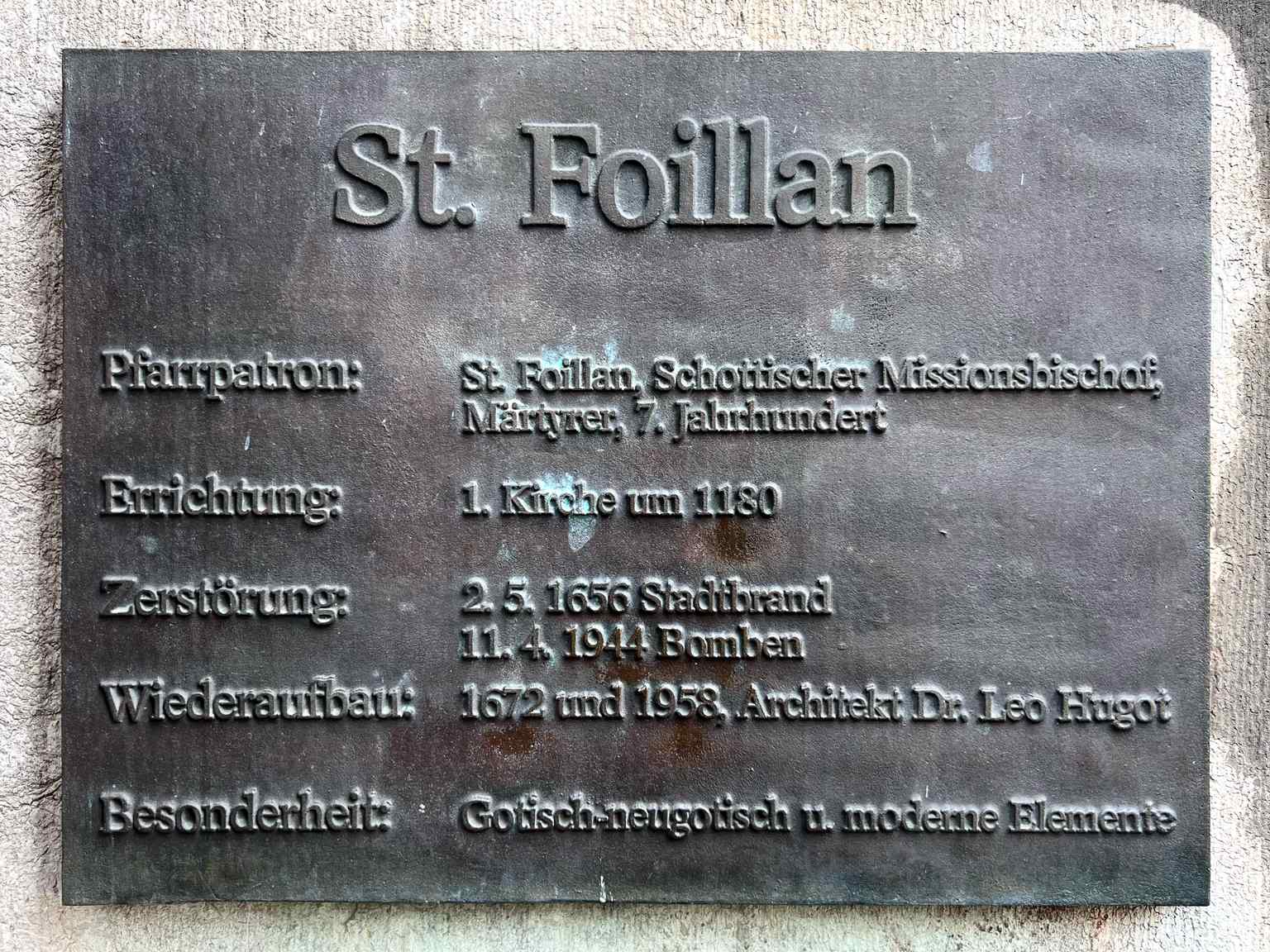
But this church is not just a monument to medieval civic pride. It bears the physical scars of modern tragedy. During a devastating bombing raid just after Easter in 1944, Saint Foillan was almost entirely destroyed. When it was rebuilt in the nineteen fifties, the architect made a powerful choice. On the outer walls, restorers deliberately left the bullet holes and shrapnel scars visible in the stone. They are the wounds of the past, preserved as a silent memorial to the fierce street fighting during the Battle of Aachen. Inside, the architect beautifully blended the surviving medieval ruins with a daring modern ceiling made of folded concrete, uniting a broken past with a hopeful future.
The people of Aachen have always known how to build and rebuild their own power, carving out their rightful place beside the thrones of kings. Let us continue our journey to another cornerstone of civic life, an institution forged specifically to serve the everyday people, as we make the short walk to Sparkasse Aachen.





