
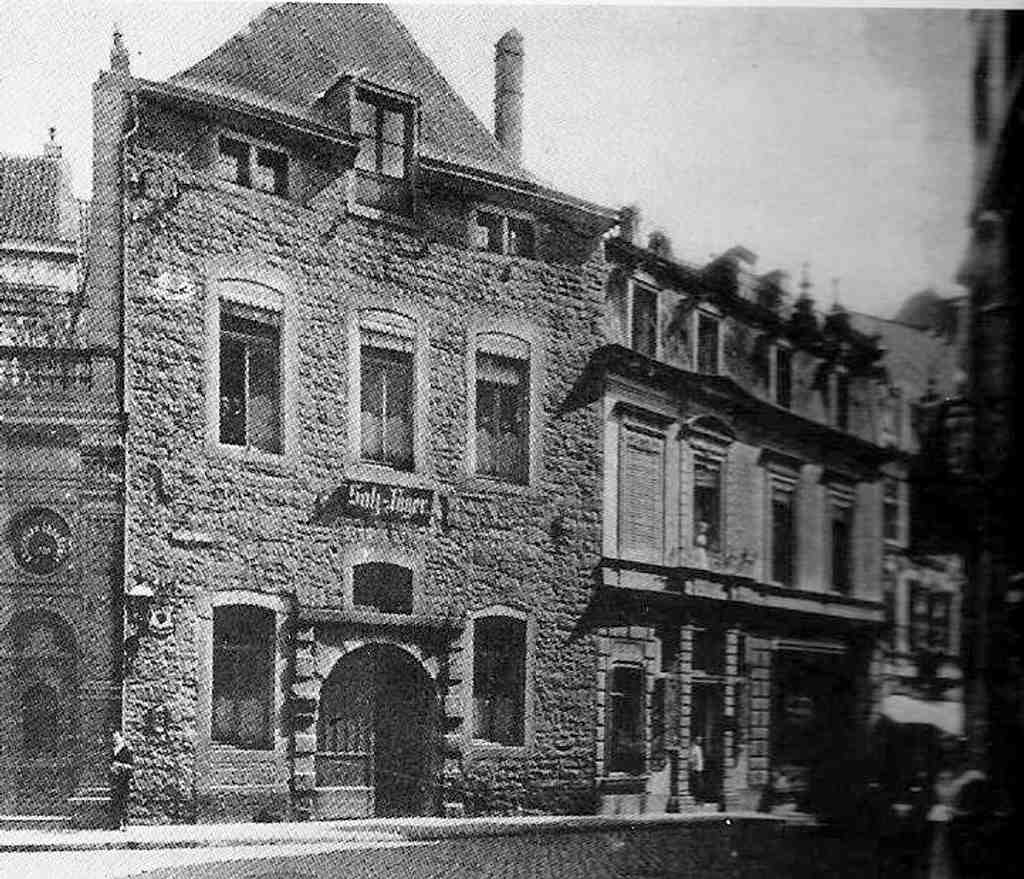
Look for the striking rough-hewn stone facade, anchored by a wide central arched doorway and topped with a steeply pitched roof featuring a prominent dormer window. Let me tell you the story of the Klüppel, a fascinating double house that once defined this very corner.
Its origins are wrapped up in some rather cunning family networking. Back in the late fourteen hundreds, a city financial official-often called a rentmaster-named Johann von Guilich owned the main house here. Through a quiet web of family ties, his relative seized the neighboring building over unpaid rent and simply handed it over to Johann. Just like that, the Great and Small Klüppel were united under one family, secretly connected by an underground cellar.
But these quiet cellars soon served a far more daring purpose. During the late sixteenth century, the city's religious landscape was fraught with conflict, forcing reformed Protestant communities to seek temporary safe havens away from the ruling Catholic authorities. The Klüppel became exactly that-a hidden sanctuary where ordinary residents gathered in secret to practice their faith.
As the Protestant community grew stronger, they began to push back against the old imperial order. A brave mayor named Peter von Zevel saw an opportunity for a major civic triumph. He boldly transformed the Great Klüppel into the official, central prayer house for the entire reformed community. For a brief, shining moment, the citizens of Aachen claimed their own spiritual independence right here, defying the immense weight of the empire's traditional powers.
Sadly, this victory was short-lived. The Catholic authorities struck back hard, securing an imperial ban-a devastating legal decree from the emperor that essentially declared the reformers as outlaws. Mayor von Zevel lost everything and was forced into exile, and the city quickly confiscated the Klüppel. The citizens had boldly flexed their power, but the heavy hand of the empire crushed their newfound freedom.
Over the following centuries, the building lived many fascinating lives. It served as a city weigh house, a noisy coffee roastery, and eventually a wildly popular restaurant boasting the city's very first gas lighting. Diplomats and wealthy travelers flocked to it, dazzled by the bright modern lights. However, despite fierce protests from the local public who wanted to protect their heritage, the historic stone walls were torn down in the nineteen thirties simply to make way for modern traffic flow.
If you need to visit the venue here today, they are open Monday through Friday from nine in the morning until one in the afternoon, and remain closed on weekends.
The spirit of Aachen is always shifting, shaped as much by local defiance as by deep imperial roots. Now, let us turn our attention back toward the legacy of the thermal waters at the site of the old baths, as we make the two-minute walk over to Kaiserbad.




