Tbilisi Audio Tour: Sacred Treasures and Legends of the Old Town
High above the tangled lanes and golden rivers of Tbilisi, legends linger behind every stone and whisper through every bell’s echo. Dive into a self-guided audio journey that peels back the centuries, revealing secrets and struggles most visitors never see. How did a fortress like Narikala withstand centuries of siege and disaster, yet crumble in a single tragic instant? What unsolved mysteries lie entombed beneath the Sioni Cathedral’s ancient stones? Why did a midnight battle over headstones erupt at the Norashen Church, splitting the city for days? Wind through royal scandals, hidden relics, forbidden prayers, and moments of revolt as you move from shadowy courtyards to panoramic ramparts. Each step draws you deeper into a city where history burns beneath your feet and every street corner could spark a new discovery. Begin exploring Tbilisi’s untold tales—if you’re ready to see what lies beyond the surface.
Tour preview
About this tour
- scheduleDuration 40–60 minsGo at your own pace
- straighten3.4 km walking routeFollow the guided path
- location_on
- wifi_offWorks offlineDownload once, use anywhere
- all_inclusiveLifetime accessReplay anytime, forever
- location_onStarts at Norashen-Kirche
Stops on this tour
On your left, looking a little serious for a building with so many stories, is the Norashen Church. Now, I know it doesn’t look like much is happening here today, but this place…Read moreShow less
On your left, looking a little serious for a building with so many stories, is the Norashen Church. Now, I know it doesn’t look like much is happening here today, but this place has seen more drama than a soap opera star’s love life-and it has the plot twists to prove it. Norashen actually means “newly built,” but let’s just say “new” is about as accurate as calling the pyramids “recent real estate developments.” It was first built way back in 1507, thanks to Satat’, a rich Armenian noble who wanted to make sure his whole family-and himself-would never be forgotten. The guy dedicated this church to his ancestors, his spouse, his three sons, and he even shoehorned his own name onto the guest list. We call that the ultimate family portrait. Back in its heyday, the place was buzzing with Armenian worship and community. Even got its own fresh batch of wall paintings done up in 1793 by none other than Hovnatan Hovnatanian-I promise, I’m not making that name up-from the famous Hovnatanian family. It looked fancy! But only a couple years later, in 1795, the Persians stormed into town, and let’s just say the church was not left unscathed. Picture stones cracking, fires flickering, prayers murmured under breath-Tbilisi was in chaos, and Norashen wore the scars for ages. But you know resilient Tbilisians. Local nobles like Melik Avetik poured their money back into repairing the place. If you’re curious, a big renovation at the time could cost what would be around tens of thousands of lari today-imagine dropping $30,000 in today’s US dollars just to keep your favorite church standing! And that was just the first in a long string of repairs, facelifts, and makeovers all through the 1800s. At one point, they even opened up schools for boys and girls inside. Church by day, classroom by recess-bell rings, prayers, and then algebra homework. Now here comes the juicy part: Norashen has been a tug-of-war rope between communities and countries. In the early 20th century, the Soviets came along with their very dry sense of humor and decided churches would make excellent libraries. No more Sunday services-just shushing librarians and lots of Soviet science books. For decades, the church sat crammed with dusty tomes and scribbled notecards. But after the collapse of the Soviet Union, things got wild. The church was suddenly claimed by the Georgian Orthodox Church, sprinkling a bit of holy water and “Georgia-fying” the place-Armenian inscriptions disappeared, some gravestones wandered off (not by their own power-though that’d make a good ghost story), and even the architecture was tweaked. Things got heated in the 2000s, with priests moving gravestones around like they were pieces on a chessboard, and angry protests breaking out. There was one guy, Father Tariel, who even tried to haul away Armenian gravestones with a bulldozer, except the Armenian community showed up in force and said, “Not on our watch!” Norashen today? Still shut, technically owned by the city, but declared a historical landmark worth more than its weight in stone. The city poured in over half a million lari-about $180,000 in today’s money-just a few years ago to stabilize the dome and spruce up the walls. Some of the original Armenian gravestones have even found their way home again. So, as you stand here, think of Norashen like a stubborn old relative-full of stories, strong opinions, and not afraid to stand firm when families clash at the dinner table. That’s Georgia for you: drama, grit, and a church that refuses to be forgotten. Ready for a new chapter? Head south for about 5 minutes, and you’ll find yourself at Saint Gevororg von Mughni-Kirche, Tbilisi. Let’s roll!
Open dedicated page →Right here on your left stands Surb Nshan Church, the Church of the Holy Seal-believe me, “holy seal” isn’t the animal, it means a sacred mark, and this place is loaded with…Read moreShow less
Right here on your left stands Surb Nshan Church, the Church of the Holy Seal-believe me, “holy seal” isn’t the animal, it means a sacred mark, and this place is loaded with stories. Built way back between 1703 and 1711, this Armenian church watched Tbilisi grow up all around it, right through some wild centuries. The local Armenians who built it probably splashed sweat, hope, and a few salty comments into these very bricks. Then, in 1780, the church got a bit of a facelift-imagine a “Georgian Extreme Makeover: Church Edition.” But here’s the part that’ll tug at your heart: the church you see now is more worn than weathered. In 2002, it suffered heavy damage from arson-yes, someone actually set fire to it. Today, it’s partially ruined, kind of like a historic castle with a battle scar. Locals pass by and remember the music, the prayers, and community that once filled it up. So, when you look at Surb Nshan, you’re gazing at something stubbornly surviving, even through the rough patches. Ready for Brücke des Friedens
Open dedicated page →But don’t be fooled by the fancy façade-inside, international bigwigs have made deals, politicians have sweated out negotiations, and legends may or may not have been born after a…Read moreShow less
But don’t be fooled by the fancy façade-inside, international bigwigs have made deals, politicians have sweated out negotiations, and legends may or may not have been born after a glass of good Georgian wine. Picture conference rooms buzzing with heated debates, midnight whispers in the lobby, and a heady scent of ambition in the air-the Ambasadori has seen it all, from Soviet-era hush-hush to today’s global powwows. Now, let’s shake off the luxury for a moment and time travel further back-Anchiskhati-Basilika is just a 1-minute walk south. Ready? Follow the path and let’s go!
Open dedicated page →
Show 10 more stopsShow fewer stopsexpand_moreexpand_less
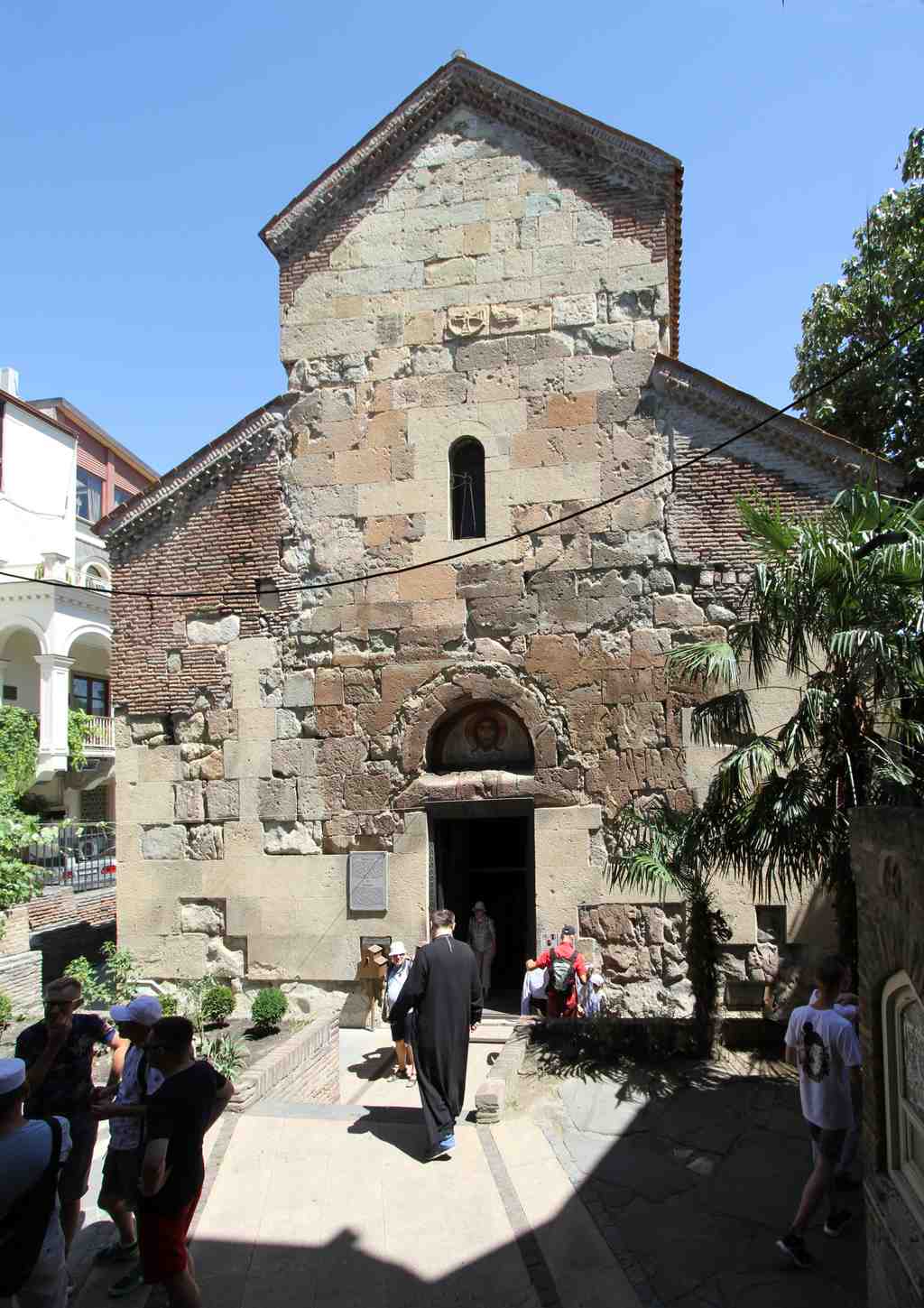
Alright, look to your left-that’s no ordinary old church. You’re staring at the Anchiskhati Basilica, the oldest surviving church in Tbilisi. It’s so old, if these walls could…Read moreShow less
Alright, look to your left-that’s no ordinary old church. You’re staring at the Anchiskhati Basilica, the oldest surviving church in Tbilisi. It’s so old, if these walls could talk, they’d probably groan! We’re talking back to the sixth century, when King Dachi decided Tbilisi would make a decent capital-mainly because the other hills had too many snakes or something. Imagine building in 522, when “internet” was code for someone actually throwing a net at a fish. Originally, this place was all about the Virgin Mary, but the plot thickens! In 1675, Georgia was feeling a bit neighborly with the Ottomans invading, so the precious “Anchiskhati” icon-crafted by sheer twelfth-century goldsmith genius-was moved here for safekeeping. Think of it as medieval witness protection. The icon’s in the Art Museum now, so if you’re an art heist enthusiast, sorry, you’re late by a few centuries. This basilica has seen more facelifts than a Hollywood celebrity-wars, rebuilds, a surprise dome in the 1870s, and then during Soviet times, it was turned into a museum for handicrafts and even an art studio. No prayers, just pottery! After Georgia’s independence in 1991? Back to business: church restored! And fun fact: those hauntingly beautiful polyphonic chants you’ll sometimes hear drifting out? That’s the Anchiskhati Choir, world-famous for sending chills down your spine-in a good way! Feeling inspired? Time to head south for 6 minutes for Surb Nshan Church, Tiflis. Let’s keep the adventure going!
Open dedicated page →Alright, look to your left-there it is: the Bridge of Peace. Now, let me paint the scene for you. In a city packed with ancient brick churches and winding alleyways, the city…Read moreShow less
Alright, look to your left-there it is: the Bridge of Peace. Now, let me paint the scene for you. In a city packed with ancient brick churches and winding alleyways, the city council decided in 2010 to plop down something completely modern, shimmering, and, well, shiny. Some folks say it looks like a giant glass wave or even a sea creature fresh out of the Black Sea. Others-less kind, perhaps-have dubbed it the “Always Ultra” bridge because, apparently, some local wits can’t keep their minds out of the pharmacy aisle. I’ll let you judge for yourself, though! Here’s the story: They brought Michele De Lucchi over from Italy-the architect, not a fancy type of pasta-to dream up something bold and futuristic. The massive swoop of glass and steel you see was actually manufactured bit by bit in Italy and shipped here in a mind-boggling convoy of 200 trucks. Can you imagine being the customs officer on that day? “Do you have anything to declare?” “Just a bridge, sir.” But wait till night falls. This thing puts on a light show worthy of a rock concert. French lighting wizard Philippe Martinaud rigged it with over a thousand custom LED fixtures-fancy lights so clever they change in waves, patterns, and even twinkle across the roof like a disco party in the sky. The walkway handrails have lights that snap on as you stroll, so you can feel like you’re starring in your own music video. Walk the length of the bridge, and every couple of minutes a glowing Morse code message scrolls by, spelling out the periodic table of elements. Hey, who said science can’t be fun and stylish? You’re standing on the city’s symbolic handshake-made to link old Tbilisi with new, and give you stellar river views. On one side you glimpse medieval fortresses and church spires; on the other, government buildings gleaming with new ambition. Some locals still grumble about its modern looks muscling into Old Town’s postcard charm, but love it or hate it, no one can ignore it. Alright, ready for the next chapter of this city’s story? Just walk south for about 6 minutes and you’ll bump into Tiflis Sioni-Kathedrale.
Open dedicated page →Alright, look to your right because you’re standing by one of Tbilisi’s rockstar landmarks: the Sioni Cathedral. Now, don’t let its calm yellow stone face fool you-this place has…Read moreShow less
Alright, look to your right because you’re standing by one of Tbilisi’s rockstar landmarks: the Sioni Cathedral. Now, don’t let its calm yellow stone face fool you-this place has seen more drama than a soap opera marathon! Imagine: kings getting crowned, invaders breaking in, earthquakes shaking everything, and then the next day, folks still showing up for Sunday service. That’s Georgian resilience for you. Let’s crank up the time machine. Picture the year? About 575. The king’s name? Guaram, which, if you ask any Georgian grandma, is pretty much synonymous with “built to last.” He and his successor Adarnase got the ball rolling here, but honestly, staying “built” was a bit of an issue. Arabs flattened the original. David the Builder-yes, that’s really what Georgians call him-rebuilt it in 1112, but then came the Mongols, Persians, Timur’s troops, earthquakes, and even more invasions. If this cathedral had a loyalty card for “Get attacked, get a free dome repair,” it would have had a lot of free domes. Now, tell me you notice the style. That’s classic Georgian inscribed cross-in-square design. Hard to say after your second glass of khvanchkara, but impressive to see in person. The yellow stone was hauled in all the way from Bolnisi, so every block here is basically an ancient delivery order. And see those carvings on the western wall? There’s a cross and a chained lion, which might raise an eyebrow or two. The chained lion’s story is a mystery-some folks say it’s a reminder that power exists but needs restraint. Or maybe it’s just the ancient version of “Beware of dog.” Let’s step inside with our minds for a sec. The dome, that’s supported not just by the altar wall but by two free-standing pillars. That’s architectural bragging rights, medieval edition. But it’s not all just fancy arches and good looks-the walls are lined with frescos from the 1800s by a Russian artist named Grigory Gagarin. In his day, if you burned down an iconostasis, the man would show up and make a new one-paid in rubles, of course, which would’ve been just a few hundred at the time, but that’s roughly six thousand U.S. bucks today. Not bad for interior decorating with a paintbrush instead of Pinterest. Now, here’s the showstopper: to the left of the altar, there’s the famous Grapevine Cross. If you see a crowd or someone in tears, this is what they’re looking at. It’s said to have been forged by Saint Nino, the woman who brought Christianity to Georgia. And yes, she didn’t just bring religion, she crafted the symbol herself-talk about multitasking. A little political plot twist: in 1802, the Russian commander-in-chief herded Georgia’s big wigs into this very cathedral and forced them to swear loyalty to the Russian Empire. Picture the tension-a cathedral full of nobles and surrounded by soldiers. Anyone dissenting got hustled off, not to the nearest café, but straight into custody. The sort of scene that would make Game of Thrones look like a kindergarten play. As you wander around, keep an eye on the churchyard and crypts. Several of Georgia’s top patriarchs have been laid to rest here, alongside Giorgi Maisashvili, a bigshot in politics and economics. The stories in these stones go far beyond religion-they’re snapshots of Georgia wrestling with centuries of outsiders and always, always rebuilding for another Sunday. Alright, ready for more stories? Just walk southeast for about 4 minutes, and you’ll reach Saint George’s Church, Tbilisi. Onward!
Open dedicated page →Alright, on your right, you’ll spot Saint George’s Church, or as the Armenian community likes to say, Surb Gevorg. This place is like Tbilisi’s version of a survival reality…Read moreShow less
Alright, on your right, you’ll spot Saint George’s Church, or as the Armenian community likes to say, Surb Gevorg. This place is like Tbilisi’s version of a survival reality show-except, instead of contestants eating bugs, it’s a church that’s taken on invaders, fires, and all kinds of political drama for more than 750 years. Here’s the scene: it’s tucked in the southwestern corner of the old Meidani Square, watched over by the ancient Narikala fortress looming from above. And once upon a time, this square wasn’t just where folks bought veggies-it was the city’s prison district! In Georgian, one nickname for this church is “Big Prison”-and honestly, is there a better name for a spot with walls this thick? Now, historians will squabble (they love to argue, trust me), but the most widely accepted founding story is from 1251, courtesy of a real estate mogul named Umek-a prince who married well and built this place as his mark on the city. Some folks will tell you it’s even older, stretching back to the 600s, but let’s just call it ancient enough to warrant a respectful "wow." Saint George’s isn’t just bricks and prayers. It’s been Persian, Armenian, and Georgian-basically, the Airbnb of churches. Shah Abbas I took it for the Persians in 1616, and it came back home to the Armenians when King Heraclius II felt generous in 1748. The place was torched in 1795-Persians again, no chill-but restored several times after, most recently with a whopping $3.5 million facelift by a dream team of wealthy donors. That would’ve been about the cost of a small palace in modern-day Tbilisi! Inside, late 18th-century murals by Hovnatan Hovnatanian (phenomenal name, honestly), plus massive frescos from the 1920s make this place feel like an art history trip. In the churchyard, you’ll find the graves of Sayat-Nova, Armenia’s rock star poet, and a few Russian generals with the kind of mustaches that mean business. Now, ready for a faith-flip? The Tolle Synagoge (Tiflisi) is just ahead. Walk northwest for 4 minutes, and you’ll be there in no time.
Open dedicated page →Alright, look to your right and feast your eyes on Narikala - Tbilisi’s very own “castle on the hill.” Picture this place a thousand years ago: kings in furry hats barking orders,…Read moreShow less
Alright, look to your right and feast your eyes on Narikala - Tbilisi’s very own “castle on the hill.” Picture this place a thousand years ago: kings in furry hats barking orders, guards trundling along stone walls, and the occasional invader peeking over, thinking, “Do we really want to try this?” Legend says old King Vakhtang Gorgasali himself founded this giant playground back when folks were still figuring out the wheel. Actually, archaeologists have found evidence people were hanging around this hill since the 4th millennium BC! The Persians, the Arabs, Mongols, Georgians - everyone’s crashed here at some point, sort of like the world’s worst Airbnb. Mongols even gave it the catchy name “Narin Qala,” or “Little Fortress.” These walls have seen earthquakes (big one in 1827!), epic sword fights, and more drama than a telenovela. The St. Nicholas Church below? The original burned down, but the new one’s got frescoes telling tales from the Bible and Georgia’s wild history. Take it in - Narikala isn’t just old stone, it’s the ultimate storyteller of Tbilisi.
Open dedicated page →On your right stands the Great Synagogue-known around town as “Tbilisi’s Big One.” Now, this is not your average local meeting spot. Imagine: it’s 1904, and the Jewish community…Read moreShow less
On your right stands the Great Synagogue-known around town as “Tbilisi’s Big One.” Now, this is not your average local meeting spot. Imagine: it’s 1904, and the Jewish community from Akhaltsikhe, tired of their old house-turned-synagogue literally crumbling around them, decided it was time for something grand. They weren’t just pitching in a few bucks-we’re talking savings worth thousands then, easily the price of a fancy four-bedroom apartment in Tbilisi today. Builders went all out: two stories of red brick with a mix of Neo-Moorish style (think elegant arches and hints of “Arabian Nights”) and Neo-Romanesque flair-because apparently, no one said you had to choose just one look. There’s even a ritual bath, a mikveh, in the basement. Picture the place on a busy day: people in their best clothes, the murmur of Georgian, Hebrew, Ladino-a real symphony of cultures. And as with any epic neighborhood project, there were opinions. Some wanted fancier tiles, others hollered for more windows. Somehow, it came together. If you’re ready for more stories, just walk west for 2 minutes-Norashen-Kirche is next!
Open dedicated page →Alright, you’re standing in front of the Saint Gevororg von Mughni Church-what a name, right? But if that tongue-twister’s too much, you can just call it the Mughni Church.…Read moreShow less
Alright, you’re standing in front of the Saint Gevororg von Mughni Church-what a name, right? But if that tongue-twister’s too much, you can just call it the Mughni Church. Picture this: back in the 13th century, Tbilisi already had a thriving Armenian community building their distinctive brick churches, and this little gem was their pride and joy. It was rebuilt entirely in 1756, which, in Tbilisi terms, is basically yesterday. The church was designed with a cross-shaped interior, all tucked neatly inside a rectangular shell-kind of like when you try to wrap a birthday present and the corners never quite line up. Fast forward to the Soviet era: the Mughni Church spent some time moonlighting as a museum, showing off folk art until the mid-1980s. But then things took a nosedive. By the ‘90s, the place was in rough shape, and the church’s beautiful dome finally gave up the ghost in 2009, thanks to some relentless Georgian rain. But hey, even in ruin, this place stands as a stubborn reminder of the city's tangled, multicultural past. Whenever you’re ready, take a 2-minute stroll south and you’ll find yourself at Nieder Bethlehemi-Kirche.
Open dedicated page →Alright, stop just a second here on your right-yep, that church with the worn stone and the solid fortress vibe. You’ve reached Nieder Bethlehemi-Kirche, or, if you were feeling…Read moreShow less
Alright, stop just a second here on your right-yep, that church with the worn stone and the solid fortress vibe. You’ve reached Nieder Bethlehemi-Kirche, or, if you were feeling Armenian, you might know it as Koosanats Sourb Stepanos Vank. Trust me, this spot has seen more church renovations than my grandma’s kitchen after a winning streak at the bingo parlor. Built originally in the 14th century and then constantly redone all the way to the 19th century, this place has played musical chairs with its identity. Armenians built, prayed, carved beautiful inscriptions, and by 1870 were fixing up the place like they were expecting royal guests. Imagine, back then-if you wanted to slap your name on a marble plaque here for posterity, it would’ve cost maybe 10 rubles, about $150 today. But by the late 1980s, the church swapped hands from the Armenian Apostolic crew to the Georgian Orthodox. And boy, did things get, let’s say... streamlined. Between 1989 and 1995, it was a little like one of those home renovation TV shows, if the only design rule was “out with the old, in with the local.” Out went Armenian inscriptions, khachkars (those are those glorious carved stone crosses), even the mausoleum and window grates. In came Georgian frescoes and a whole new set of stories. Tensions ran high-families watched their ancestors’ stories literally being bricked in or carried off to other churches. Standing here, you get a sense of the layers-faith, politics, identity-all jostling for space, right under the mighty view of Narikala. Ready to keep going? Heilige Mutter von Gott Kirche von Bethlehem, Tbilisi is just a 1-minute stroll south. Right this way!
Open dedicated page →Alright, here it is: the Holy Mother of God Church of Bethlehem-known by locals as the Upper Bethlehem Church, not to be confused with, well, actual Bethlehem! Take a look at…Read moreShow less
Alright, here it is: the Holy Mother of God Church of Bethlehem-known by locals as the Upper Bethlehem Church, not to be confused with, well, actual Bethlehem! Take a look at those weathered stones: this spot holds tales of faith, stubbornness, and a dash of high drama, as if it’s auditioning for a historical soap opera. Picture this neighborhood in the 18th century: priests in flowing robes, thick accents echoing in the alleyways, big thoughts about god and gold. The original chapel? That was started by a priest named Gregory, who unfortunately didn’t quite see the finish line-in fact, he’s buried right here. His grandson, Barsegh, had to roll up his sleeves and finish granddad’s work. Family projects-gotta love ’em. Down the road, things only get spicier. The upper portions you see, those dark stones, were put in by Agha-Meliq Bebutyan-a guy so bold he joined Nadir Shah’s Indian crusade. He brought two nuns from Persia’s St. Yekaterina Monastery, which is like flying in consultants from Paris, but for holy matters. His son fenced the place in tight-I’m guessing “keep out” was written in three languages. Stories here turn downright cinematic. In the late 1700s, the archpriest-a fellow named Mkhitar-stood his ground when a Persian conqueror demanded the church’s treasures. Mkhitar wouldn’t squeal, so he paid the ultimate price. If Sunday sermons ever feel dull, just remember: some priests here literally risked it all. Today, the church looks Georgian Orthodox, but its bones are Armenian. Think of it as Tbilisi’s spiritual lasagna-history layered on history. Alright legend, onward! Ready for Kartlis deda
Open dedicated page →Stop right there and look up! Meet Kartlis Deda-known to the locals as the Mother of Georgians. She’s twenty meters tall, made of aluminum, and quite literally keeping a close eye…Read moreShow less
Stop right there and look up! Meet Kartlis Deda-known to the locals as the Mother of Georgians. She’s twenty meters tall, made of aluminum, and quite literally keeping a close eye on the whole city from Sololaki Hill. Picture 1958: Tbilisi’s throwing a massive 1,500th birthday bash, and they decide, “Hey, let’s build a giant mom on the hill!” Originally, she was a wooden party decoration, but, like any mom with a good hairdo, she was just too fabulous to take down. So, they gave her a shiny aluminum outfit in the sixties and replaced her with an upgrade in the nineties. Her two hands say it all-wine bowl on the left, to welcome friends; sword on the right, for enemies who might get too cheeky. The sculptor, Elguja Amashukeli, scored a big state prize in 1966 for this. It’s a bit like your grandma-she’ll feed you first, then smack you if you act out. That’s Tbilisi’s spirit in a nutshell. When you’re ready for more sweeping views and dramatic tales, head east for about eight minutes to reach Narikala. Let’s keep going!
Open dedicated page →
Frequently asked questions
How do I start the tour?
After purchase, download the AudaTours app and enter your redemption code. The tour will be ready to start immediately - just tap play and follow the GPS-guided route.
Do I need internet during the tour?
No! Download the tour before you start and enjoy it fully offline. Only the chat feature requires internet. We recommend downloading on WiFi to save mobile data.
Is this a guided group tour?
No - this is a self-guided audio tour. You explore independently at your own pace, with audio narration playing through your phone. No tour guide, no group, no schedule.
How long does the tour take?
Most tours take 60–90 minutes to complete, but you control the pace entirely. Pause, skip stops, or take breaks whenever you want.
What if I can't finish the tour today?
No problem! Tours have lifetime access. Pause and resume whenever you like - tomorrow, next week, or next year. Your progress is saved.
What languages are available?
All tours are available in 50+ languages. Select your preferred language when redeeming your code. Note: language cannot be changed after tour generation.
Where do I access the tour after purchase?
Download the free AudaTours app from the App Store or Google Play. Enter your redemption code (sent via email) and the tour will appear in your library, ready to download and start.
If you don't enjoy the tour, we'll refund your purchase. Contact us at [email protected]
Checkout securely with