
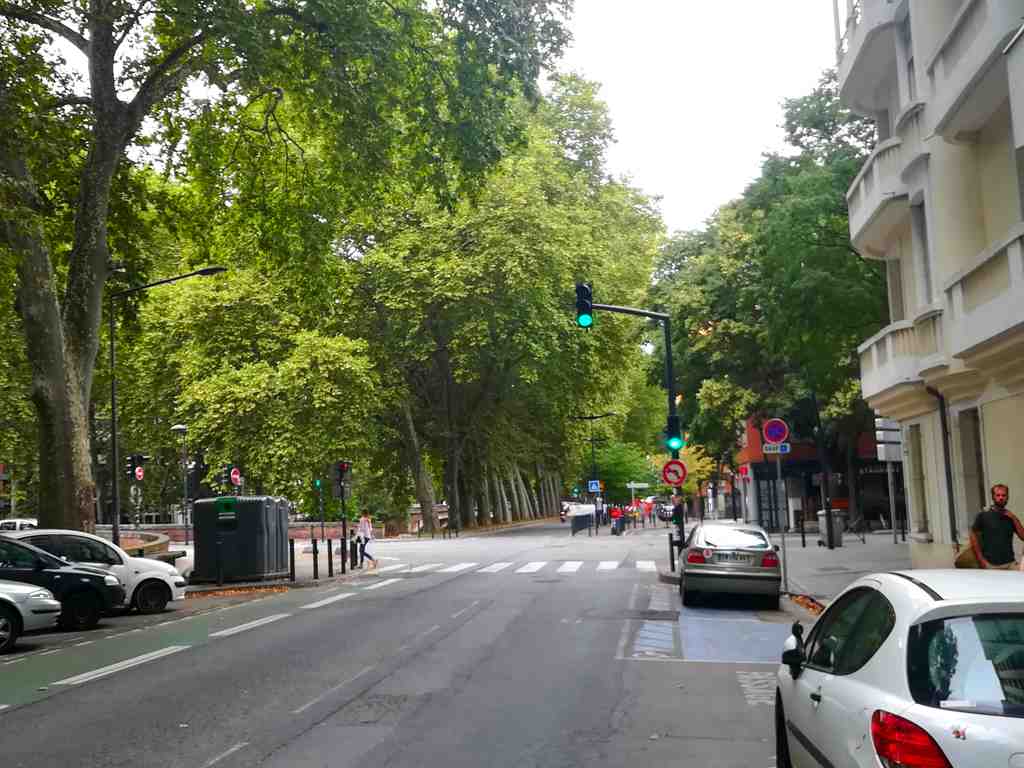
Look for a broad asphalt avenue stretched beside the stone-lined Canal de Brienne, with a parallel service lane and long, straight edges that make it read more like an old road than a local street.
This is Allée de Barcelone, and its first secret is that it is not really just a street. It is an old road axis folded into the modern city, a route that once carried people and goods in and out of Toulouse and still marks the edge between Compans-Caffarelli and the Amidonniers. Even the name hints that this edge was asked to mean something larger than itself.
Its deeper story begins with the engineer Joseph-Marie de Saget. In the late eighteenth century, he chose a practical route for the Canal de Brienne: he ran it through the city’s old defensive ditches near Saint-Pierre, then led it to the Port de l’Embouchure so boats could join the Canal du Midi network without risking the difficult passage at the Bazacle. A former line of defence became a line of connection. That is the sort of decision that quietly reshapes a city for centuries.
The road beside it kept changing identity as Toulouse expanded. In eighteen thirteen, officials classified this stretch as part of departmental road seven between Lectoure and Toulouse. In nineteen thirty-eight, they turned it into departmental road one, linking villages such as Séguenville and Cabanac-Séguenville to Toulouse and onward to Revel. Then, in twenty seventeen, Toulouse Métropole took over the section inside the city and renamed it metropolitan road one. Those bureaucratic labels may sound dry, but they reveal something important: what feels like an ordinary avenue is really the latest version of a much older route.
Then came the most revealing change of all. In nineteen thirteen, Toulouse renamed the north-side canal walk Barcelone to celebrate friendship with Barcelona after a mayoral visit from the city in nineteen oh nine. The south side kept the older name Brienne, and nearby the newly finished bridge by engineer Paul Séjourné became the Pont des Catalans. That was not accidental. The city used names to declare affinity, to point south, and to turn infrastructure into a little piece of diplomacy.
And yet the older truth never disappeared. Beneath the gracious name, this remains a hard-working traffic corridor. Part of it now operates as a shared zone, meaning pedestrians, bicycles, and cars are supposed to share space carefully, with speeds held to twenty kilometres an hour. Residents still asked for noise and speed radars in twenty twenty-one, especially near the Ponts-Jumeaux, after nights disturbed by loud engines and dangerous bursts of acceleration. Others pressed for better lighting between Place Héraclès and the Ponts-Jumeaux, asking for a safer walk home. In twenty twenty-four, major works on high-voltage lines blocked sections of the allée for months. So this street tells two truths at once: civic elegance in the name, pressure and negotiation in daily life.
There is even a gentler human trace here. At number one hundred and fifty, Louis Castille ran the Café Castille from around eighteen ninety-five, and later the address became a cinema. Earlier still, the Eldorado hosted skating concerts around nineteen ten, and a postcard from nineteen twelve shows Professor Gueden teaching roller skating there. On a road now measured in lanes and limits, people once came to glide for pleasure.
Ahead, a figure from myth will make this business of naming and memory feel more personal: Hercules the Archer, about four minutes away. If you want a break later, a nearby place linked to this stop is moderately priced and usually open from nine in the morning until ten at night, except on Sundays.




