
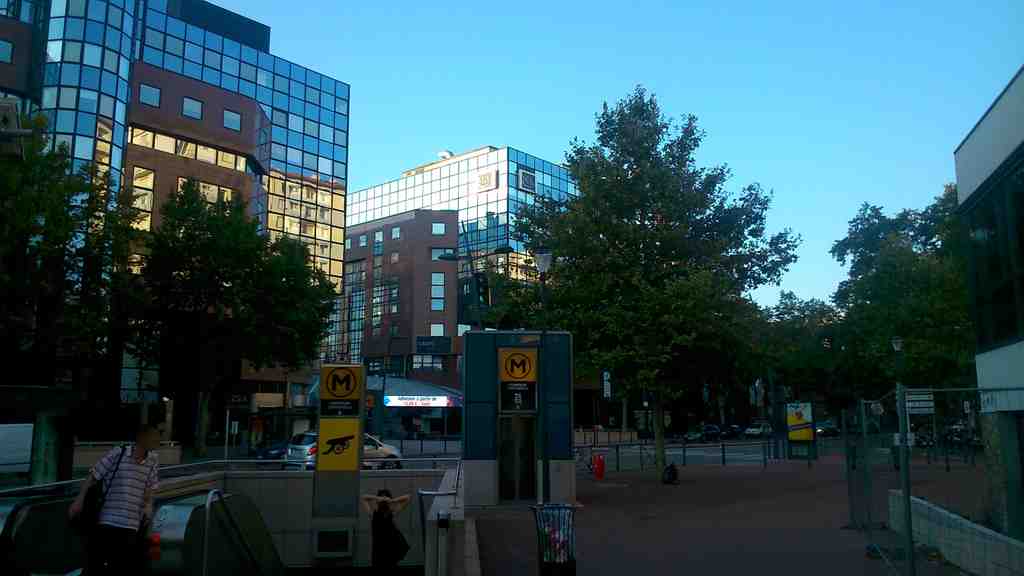
On your right, look for a broad paved esplanade framed by pale stone and glass blocks, with long straight facades and the open sweep of Place de l’Europe marking the heart of the district.
Compans-Caffarelli is not a single building so much as a carefully rewritten piece of Toulouse. What stands here now began with military order. The first Compans barracks rose beside the old city ramparts and became the seed for a much larger military complex. Then, in eighteen forty-six, work began on the Caffarelli barracks; builders finished it in eighteen fifty-one. For well over a century, this was a place of drills, regiments, and ceremony. Place de l’Europe nearby kept that memory alive, because military ceremonies continued there until nineteen seventy-seven.
The real turning point came through politics and paperwork, not bricks. In nineteen seventy-two, Pierre Baudis launched a plan for a twenty-hectare Z-A-C - that means a specially planned development zone - to convert the barracks site into a mixed urban quarter. But the idea could not fully breathe until the state released the land. In nineteen seventy-seven, Toulouse signed an agreement with the Ministry of Defence, and the transfer of the former barracks lands finally freed roughly nineteen hectares for the city. That is the key to everything around you. Without that handover, there would be no business district, no park, no Japanese garden, no congress centre, and certainly no neat coexistence of offices, flats, schools, and public space.
Pierre Baudis is the human figure to keep in mind here. He did not simply inherit an empty site; he pushed Toulouse to imagine one. He also backed the green spaces that now thread through the district. That curious decision matters. It announced that this quarter would not remain a stern memorial to military land. It would become a civilian landscape, one that could host contemplation as easily as commerce.
If you glance at the image on your screen, the broad esplanade makes that planning logic easy to read: generous space, large buildings, and a deliberate sense of arrival. To the east, the district grew taller, busier, and more commercial, filling with offices, hotels, shops, and major institutions. To the west, it settles into quieter residential streets. Even the landmarks we have already met fit that pattern. The sports palace was the first completed building of the new development in the early nineteen eighties, at first marooned among vast car parks. Toulouse Business School later took over the former Sud Radio premises, turning a media building into a school of management. Reuse, here, is almost a local reflex.
Even the metro remembers the old ground. Since two thousand and seventeen, the Compans-Caffarelli station has carried a small cannon symbol, a nod to the artillery regiments that once occupied these barracks.
As you continue toward Barcelona Alley, notice how the district begins to speak less about parade and command, and more about circulation, exchange, and arrival. That next street carries the story forward.




