
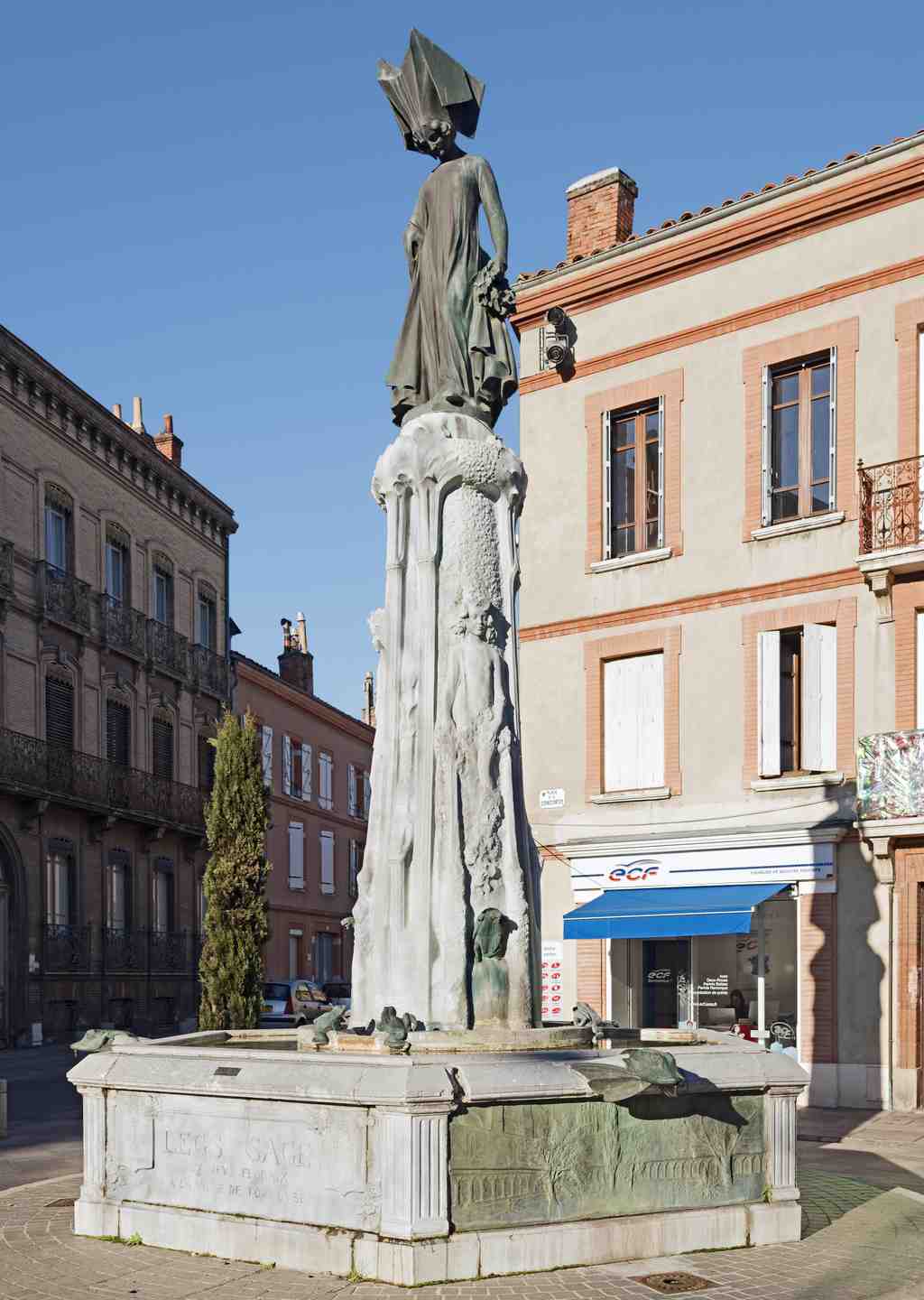
To spot the Fontaine Clémence Isaure, just look towards the center of the square-rising above the fountain’s pool is a tall, marble column crowned by a striking bronze lady in a flowing gown, wearing a dramatic, pointed headdress that no one in Toulouse could possibly miss.
Alright, here we are, at the heart of Place de la Concorde, in front of Toulouse’s most poetic-and debated-fountains: the Fontaine Clémence Isaure. Take a moment and let your eyes wander up from the marble basin, past the fantastically detailed frogs, turtles, and blooming flowers, and follow the slender, geometric column to meet the lady of the hour herself. You can’t overlook her; she’s the one in the soaring, almost comically large headdress! Some say it looks more fit for a wizard at a carnival than a legendary muse, but that’s half the fun.
A little over a century ago, in 1905, a local pharmacist named Octave Sage made a generous donation to build this fountain-what a way to make your mark, right? It was meant to be both beautiful and useful, a place where nature, art, and the people of Toulouse could meet. In 1910, the search for an artist began, and Léo Laporte-Blairsy was chosen, though not without some drama. His first proposal, with Clémence Isaure’s head uncovered, was rejected by the townsfolk-Toulouse takes its legends seriously! Rumor has it, Laporte-Blairsy added the enormous hennin, that tall pointy hat, as a bit of a sarcastic jab. Ironically, that’s the version you see standing before you now.
But here’s the surprise twist-this statue doesn’t actually have to look like Clémence Isaure at all! According to some, she’s simply a tribute to the poetry and beauty of Occitan culture, her delicate form and flowing dress representing the link between the earth and its people. A touch whimsical, a dash mysterious, and-naturally-a sprinkle of controversy. At her grand unveiling in 1913, many locals were absolutely scandalized. “That’s not Clémence Isaure!” they cried, remembering her statue in the Hotel d’Assézat. Even the bishop of Toulouse nearly put the brakes on the whole thing! But, with a little diplomatic magic, she won everyone over.
Wartime brought new suspense. In 1942, as bronze statues across Toulouse were snatched up for the war effort, Clémence Isaure was dismantled-but, in a plot twist worthy of a novel, she survived and was returned, untouched, after the war.
Now, this fountain has its own magical tradition: every New Year’s Eve, locals bring fresh, uncut flowers and float them in the basin, a silent poem of renewal. So, as you stand here, among the frogs and dragons, you’re not just looking at a work of art-you’re part of a living, ever-blooming story. Who knew a fountain could be this dramatic?




