
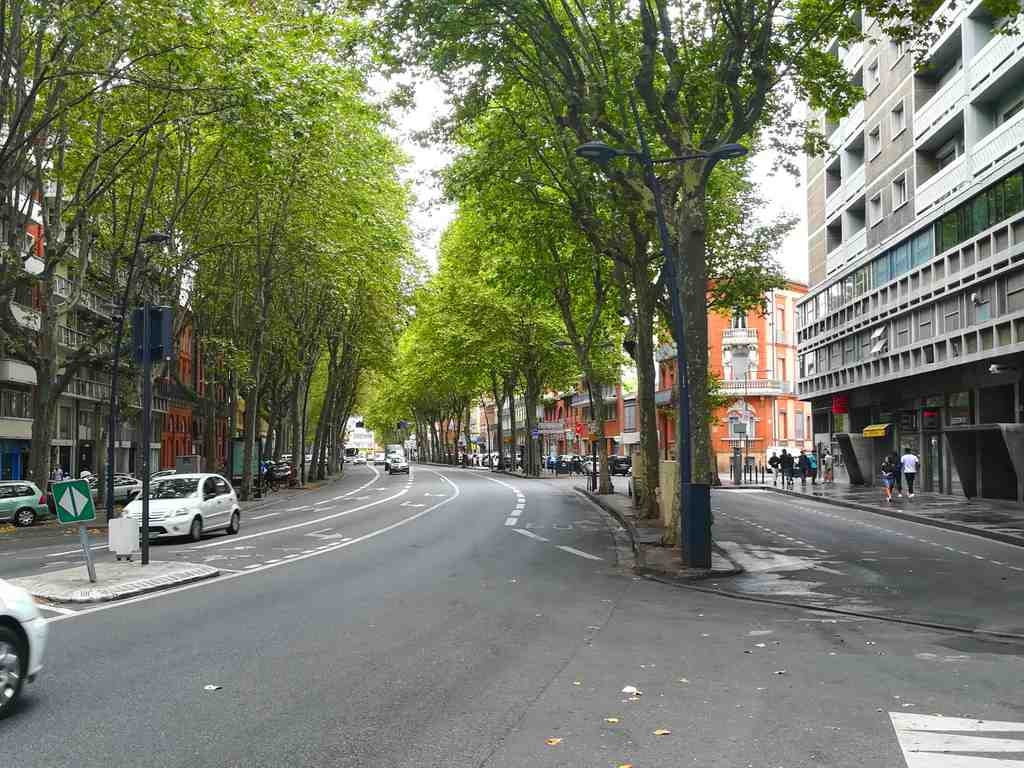
In front of you stretches Arcole Boulevard-a wide, gently curving street lined on both sides with rows of tall, leafy trees that almost kiss overhead, while striking red-brick and modern gray buildings hug the sidewalks; just follow the flow of cars under the green canopy to spot it.
Now, take a deep breath and listen to the life of this boulevard, where every building, every tree, and every echoing footstep comes with its own little secret. Imagine yourself here, north of Toulouse’s historic center, right on the border between the buzzing Arnaud-Bernard and peaceful Chalets neighborhoods. Back in the 18th century, if you stood where you are now, you wouldn’t see cars or shops, just a countryside promenade-a wide path peppered with market gardens, shaded by rows of sturdy trees, and bordered by two ancient gates: Arnaud-Bernard to the west and Pouzonville to the east. Picture couples ambling hand-in-hand, perhaps an accordion playing softly in the background, and the soft rustle of leaves overhead.
As time wound forward to 1815, Toulouse was growing-those city planners, always wanting to rearrange things!-and an architect called Urbain Vitry cooked up a grand plan: out with the old medieval wall, and in with a sparkling boulevard to smooth out the city’s wrinkles. By 1825, new life pulsed along these brand-new sidewalks. Sounds nice, but the name? Originally, it was the Boulevard de Pouzonville, named after the long-gone city gate near Rue Jean-Baptiste-Merly, but when 1840 rolled around, a brand-new story took center stage-or should I say, center street.
Let’s spice things up: Arcole, the very name you see on street signs today, carries not one, but two legends on its strong shoulders. Some say it’s the famous Battle of Arcole in Verona-where a young, gutsy Napoleon Bonaparte (before the hat got really big) snatched victory from the Austrians. Picture the noise, the shouting, the clash of bayonets, maybe Napoleon’s horse neighing in surprise. But hang on, Toulouse is a city of many tales, and another story tells of a young Parisian locksmith who lost his life fighting on the Pont de Grève during the July Revolution in 1830-his courage inspired his friends, and his name was later given to a bridge in Paris, and eventually right here, to this boulevard. Whoever the real namesake, there’s definitely heroism hidden in the street signs.
Keep looking left and right as you stroll-notice any grand buildings catching your eye? Take the Immeuble Citroën at number 2-2 bis, one of the city’s earliest tall buildings. When it first rose in the late 1950s, its modern concrete shape caused quite the neighborhood gossip. Sixteen stories high, this building-once home to the famous Citroën garage-is now filled with shops, offices, and apartments, each level a slice of Toulouse life. The lower floors are all swooping horizontal lines with shops bustling below, while the upper ones pull back, climbing up with elegant vertical lines like fingers reaching upward for the sunlight.
And just next door at number 4, you’ll spy an eclectic beauty with seven windowed bays and balconies dancing with ornate ironwork and geometric flourishes. Look for the majestic face of Hermes carved in stone, and the two muscular stone atlantes lifting an upper balcony like decorative strongmen in a circus act. If you find yourself smiling, you’re not alone-Toulouse’s architecture has always loved to wink at passersby.
Further along, there’s number 13-the École Élémentaire du Nord-whose walls have heard the laughter and whispers of generations of children since the 19th century. And at number 50, why not pause for a moment? This modest brick house, built in 1903, is a charming example of Art Nouveau decoration and leafy balcony ironwork-spot the tiny sculpted oak leaves if you can.
Keep your ears open and your eyes peeled! At number 56, legendary singer Claude Nougaro was born. Who knows, maybe if you stand here at night, you might just catch an echo of jazz and chanson floating out of old windows.
Arcole Boulevard is more than a street; it’s a living backdrop for revolutionaries, architects, schoolchildren, musicians and dreamers. So, whenever you walk under these leafy branches, remember: you’re part of the latest chapter in a story centuries in the making-one that still grows every day, just like these trees above your head.
Eager to learn more about the location and access, odonymy or the heritage and places of interest? Simply drop your inquiries in the chat section and I'll provide the details you need.




