
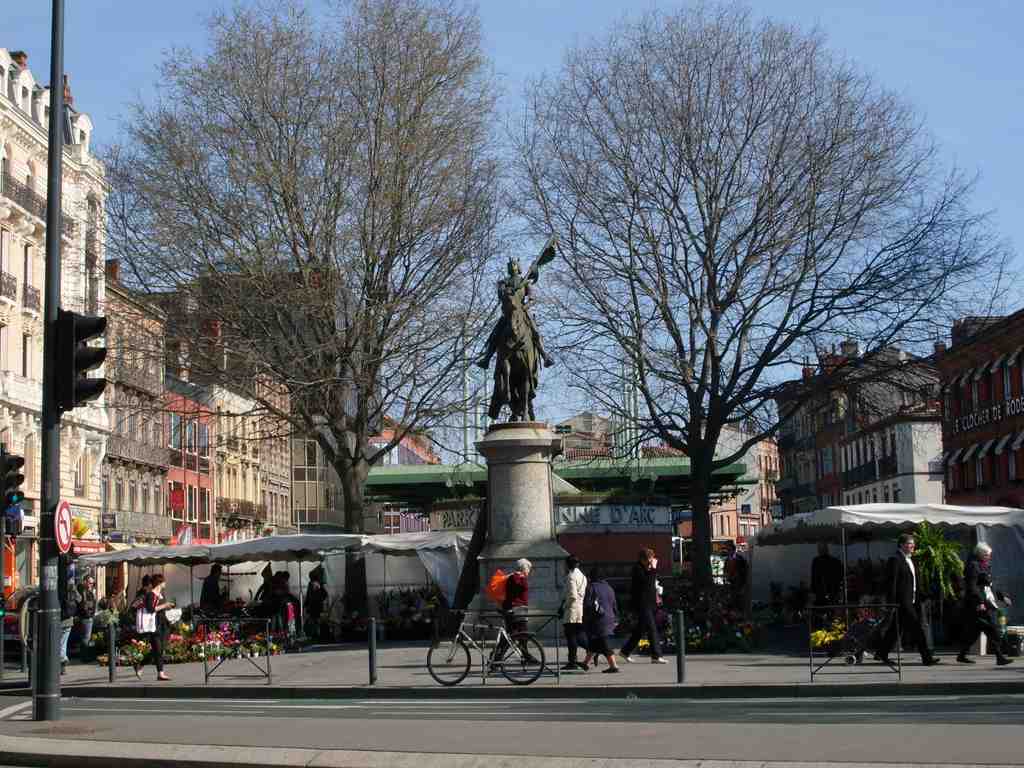
To spot Place Jeanne-d’Arc, just look ahead for a lively square with a striking bronze statue of a woman in armor on horseback atop a tall pedestal, flanked by leafy trees and surrounded by the hustle and bustle of market stalls and people on the move.
Welcome to Place Jeanne-d’Arc, a spot in Toulouse where history, legend, and everyday city life cross paths-sometimes more hurriedly than a bus at rush hour! As you stand here, take in the vibrant atmosphere: bicycles whizz by, buses rumble up to the curb, and market sellers chat with locals buying fresh flowers. There’s always something going on in this square, and that’s honestly how it’s been for centuries.
It’s hard to believe that, back in the Middle Ages, this area wasn’t a lively square at all, but a patchwork of fields outside Toulouse’s city walls. As the town grew, a new suburb sprang up around the nearby abbey of Saint-Sernin, and sturdy walls were built for protection. There was even a gate here called Matabiau-named after a rather brutal pastime: "mata buòu" in Occitan means "where the oxen are slain". So, yes, in the eleventh century, you probably would have been dodging cows on their way to meet their fate, rather than avoiding buses!
Fast forward to the 1800s, and Toulouse was transforming. The city planners wanted to open up the old medieval ramparts and let the city breathe. They created spacious boulevards lined with trees-one of which, the Boulevard de Strasbourg, leads right here to this square. At that time, the square was still just a modest market with livestock traded and an old water trough in the center. If you stood here in the nineteenth century, you’d smell sheep, see farmers haggling over prices, and probably hear a few grumpy oxen too.
Over the years, the face of the square changed again and again. By 1922, a new monument became the heart of this space-one that you can’t miss: the statue of Jeanne d’Arc herself. She stands proud on her mighty horse, in shining knight’s armor, holding her banner high and her face turned skyward, as if still listening for a message. Sculpted by the talented Antonin Mercié and cast in bronze by Ferdinand Barbedienne, she was welcomed by a crowd of 20,000 people on inauguration day, all hoping to catch a bit of the spirit of France’s most famous heroine. They say her monument became the rallying spot for everyone from bustling merchants to dreamy poets.
The square didn’t settle down when Jeanne arrived-not in the least! In the 1970s, the space became the nerve center of Toulouse’s urban transport: buses now snake their way around, coming and going, with people constantly hopping on and off. Under your feet, an underground parking garage was added in 1988, ensuring this place remains the beating heart of downtown.
The buildings around you whisper their own stories. That building at number 5, with its ornate stone arch and Renaissance revival flourishes, was designed in the early twentieth century-step up close and see if you can spot the carved leaves shaping its doorway. Across the square stands the modern façade of the Credit Agricole headquarters, a bold wall of glass and aluminum that hints at Toulouse’s forward-thinking spirit. And right at the corner, the Clocher de Rodez hotel stands proudly; its roots as a travelers’ inn go all the way back to 1805, when it served tired stagecoach passengers rather than business travelers.
But even as the square grew and changed, some traditions refused to budge. The market here, once dominated by sheep and cows, turned into a thriving flower market. On bright mornings, the scent of blossoms and the laughter of merchants fill the air, just as they have for generations. And all the while, between the rumble of the buses, the clatter of passing bikes, and the hum of busy shoppers, Jeanne d’Arc watches over her square, perhaps silently reminding passersby to be brave in their everyday lives-or at least to cross the street carefully!




