
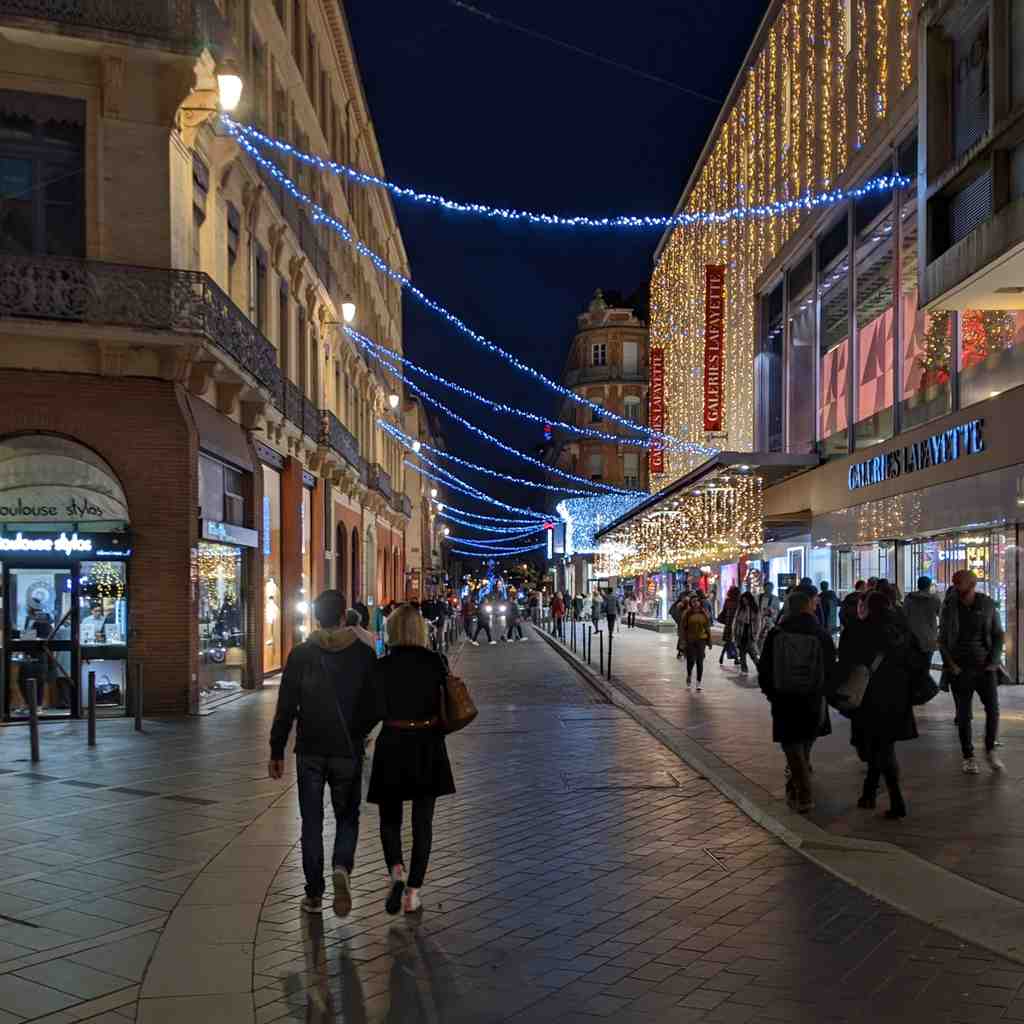
To spot Rue Lapeyrouse, look ahead for a lively, straight street lined with glowing shop displays and festive lights strung overhead, with the grand facade of Galeries Lafayette bright on your right.
Imagine you’re standing here in the heart of Toulouse, the evening air tinged with the excitement of city life. Rue Lapeyrouse stretches out before you-138 meters of elegant, rectilinear urban poetry, its cobblestones gently guiding your footsteps from Place Wilson to Rue d’Alsace-Lorraine. Today, the air hums with the sound of chatter, shop doors swinging open, and laughter echoing between the historic buildings.
But centuries ago, this street was almost a secret: in the Middle Ages, it was simply a nameless path, a shortcut for those in the know, winding from mysterious lanes like the “Ruelle des Imaginaires” toward the stone defenses that once protected Toulouse. If you could peel back the layers of asphalt beneath your feet, you might glimpse remnants of the Roman wall from the 4th century, still hidden in the cellars of number 9-a silent witness to vanished centuries and the city’s unending transformation.
Walk with me through time: in the 15th century, this was little more than “the path to Pla Montardy.” By the 1600s, a smoky auberge called Logis Delfum popped up at the corner-giving the lane its first real name, Rue del Fum, or “Smoke Street.” Rumor has it that travelers could hear the clink of dice and the thump of lively games drifting out from the gaming halls and grand hotels that sprang up, drawing the city’s aristocrats searching for amusement.
Yet change is always on the horizon in Toulouse. The Revolution swept through, and suddenly the lane was christened Rue Mucius-Scevola, named for a Roman hero who famously plunged his hand into fire to prove his courage. Picture it: fervor and pride, but also the tension of an era where names could change overnight, echoing the spirit of resistance and upheaval.
By the 19th century, the city’s visionaries were dreaming bigger and bolder. The grand Place Wilson was carved out, and Rue Lapeyrouse was extended directly toward it. New neoclassical buildings replaced the old inns, their brick and stone facades rising up in elegant lines, crowned with arcades and decorative ironwork.
The street’s most cherished tribute is found in its very name-a nod to Philippe Picot de Lapeyrouse, a man whose life reads like an adventure. Born here in 1744 to a family of ambitious merchants, Lapeyrouse began with the law but soon followed a different passion: the secrets of the natural world. An heir to fortune, he poured his energy into science, surviving the perilous twists of the Revolution-sometimes with trepidation!-and going on to found Toulouse’s first Museum of Natural History and the lush Jardin des Plantes.
He was a mayor, a baron, a scientist, a freemason-both celebrated and hunted, as political winds shifted between revolution and monarchy. In 1815, during the White Terror, he was forced to flee. Imagine the tension in the air, the hurried packing, the regret at leaving his beloved city. He died in 1818, far from the bustle of this street now named in his honor.
There’s another layer to Rue Lapeyrouse’s story-its architectural marvels. See the imposing Galeries Lafayette on your right, its modern lines a testament to 1960s ambition, with its curving travertine and generous glass welcoming shoppers under bright lights. Once, a panoramic rooftop bar here let visitors sip drinks high above the city, gazing across Toulouse’s red rooftops. Even now, the rooftop restaurant, ‘Ma Biche sur le Toit,’ draws those hungry for views and stories.
Look to the north and you'll find buildings where neoclassical style meets tradition-arcaded shops at ground level, tall windows framed by sculpted balconies, each ornament telling a silent story of Toulouse’s prosperity in the 1800s. Some are listed as historic monuments, their facades and roofs preserved with care.
As you stand here on Rue Lapeyrouse, feel the hum of centuries. Aristocrats and revolutionaries, merchants and modern shoppers-all have left their footprints in this busy, beautiful stretch of the city. If you listen closely, you might just hear their whispers carried on the evening breeze, sharing secrets from every era of Toulouse’s rich, restless history.




