
Look around for a large, circular square surrounded by harmonious brick buildings and shady trees, with a carousel and fountains at its center-this is Place Wilson, often bustling with people, music, and laughter.
Take a moment right here: in the heart of Toulouse’s Saint-Georges neighborhood, you stand at Place du Président-Thomas-Woodrow-Wilson. It might seem like any lively city square, but under your feet, history runs deep like the Garonne. Imagine the sound of students chatting at late-night cafés, the clink of coffee cups, and the distant hum of cinema-goers bustling to the theaters. This has always been a place where life pulses, whether you’re catching the Ville shuttle, hopping off the Metro at Capitole, or grabbing a bike at a VélôToulouse station.
But this square hasn’t always been called Place Wilson. It might surprise you, but for centuries-from the days of the medieval Villeneuve family to more recent times-it’s played a dramatic role in Toulouse’s story. Back in the Middle Ages, the mighty Villeneuve family had their tower around here, linked closely with the city’s rulers. In 1216, Simon de Montfort met with the city’s consuls right on this spot as his army besieged Toulouse. Try to picture the city walls, just outside the gate known as Porte Villeneuve, the distant clang of armor, and whispered negotiations.
Fast forward a few hundred years to 1562: war shakes Toulouse. Protestant fighters are forced from the city through that same ancient gate, led away after fierce battles at the nearby Capitole. To keep them out for good, Catholic townsfolk seal the gate and install a statue of the Virgin Mary-Notre-Dame du Rempart-to stand as a guardian and, perhaps, a warning to anyone who might threaten the city’s peace.
As Toulouse grew, the square changed along with it. In the late 1700s, carriages rattled over cobblestones, causing chaos and accidents as drivers came to pay tolls at the Capitole. The city decided to solve the problem: in 1783, a new vision began. An ambitious architect, Jacques-Pascal Virebent, drew grand plans for a double square-one “inside” the city, one “outside”-divided by a monumental gateway. Work stuttered-wars and revolutions kept breaking out-but by the early 1800s, teams of workers finally tore down almost 300 meters of medieval wall, sculpting the Place into its modern shape.
Names here have come and gone like changing tides. It’s been Villeneuve Square, then Angoulême after the nobleman who entered Toulouse in triumph with British Wellington’s army. Then came Lafayette, the hero of two worlds, after the winds of revolution swept the monarchy away. Later, politics shifted again-a column was almost built here to celebrate “restored liberty”-but plans changed, rulers changed, and by the end of World War I, the square was officially named for Woodrow Wilson, honoring the US President who allied with the French and stood for peace after so much conflict.
But Place Wilson hasn’t just lived in the world of politics. In 1876, the ornate Square Lafayette was built in the center, once dazzling with iron railings and crowned by the sculpture of Moses breaking his chains. Over the years, the garden grew crowded with trees-look around for a cypress from Virginia, a female ginkgo, an American red oak, tulip trees, and even a weeping cedar whispering in the wind. In spring, the air smells green, and when you close your eyes, you might imagine the splash of water from the central fountain and the call of birds overhead.
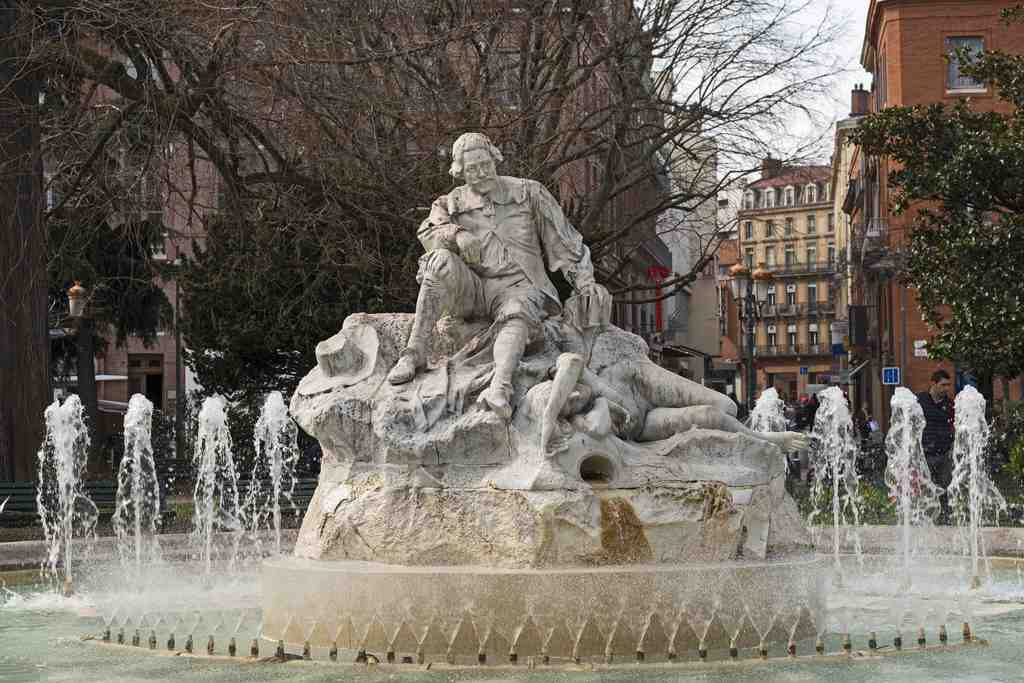
Right at the heart of all this is the Monument to Goudouli, Pèire Godolin, a beloved poet. This marble statue, finished after many delays in 1908, shows Godolin resting with his hat and book, a gentle smile on his lips, beside an enchanting nude figure pouring water from an urn-she’s the Garonne, the river that’s always been Toulouse’s lifeblood. Children play around the fountain, lovers meet on its benches, and time seems to linger, just for a moment.
War scarred this place too: during World War II, there were plans to move the Goudouli monument to the Jardin des Plantes, but the people of Toulouse objected fiercely, determined to keep their poet in the city’s heart.
The square also features a bust of Armand Silvestre, another son of Toulouse, sculpted in gleaming white stone. And in the winter, the branches here gather soft fog, while in summer, the square is all light and music.
Finally, look for the carousel, a more recent arrival in 2007, but already beloved, with painted horses circling in a blur of color and laughter-a final note in the ever-evolving song of Place Wilson. Here, centuries of memory, poetry, and joy mingle in the air, inviting you not just to pass through, but to pause and be part of Toulouse’s living story.




