
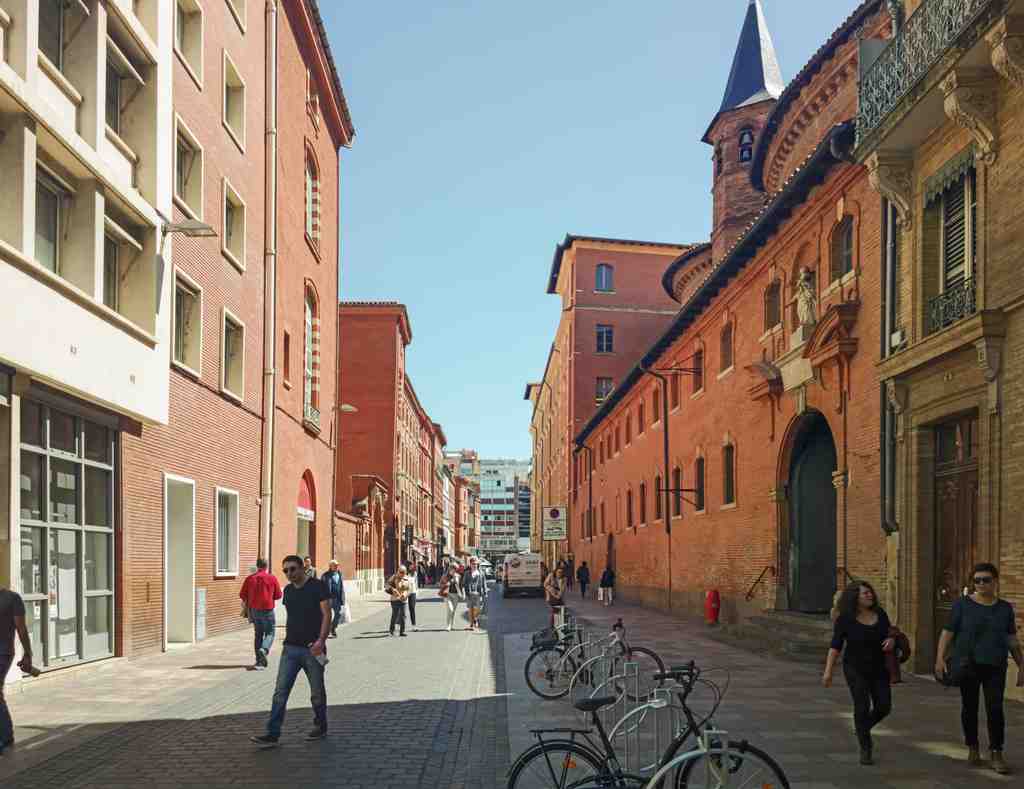
To spot the Rue du Lieutenant-Colonel-Pélissier, look ahead for an unusually wide street lined with tall, reddish-brick buildings and a row of bicycles, with an elegant pointed turret and old, arched doorways on your right.
Now, pause a moment and take in the living heartbeat of this street, a wide cobblestone ribbon that has welcomed the footsteps of everyone from medieval monks to 21st-century city dwellers. Right here, in the heart of Toulouse’s Saint-Georges district, you’re standing in a place where history has been written layer upon layer-much like the rich red bricks you see all around.
Hundreds of years ago, there was nothing but a simple, nameless path through a grassy field known as the Pré-Montardi. Imagine the breeze rustling through tall grass, only a solitary cart or two creaking by. In 1508, the city leaders, known as the capitouls, decided to carve out a grand street, wide and straight-a rare luxury in Toulouse-hoping to draw in important townsfolk and illustrious new buildings.
As you look up and down the street, you might catch the grandeur of the past: stately facades and elegant windows rise above shopfronts and doorways. At number 3, the Hôtel Caulet-Rességuier stands as a silent witness to this transformation. Built at the end of the 16th century, it began as the residence of Jean-Étienne Duranti-a man whose name echoed in the halls of parliament, before meeting a tragic end during the Wars of Religion. Later, this mansion became home to powerful financiers and, in the next century, gained a classically styled face as tastes and fortunes changed.
But even deeper stories are carried in these walls. Picture the 17th century: the air fills with the somber procession of the Pénitents bleus, an influential brotherhood in their blue robes, gathering in the chapels they built for both prayer and prestige. You can still see the monumentally classical façade of their chapel at number 10, marked with polychrome bricks, stone pilasters, and a watching angel above the portal. This brotherhood drew in not only local leaders, but cardinals and judges, even tying Toulouse tighter to the fate of France's great families.
Music and laughter once echoed down this street. In the days of Louis XIII, Mathelin Tailhasson-the “king of violins”-lived at what is now number 7, dazzling audiences with his music. There were royal tennis courts too, grand halls for music and theater, including the city’s very first opera house, whose walls once heard the clapping of hands and the chatter of marionettes. One fateful night in 1748, flames devoured the opera, but the people rebuilt, determined that art would always have a home here.
That spirit of change didn’t stop. The Revolution swept through in 1790, expelling monks and shutting down brotherhoods. The chapels were repurposed, the opera became a civic center. Soldiers marched in as the barracks took over, and in the 20th century the city’s pulse grew ever busier, with the whir of sewing machines from boutiques and the clinking of glasses in brasseries.
But perhaps the street’s most touching echo is its name, honoring Lieutenant-Colonel Louis Pélissier-a local hero of the French Resistance. In World War II, from the very offices on this street, he orchestrated acts of defiance against occupying forces, risking everything for freedom. He was executed in 1944, but Toulouse gave him a hero’s farewell, and his story still lives in every brick.
If you close your eyes for a moment, you might hear layers of the past blending together-church bells, carriage wheels, the call of children, solemn processions, and triumphant brass bands celebrating liberation. Each sound, each brick, and each shadow on Rue du Lieutenant-Colonel-Pélissier reminds us that every corner of Toulouse has its secrets, waiting for you to imagine them brought vividly to life.




