
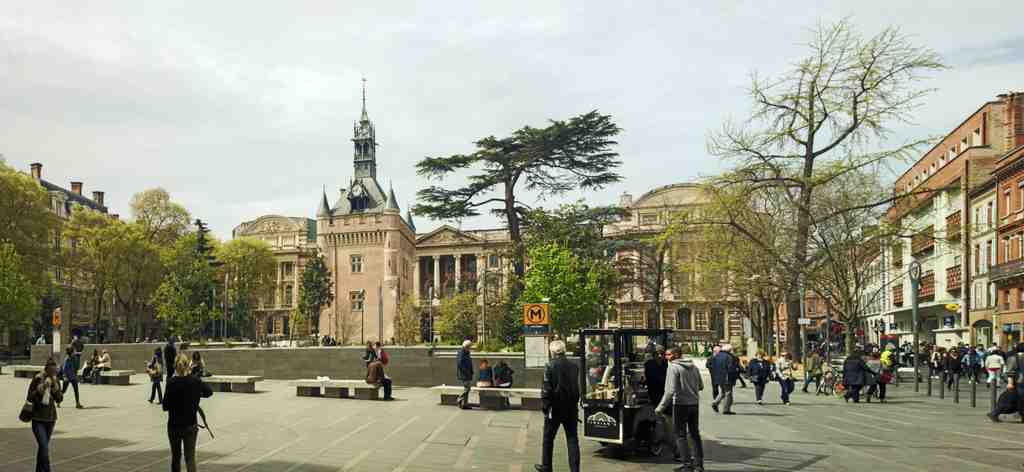
Directly in front of you, the Square Charles-de-Gaulle opens as a wide, elegant plaza, framed by leafy trees, smooth granite lines, and a dramatic historic building with a pointed spire-the Capitole’s eastern tower-rising just beyond the public benches and bustling crowd; simply face the open space with the building’s decorative façade and tall clock tower to find your bearings.
Now, take a breath and picture the square not just as a modern gathering space, but as a pocket where the layers of Toulouse’s story settle like dust-shimmering a bit in the sunlight. Right now, you might hear the low murmur of conversations, the clang of a coffee cart, and the shush of footsteps crossing the big gray stones. A few kids might be laughing near the fountain, and pigeons strut like they’ve always lived here.
But this place has changed shape many times. In the 1870s, city planners decided to carve a new road-Rue d’Alsace-Lorraine-straight through the medieval heart of town. Imagine the creak and crash as old buildings were cleared. The city’s Maison Commune, the old collective house, was torn down right where you’re standing, and part of its great stone doorway was carried off and rebuilt at the Jardin des Plantes. Even the ornate iron gates were removed decades later to make way for wide sidewalks. They wanted sunlight and open air, a square where the city could move and breathe.
And breathe it did! This new plaza became the centerpiece of the Capitole quarter, on a ground shaped like an irregular trapezoid, surrounded by busy streets-Rue Lafayette to your left, Rue Ernest-Roschach behind, Rue d’Alsace-Lorraine and Rue du Poids-de-l’Huile crisscrossing nearby. Each name is a clue, a map of the tangled city. North of here, there’s even a spot dedicated to “Laïcité”-the secular spirit so deeply woven through French civic life; the very idea is celebrated here every December 9th, the day set aside for national reflection on secularism.
After the war, liberation swept all of France. In 1944, as the Nazis retreated and the Resistance stepped out of the shadows, this square received a new name to honor Charles de Gaulle-the towering general who called France to freedom on June 18, 1940, and later became the nation’s president. Imagine the electricity when de Gaulle himself visited Toulouse that very September. Since then, a granite monument bearing his face and the Lorraine cross has stood here-silent but powerful-reminding everyone who walks past of how fragile and precious freedom can be.
Now, let your eyes wander to one of the square’s best-loved quirks: the monuments sprinkled through the space. Look for Jean Jaurès, the bronze figure with a story almost as dramatic as the man it honors. The statue was first raised in 1929, then faced a small tragedy-when the Germans needed metal during World War II, parts of Jaurès’ statue were melted down. Later, what was left-his head and some heroic reliefs-was worked into a new monument. But misfortune kept following: the head was stolen (twice!), hidden away, then replaced, lost, and replaced again. These scars are like wrinkles, telling stories of struggle as much as of peace.
You’ll also see the gentle sculpture called “Maternity” by Jean-Louis Toutain-a mother and child cast in swooping, modern shapes-right at the heart of the square. Touching it, you might notice some small damage; even art suffers the honesty of playground games and clambering children. The park caretakers have patched it up, but it’s a living thing, part of the city’s pulse.
And if you’re here when the sun is hot, children squeal in delight at the “dry fountain”-14 jets of water that leap right from the granite, sparkling and cool, no pool to splash in but irresistible nonetheless. Since 2015, grownups aren’t allowed to play in it-the stones get slippery and there were a few tumbles-but there’s something mesmerizing about the water anyway.
Finally, just pause for a second, and listen. The square is the city’s pulse: at your feet, metro trains hush and rumble below, cyclists zip past on VélôToulouse rides, and music sometimes drifts from the open cafés. And statues: don’t miss Claude Nougaro-Toulouse’s poet and singer-arms open as if to embrace the whole city, his words inscribed on his shoulders, still echoing with life.
All around, you’ll find gigantic trees-cedars, a sycamore, hackberries-that give cooling shade in the summer and golden leaves in the autumn. Through all these changes-the stones, the art, the laughter, the politics-Square Charles-de-Gaulle keeps changing and surviving, holding fast at the heart of Toulouse, each day adding just a little more to its tangled, beautiful story.




