
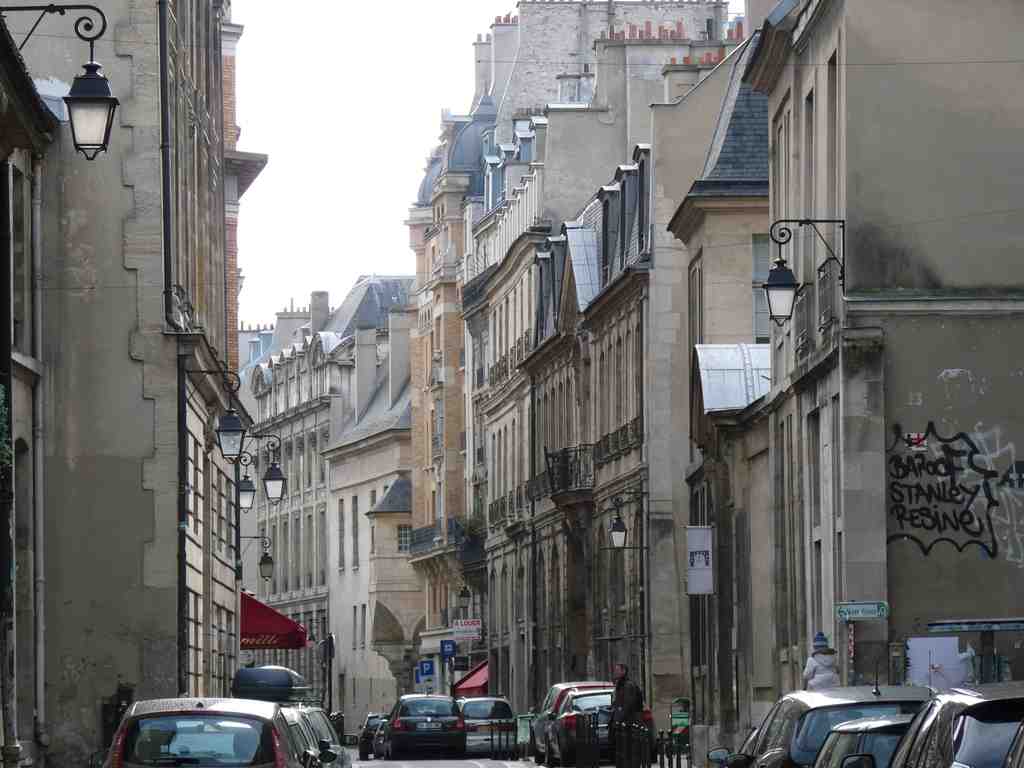
Just ahead, you’ll spot the Street of the Francs-Bourgeois stretching out with its row of elegant, cream-colored historic buildings on either side-just look forward and you’ll see its old Parisian lanterns dangling above the narrow, cobblestoned road, guiding your way.
Welcome to one of Paris’s most characterful streets-where every step feels like a little time machine! Imagine standing here centuries ago, the air filled with the clatter of horses’ hooves, the cries of street vendors, and perhaps a whiff of fresh bread from an old bakery’s oven. The Street of the Francs-Bourgeois goes back to the 14th century, even though some say parts of its backbone once bordered the legendary wall of Philippe Auguste, the city’s ancient ramparts. It wasn’t always so grand-in fact, its name tells a story of compassion and struggle: “Francs-Bourgeois” refers to the poor who once lived here, exempt from taxes because of their dire circumstances, housed in what were called “homes of alms.” So, Paris was already finding clever ways around the taxman!
Over the centuries, the street picked up all sorts of nicknames-a bit like an actor changing costumes-as trades moved in and out: it was once called “the street of pulleys,” thanks to the bustling weavers and their noisy contraptions. Picture it: the hum of weaving looms echoing off the stone, mixing with the laughter of children darting between trade carts.
And don’t be fooled by the street’s chic vibe today-with its stylish boutiques and luxury shops, it wasn’t always this fashionable! For a long time, the area was lined with workshops and industries. The street could be downright grimy, and there were plenty of locals who might have hesitated to stroll here at night. In fact, the zigzagging path you notice as you walk-the odd recesses and curious corners-comes from centuries of new buildings being set back from the old, thanks to 19th-century rules about street width. So much for straight lines in Paris!
Let your eyes wander up-see those grand old buildings, some with stately balconies and ornate stonework? Many of these are what the French call “hôtels particuliers”-the mansions of wealthy nobles and notable families from the 16th and 17th centuries. At number 8, you’d find the grand Hôtel d’Argouges, where the young Louis Daniel Beauperthuy lived when he was a student (no pressure for your own homework). Number 26 is the Hôtel Mortier, designed in the 1500s and jazzed up again in the 1700s-a genuine monument historique! If these walls could talk, they’d have gossip from royal times, revolutionary days, and the bustling 20th century.
There was even a caserne here, at number 12, once packed with gendarmes, maybe ready to chase down a villain or two. And at number 24… a somber marker reminds us of Isidore Kargeman and his family, deported during World War II-just one of the street’s many echoes of the city’s turbulent past.
A bit further along, you might notice the entrance to the Jardin de l'Hôtel-Lamoignon and the Hôtel Carnavalet. The arc at number 16 was brought here from the Île de la Cité and dates all the way back to medieval times-some people collect stamps; Parisians collect entire arches!
Even the local industry has a flavor all its own. At number 39, imagine a foundry, the Société des Cendres, where jewelers would bring their sweepings-yes, their scraps!-and the workers would sift out every last speck of precious metal. Today, the building's been transformed, keeping a bit of its mysterious industrial flair.
Now, here’s a twist for the book lovers and dreamers: at number 53, you’ll find the entrance to the beautiful Church of Notre-Dame-des-Blancs-Manteaux, while at numbers 35 and 37, the Maison de l’Europe and the Jardin des Rosiers hold secrets of poetry, music, and even some political intrigue from centuries past.
Over time, the street has rolled with the punches-absorbing neighboring streets, changing names with the tidal wave of history (for a time, it was even called “Street of the Free Citizens” during the Revolution; now that’s some PR glow-up!).
So as you walk, take in the clinking echo of distant footsteps, feel the shifting moods of centuries swirling around you, and imagine: merchants, noblemen, revolutionaries, even poets, all sharing this very stone path. The Francs-Bourgeois street is like a stage, and for a moment, you’re part of the show. Don’t forget to check for secret gardens and quirky doorways-they’re everywhere if you let your eyes wander.




