
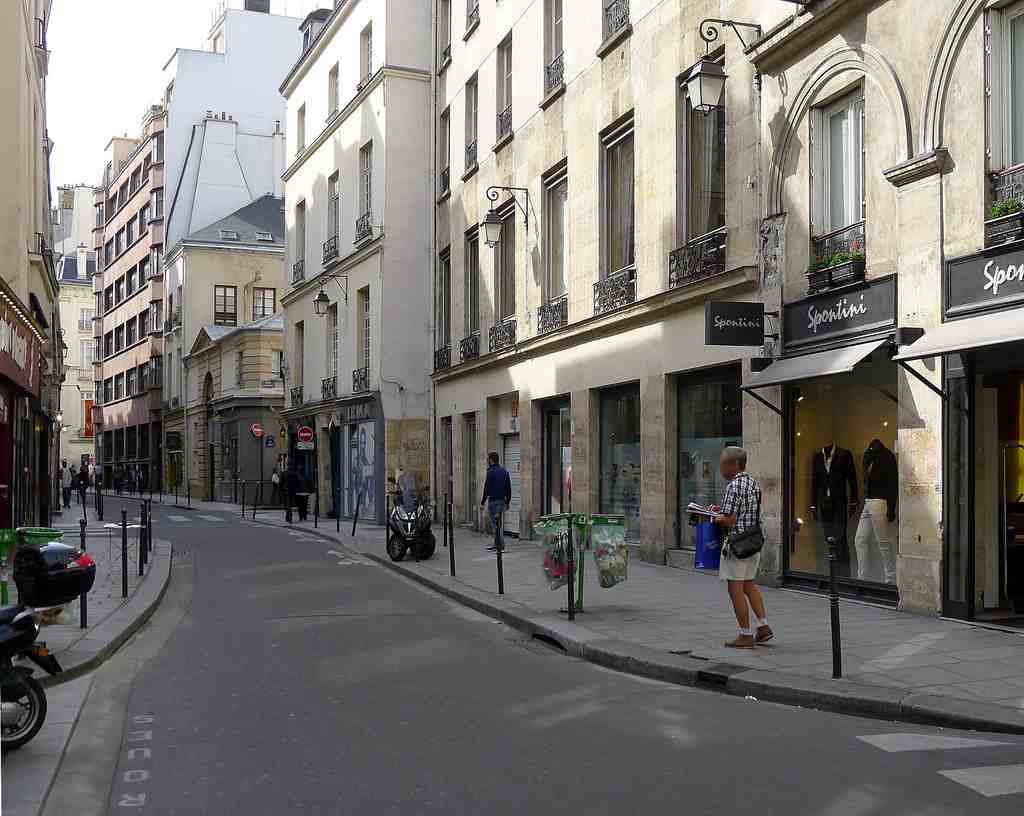
To spot Saint-Croix-de-la-Bretonnerie Street, look for the gentle curve in the narrow road lined with handsome stone buildings and quaint shopfronts, just ahead of you.
Ah, welcome to Saint-Croix-de-la-Bretonnerie Street! Now, before you start looking for lost monks or secret treasures (though, to be honest, this street probably has both), take a deep breath and listen. You’re now standing on one of the oldest arteries of the Marais, where every stone seems to whisper stories from centuries past. Let’s wander back in time together-no time machine needed, just imagination and maybe a comfy pair of shoes.
Picture this: it’s the 13th century, and Paris is full of mud, mystery, and the occasional monk on a mission. Right here, where you’re standing, a group of canons from Sainte-Croix, cloaked and crossing their hearts-literally, with embroidered crosses on their chests-set up a convent. They called it Sainte-Croix-de-la-Bretonnerie. If you squint, you can almost see them bustling around, eager to win favor from King Louis IX. According to an old tale by Joinville, the king was more than happy to help these pious newcomers, giving them shelter and a patch of land known as Carrefour du Temple, which would soon become Rue Sainte-Croix.
But wait, there’s more! The “Bretonnerie” in the street’s name isn’t just a fancy Parisian flourish. Long before even the monks appeared, this was a place known as “Champ aux Bretons”-the field of the Bretons. Why? Legend has it that on a stormy night in 1228, five Englishmen (not the best night for sightseeing, let’s just say) snuck into the orchard belonging to a certain Renaud de Bréhan, a nobleman with royal Welsh connections and possibly a short temper. With only a trusty chaplain and loyal servant by his side, Renaud was challenged by these English rivals. Swords clashed, shouts echoed through the stone gardens, and by sunrise, three Englishmen were no more. The place where this dramatic scuffle took place became the “Champ aux Bretons,” and soon the entire street wore the name with a bit of swagger.
By the time the canons arrived in 1258, they found not just a street but a patchwork of gardens, orchards, and scattered homes, all tucked safely inside the mighty walls of Philippe Auguste’s city. Over the next decades, their convent grew rich and powerful, a glittering beacon in the Marais. By 1314, the street had its full, elegant name-Saint-Croix-de-la-Bretonnerie. Picture grand homes rising along the cobbles, fashionable carriages rumbling by, and the air alive with the sound of bells calling the faithful to prayer.
Every century has left a mark here. In the roaring 17th and 18th centuries, this very street was dressed to impress with stunning private mansions and delicate little hotels, many of which still line the road today. Imagine hushed secrets traded behind heavy doors, and Parisian astronomers-like Joseph Jérôme Lefrançois de Lalande at No. 16-studying the night sky through smoky glass.
But fame here isn’t only about the elite; this street has played host to just about everyone: creative minds (like those at the legendary Les Mots à la bouche bookstore), chocolatiers (the Menier empire was founded at No. 37), and even brave botanists like Denis Dodart, who might have been your neighbor had you visited in the 1600s.
Of course, nothing lasts forever. After centuries in the spiritual limelight, the priory closed in 1778, its buildings swept away during the tumults of the French Revolution. In its place, the square you might glimpse ahead was born-a little patch of green where echoes of the past still linger. These days, since the 1980s, the street has reinvented itself, trading medieval drama for vibrant, joyful energy-it’s now a cherished center of gay Paris, bubbling with cafés, cheerful chatter, and just a hint of that old rebellious spirit.
So as you walk, listen closely-you just might catch the ghostly footfall of monks, the echoes of a midnight duel, or the faint crackle of Parisian laughter. This street has seen it all, and if you linger a while, perhaps it will let you in on a few more secrets before you wander on.
If you're keen on discovering more about the location and access, origin of the name or the historical, head down to the chat section and engage with me.




