
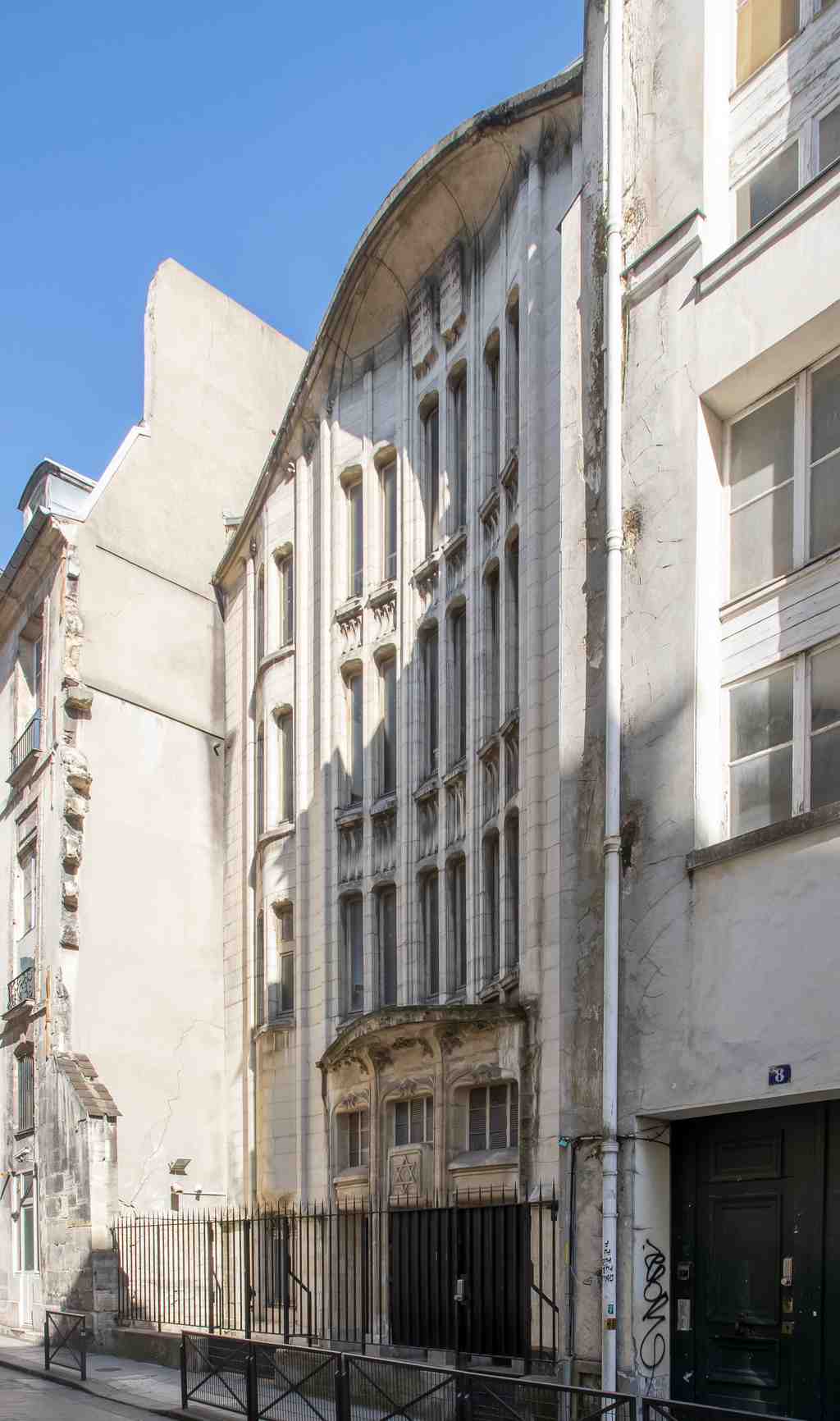
To spot the Pavée Street Synagogue, look for a tall, narrow building with art nouveau details, marked by vertical lines of windows and a gently curved roof, nestled closely between neighboring buildings at number 10 Rue Pavée.
Now that you’re standing right outside, let’s step back in time and imagine a scene that’s equal parts Parisian glamour and a sprinkle of mystery-because this is no ordinary synagogue. In fact, it’s the only religious building designed by the legendary Art Nouveau architect Hector Guimard, better known for the Paris Metro entrances! Picture it: The year is 1913. This street is buzzing with the footfalls of newcomers from the east, Russian Jewish families arriving in search of safety and community. Out of the very narrow plot-just five meters wide!-Guimard creates a stone building that seems to stretch up, up, up into the Paris sky, like a prayer itself.
This synagogue was not just a place to pray, but a bold announcement: Orthodoxy had made a home here in Paris. It was built for the Agoudas Hakehilos, an association born from nine Orthodox Jewish groups, and entirely funded by the community. On inauguration day, June 7, 1914, the famous cantor Gershon Sirota from Warsaw sang in celebration! Imagine the resonance of his voice filling the high, sunlit space-Guimard designed the interiors to soar with verticality, with two mezzanine levels flanking the main aisle, sunlight streaming through the glass roof and a grand window at the back.
Now, here’s a quirky touch: If you look closely, you’ll see the wavy Art Nouveau lines on the façade echoed in the design of the pews inside-triangles and undulating shapes everywhere! And though today there’s a Star of David above the entrance, in the earliest days only a simple triangle marked the spot-sometimes, Jewish symbolism had to stay subtle.
But this peaceful place has seen shadows, too. On the eve of Yom Kippur in 1941, tragedy struck. In the dead of night, as the city slept, collaborators dynamited this very synagogue-one of seven attacked that night by an extremist group allied with the Nazis. The damage left behind scars: the entryway was never completely restored to its original glory. Yet, like the spirit of those who worshipped here, the building endured-and was brought back to life.
These walls have absorbed a century’s worth of voices: the prayers of Rabbi Joël Leib HaLevi Herzog, the wisdom of Rabbi Rottenberg and his son, the melodies of hazzans like Elinke Hirschin and Zousman Pessine, who tragically perished in Auschwitz. Each left a piece of their story here, stitched into the very fabric of the city.
Today, the Pavée Street Synagogue still hums with life as an active Orthodox synagogue, though its doors stay closed to everyday visitors-unless Heritage Days roll around. And if the walls could whisper, they might share tales of survival, transformation and the gentle persistence of community in the heart of the Marais. So as you stand here, you’re not just at a building; you’re at a crossroads of memory and hope, with history looking you right in the eye. Now, ready for the next stop? Let’s keep exploring!




