
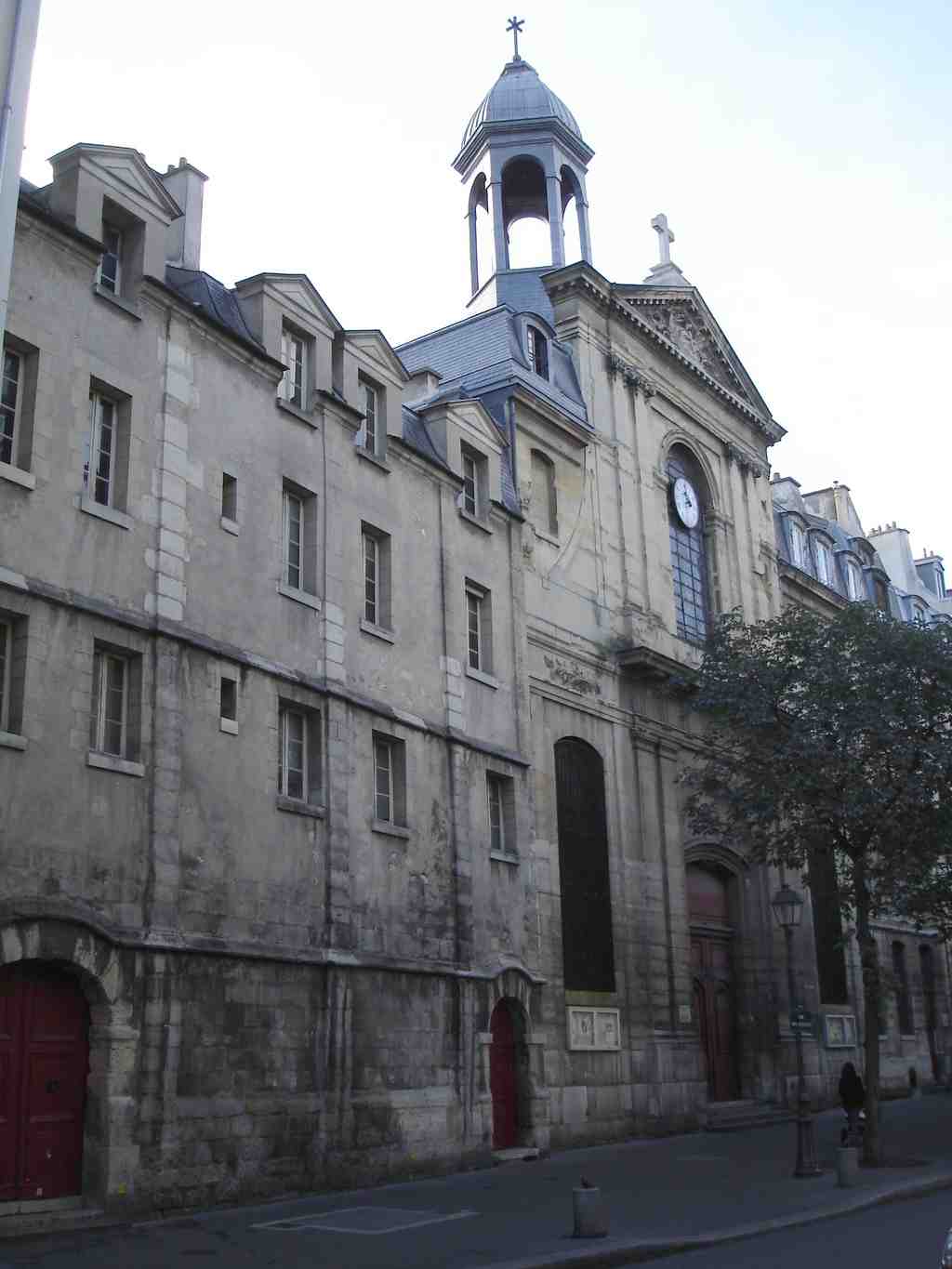
Look to your right and you’ll see a long stone façade topped by a slender bell tower with a cross, standing behind tall windows and beneath a distinct clock-welcome to the Cloister and Church of Billettes.
Now, get ready for a story that has a little bit of everything: miracles, mystery, royal drama, and a healthy dose of Parisian stubbornness. Let’s set the scene: imagine the year is 1294-Paris smells of wet stone and street vendors are calling out their goods. Right where you’re standing, a wild legend was about to take root. According to the tale, a man called Jonathas, accused of profaning a holy communion wafer, wasn’t about to get off with a slap on the wrist. As the story went, when Jonathas cut into the host, it began to bleed! Not one to be outdone, he supposedly tossed it into boiling water-and what happened next? The host floated up and flew! Whether or not you believe in miracles, this tale caused an explosion of religious fervor, and soon, a chapel-called the “House of Miracles”-was built right here.
The king at the time, Philippe IV, decided the land (taken from Jonathas after a very unfortunate day in court for him) could be put to better use. He handed it to Reinier Flaming, who then started the chain of buildings that grew layer by layer into the church you see now. Popularity bloomed; the place became a pilgrimage hotspot, and in 1405 a new, grander church was built, followed in 1427 by a cloister-so if these old stones could talk, they’d have at least six centuries’ worth of juicy secrets. One fun fact: that very cloister is the only surviving medieval cloister in all of Paris, a genuine time portal tucked inside the city.
Through the centuries, Billettes transformed and adapted. By the 17th century, the Carmelite monks, also called the Carmes-Billettes, had taken over. But, in true Parisian spirit, the neighbors-specifically, those at Saint-Jean-en-Grève just down the road-objected loudly every time someone tried to rebuild or renovate. Lawsuits, angry petitions, and years of negotiations followed. You could say Parisian bureaucracy has always been a thing; some things just never go out of style!
Let’s jump to the 18th century, when you’d have seen monks bustling about, heated debates in the Parliament of Paris, and a determined architect named Jacques Hardouin-Mansart de Sagonne-the last of the legendary Mansart architectural family-battling the neighbor’s complaints to rework the church. He borrowed ideas from his famous grandfather, adding classic touches like those “pots-à-feu” (those fire-pot finials) up on the façade and the palm decorations-keep your eyes sharp, you’ll spot mansart’s elegant style writ large against the sky.
During the French Revolution, everything changed. The church and its adjoining cloister were decommissioned and sold off, the monks scattered. But here’s a twist worthy of a novel: what was once seen as a miracle site and then a Catholic monastery, became a home for Protestants-this was a big deal because, before the Revolution, Protestants weren’t allowed to worship freely in Paris. For a time, they were hidden away in embassies or exiled to the suburbs; then came the Declaration of the Rights of Man, and soon after, this very place became a symbol of the newfound religious freedom.
In the 1800s, thanks to Napoleon, the Lutheran community was able to acquire the church, turning it into the vibrant Protestant parish it is today. Listen closely-if you were here in the 19th century you might’ve heard organ music rolling out the doors, French and German voices blending in hymns, and maybe the distant ringing of the church bell, gifted by a duchess. Even royal figures, like the princess Hélène de Mecklembourg-Schwerin, came here.
Modern touches keep the story going: a sculptor reinvented the altar in the 1980s, contemporary artworks now fill the cloister, and today, it remains a lively venue for concerts and exhibitions-a keeper of memories and a hive of creativity.
Take a moment to look up at the stately windows and that delicate bell tower, and let your imagination slip backwards-can you hear the echoes of monks’ footsteps, hopeful prayers, and maybe a medieval Parisian shouting, “Not on my street!”? The Cloister and Church of Billettes is one of those places where legends linger, and history is always just a whisper away.




