
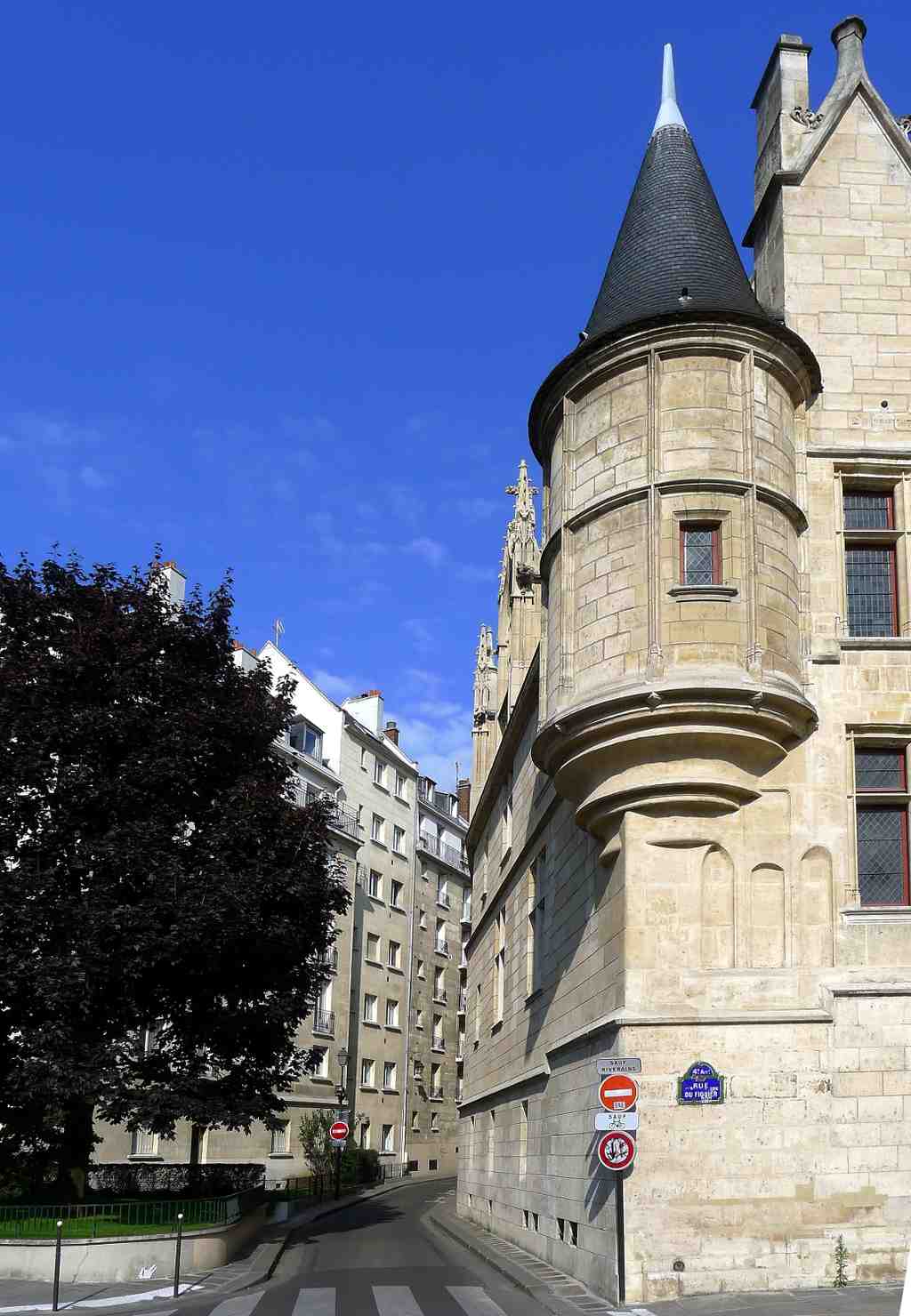
To spot City Hall Street, look for a narrow street edged with pale stone buildings, and keep your eyes peeled to the right-there’s a striking turret with a cone-shaped slate roof protruding from the corner, making the entrance hard to miss!
Now, as you stand at the edge of City Hall Street, let your imagination drift back-not just a few years, but centuries. This street, stretching nearly half a kilometer from the Hôtel de Sens to Rue de Brosse, follows more or less the same curve it has for 800 years, shadowing the great Seine and humming with echoes from every era Paris has seen. Let’s peel back the layers: the smooth stones under your feet have felt the patter of medieval boots, the clattering hooves of horse-drawn carts, the parade of religious processions, even the thunder of revolution.
This road didn’t always bear the grand title of City Hall Street. Back in the 13th century, it was first called “rue de la Foulerie,” thanks to the fouleurs, or fullers, who busied themselves washing and ‘fulling’ wool, using water from the nearby river. Later came the “morteliers”-no, not a band of nighttime assassins, as some dramatic storytellers claimed, but hardworking masons who specialized in making ‘mortiers’-huge stone troughs for mixing mortar. Their sweat and dust gave the street its long-held name: rue de la Mortellerie.
But the truth isn’t always just about bricks. In the Middle Ages, this sector was the lifeblood of a bustling village of fishermen and boatmen, flanked by tiny side alleys with such poetic names as rue du Paon-Blanc and ruelle des Trois-Maures. Picture it: the air thick with the smell of wet stone, the river’s mist mingling with the shouts of masons and the clanging tools of the men breaking rocks into dust for cement. Imagine religious processions weaving slowly from Notre-Dame to distant churches, winding their solemn way through the crowd and chaos.
The street has seen its share of shadows too. A devastating cholera epidemic swept through Paris in 1832, leaving heartbreak in its wake. Here in Mortellerie, out of fewer than 5,000 residents, over 300 lost their lives-an unimaginable heartbreak in a tight-knit community. The stories of grief and resilience echo in these very walls.
In 1835, the street got its more dignified name-rue de l’Hôtel-de-Ville-because if you keep walking, it leads you straight to the heart of Paris’s civic life, the majestic Hôtel de Ville. And yet, not all was peace. In June 1848, these stones were blasted and bloodied in the swirling chaos of revolution-imagine barricades rising where you stand, while the artist Ernest Meissonier captured the clash for immortality in his famous painting.
Things changed in the name of progress. Whole stretches of buildings and ancient alleys were swept away, like dust off a cobblestone, especially after the grim devastation of World War I. Streets that once connected to the quay disappeared, replaced by the grander, straighter roads of the modern city. Somewhere under your feet lies the memory of the old rue de la Masure and the deeply historic, but very narrow, rue du Paon-Blanc.
But City Hall Street is more than lost alleys and vanished masons. Look for house number 56-its cellar is officially protected for its age. At No. 62, the restaurant Chez Julien occupies an old auberge, still showing off an ornate 1820s cast-iron grill, and its painted ceiling will have you feeling like you’ve wandered into a storybook sky. Or peer up at No. 80, where the sundial and pediment come from another lost street, quietly ticking off the time as the city races on.
Even in its present-day hush, where you can hear your own footsteps, City Hall Street carries magic-a place where every stone, every shadow, has a story, and where the ghosts of masons, fishers, revolutionaries, and Parisians lost and found linger on. Welcome, friend, to a crossroads of memory and living history… where the city’s beating heart is never far away. And hey, keep your eyes open-a little Parisian magic might just be hiding in the next window!




