
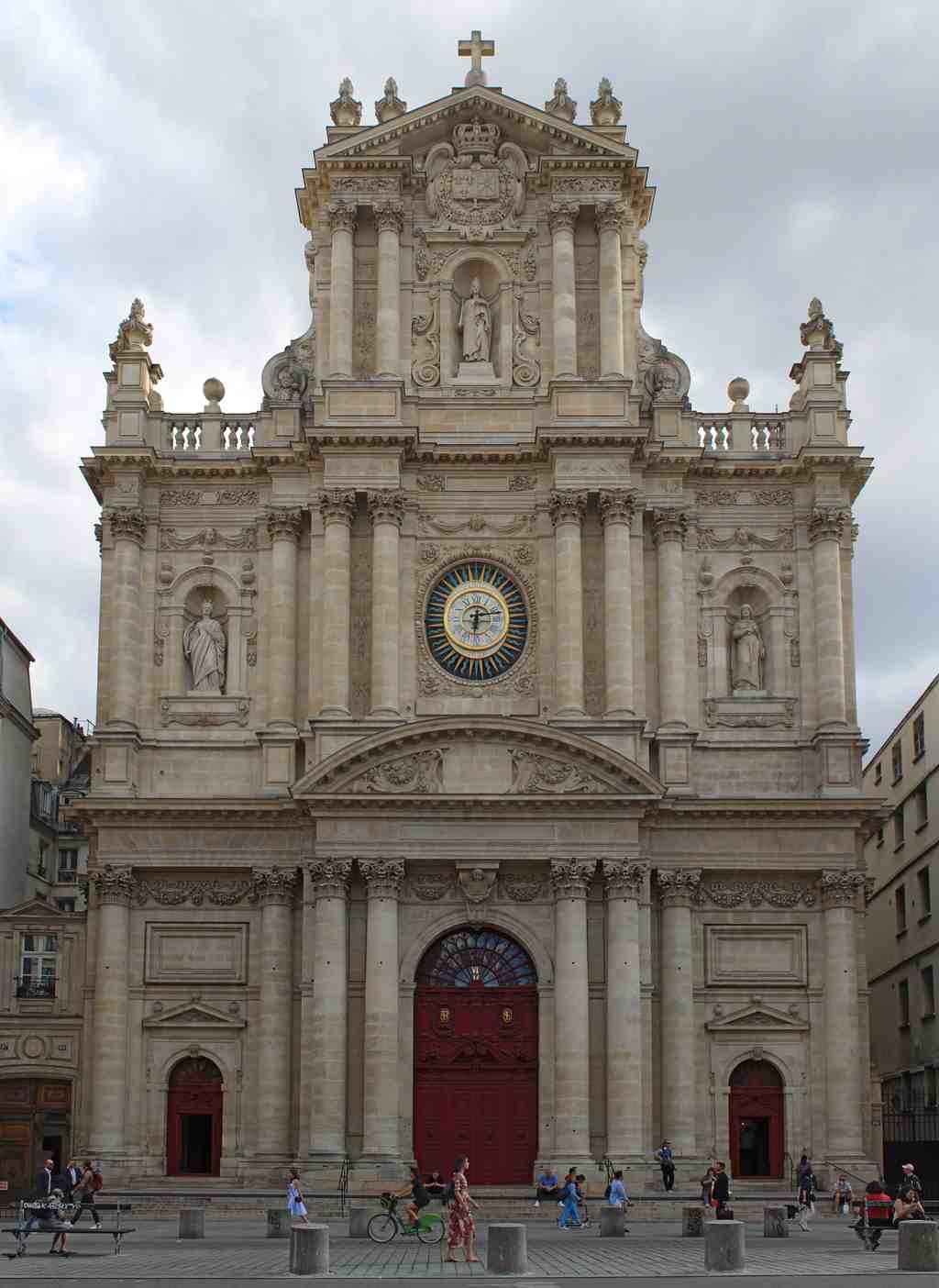
To spot Saint-Paul-Saint-Louis in front of you, just look for the grand stone façade loaded with carved columns, three statues gazing down, a golden clock at the center, and huge red doors right beneath-all stacked up like a cake designed by an over-caffeinated architect.
Now, step into one of the most dramatic chapters in Parisian church history! Imagine it’s the early 1600s-horses clop down Rue Saint-Antoine, and the Marais quarter isn’t quite as fashionable as today. Suddenly, a bold new church rises above the city’s rooftops. Built from 1627 to 1641 by two determined Jesuit architects, Étienne Martellange and François Derand, this marvel didn’t just settle for Gothic arches. Instead, they went all-in on the fancy new Baroque style-think more sparkle, more drama, and a whole lot more wow. It was the first in all of Paris to do this, and it sparked a trend hotter than Parisian bread at sunrise.
But before this, the ground beneath your feet was holy in a wilder way. An older church, Saint-Paul-des-Champs, stood here as far back as 1125, serving up baptisms for notables like Madame de Sévigné and attracting legendary locals like the chemist Antoine Lavoisier-until he sadly lost his head (and his church membership) to the guillotine during the Revolution. Behind it, a cemetery once teemed with whispers, holding the remains of everyone from François Rabelais to the architect François Mansart. Today, that’s all gone, but a scrap of the old wall still clings to existence next to the Lycée Charlemagne, like a historical hangnail.
Flash forward, and the Jesuits set up shop here, building this dazzling house of worship with Louis XIII himself laying the first stone-proving even kings enjoy a little DIY. The church was decked out for grand audiences: imagine Cardinal Richelieu saying mass on opening day, or the Jesuit preacher Louis Bourdaloue thundering from the pulpit and drawing crowds bigger than a Paris sale at Galeries Lafayette. The church quickly earned a reputation for soul-stirring music too, featuring future superstars like Marc-Antoine Charpentier and Jean-Philippe Rameau at the organ keys and choirs that made the stones tremble. In fact, the Jesuits here became the official “conscience directors” of France’s kings-talk about job security!
Oh, but no church in Paris gets to coast for long. The Jesuits had a royal falling out in 1762 and got kicked out, and the church got handed over to a different religious crew. Even so, it remained a secret treasure house for history: it once hid the hearts of Louis XIII and Louis XIV after the Revolution (no, not metaphorically-the actual hearts, sealed in urns!). The Revolutionaries stormed in and turned the church into a temple for their wild new “Cult of Reason,” and at one dark moment, the church witnessed the killing of five priests during the September Massacres-a memory still marked by a plaque.
Once peace returned, Saint-Paul-Saint-Louis reclaimed its magic, gathering up big-name artists too. Delacroix himself painted Christ in the Garden of Olives for the church. And right by the entrance, look for the giant clamshell holy water bowls-donated by none other than Victor Hugo after his daughter got married here in 1843. This place has seen both love and loss: just seven months after her wedding in this church, Leopoldine was swept away with her husband in a tragic river accident.
And while the exterior shows off its Baroque muscles-columns everywhere, statues almost stepping out to greet you, and a dome that was one of the first in Paris-the inside is pure theater. Flooded with light, shimmering with white stained glass (so much more upbeat than the medieval gloom), sculpture is crammed into every nook, and the paintings bring saints, kings, and martyrs to life. Every sound is rich and grand, especially when the organ lets loose-its pipes and pedals have survived revolution, restoration, and even modern wiring.
So take in those three statues above the door, the golden clock, and the sense that you’re standing where drama, beauty, faith, and ambition all collided-turning a once-middle-of-nowhere parish into one dazzling symbol of Parisian style and resilience.
If you're curious about the exterior, interior or the art and decoration, the chat section below is the perfect place to seek clarification.




