
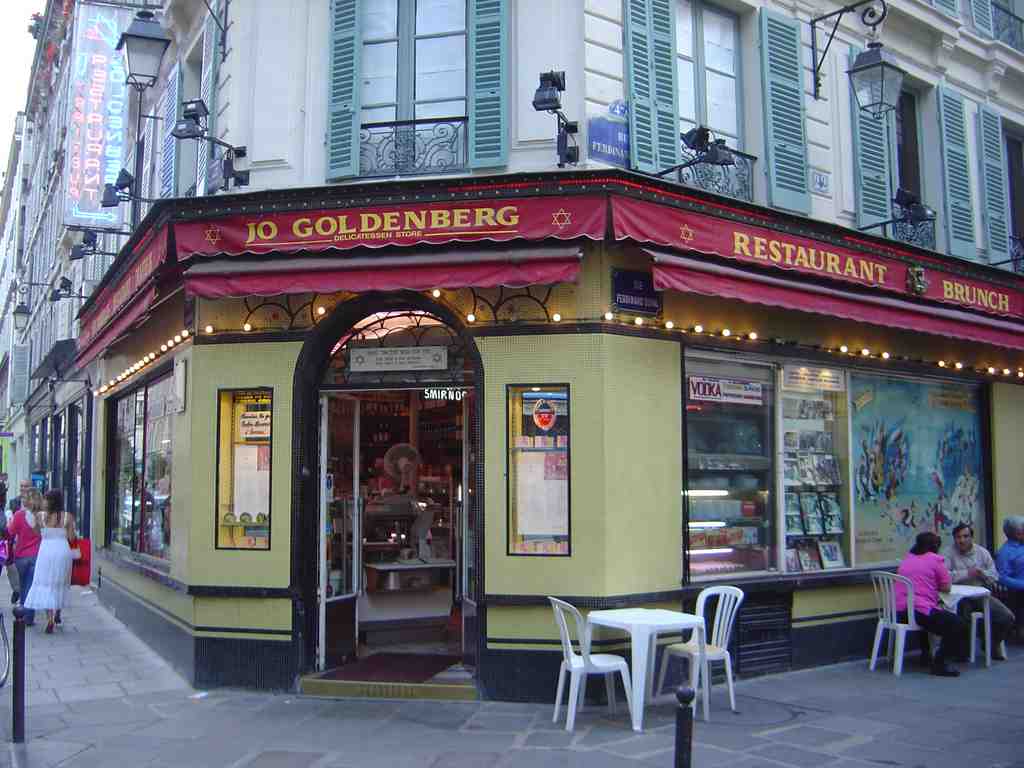
Look for the bright yellow corner building at the intersection, with a deep red awning and the words “Jo Goldenberg” above the entrance-it stands out with its large windows and little tables just outside.
Alright, my friend, you’re standing at a corner that looks cheerful-red awnings, shining lights, and colorful tables set out for lunch. But if you listen closely to the cobblestones beneath your feet, they’ll whisper one of Paris’s most intense secrets. Here, in the Marais’s bustling Jewish Quarter, you’re at the infamous site of the 1982 attack on Rue des Rosiers-right in front of what used to be Jo Goldenberg’s famed restaurant.
It’s a sunny Monday, August 9, 1982, and the scent of Central European Jewish cuisine drifts out the restaurant’s doors. Imagine about fifty hungry diners chatting and laughing, forks clinking on plates, the hum of Paris in the summer. Suddenly, a car screeches to a halt outside. The door flings open. Out steps a group-faces masked, gray suits, black bags slung on their shoulders. What happens next feels like something from a thriller, except the fear was all too real.
Two to five men burst inside, tossing a grenade into the middle of the dining room. A flash, a bang-panicked screams shatter the lunchtime calm, as chairs tip and glasses crash to the ground. As smoke fills the air, the attackers fire their submachine guns at diners and staff. Before anyone can react, a second grenade is hurled. The group bolts for the street, shooting as they go, leaving chaos and heartbreak behind-six people dead, twenty-two wounded, and a wound in the neighborhood that still aches today.
The scene spiraled into confusion. A courageous plainclothes policeman named André Douard, who just happened to be nearby, rushed in to help, gun drawn. In the midst of the panic, Marco Goldenberg, the owner’s son, tried to protect the restaurant by firing a hunting rifle out the window-but accidentally shot Douard, thinking he was one of the attackers. In less than three minutes, everything changed, and it left scars both physical and invisible.
At first, nobody was sure who was responsible. Some thought it might be a homegrown extremist group, others looked toward the Middle East. The investigation became a real-life detective story: shattered grenades, Polish ammunition traced back to a notorious militant Palestinian faction-the Fatah-Revolutionary Council, led by the mysterious and dangerous Abu Nidal. The weapons, the method, the cold “shoot and run” tactics-it all pointed to this group. They’d struck from Paris to Vienna, Brussels to Rome, all under the relentless leadership of Abu Nidal, a man with more aliases than a spy novel villain.
For years, theories buzzed around-some suggested even neo-Nazis might have been involved, thanks to a pair of German troublemakers passing through Paris. Portraits sketched, old photos checked, the mystery thickened, but by 2011, investigators were certain: the trail led back to the Revolutionary Council. They unmasked the team-code-named instructors, sharpshooters, planners-some living as far away as Norway and Jordan.
And here’s a little Parisian twist: for years after, if you looked closely at the windows, you could see the impacts from the bullets, tiny reminders of what happened. (They were, you might say, Paris’s most chilling version of “window shopping.”) In 2011, the city placed a new memorial plaque after the original vanished-proof that history in Paris can get misplaced, just like your friend after too much wine.
The attack sent shockwaves through France. President François Mitterrand came here to pay homage, but tempers were high-some blamed the government for not doing enough to protect the community. Mitterrand promised change, launching France’s first big anti-terrorist operations. Yet, even with new security, the attackers themselves seemed to vanish into thin air, smuggling themselves out of reach-until decades later, when international warrants caught up with a couple of them at last.
In the end, Jo Goldenberg’s restaurant-once a symbol of laughter and good food-closed, but the memory of August 1982 endures. Just imagine how the sounds of the past echo through these streets: the explosion, the shouts, the sirens, the voices of Parisians vowing never to forget. Today, even as cafés fill up and music spills from windows, look around and feel the pulse of Parisian resilience and remembrance.
And as you wander on, remember: every street corner in Paris has a story-some sweet, some bitter, and this one? It’s a powerful mix of both. Ready to keep exploring? Let’s go find some hope and history around the next bend!
To delve deeper into the attack, investigation or the on the sidelines of the attack, simply drop your query in the chat section and I'll provide more information.




