
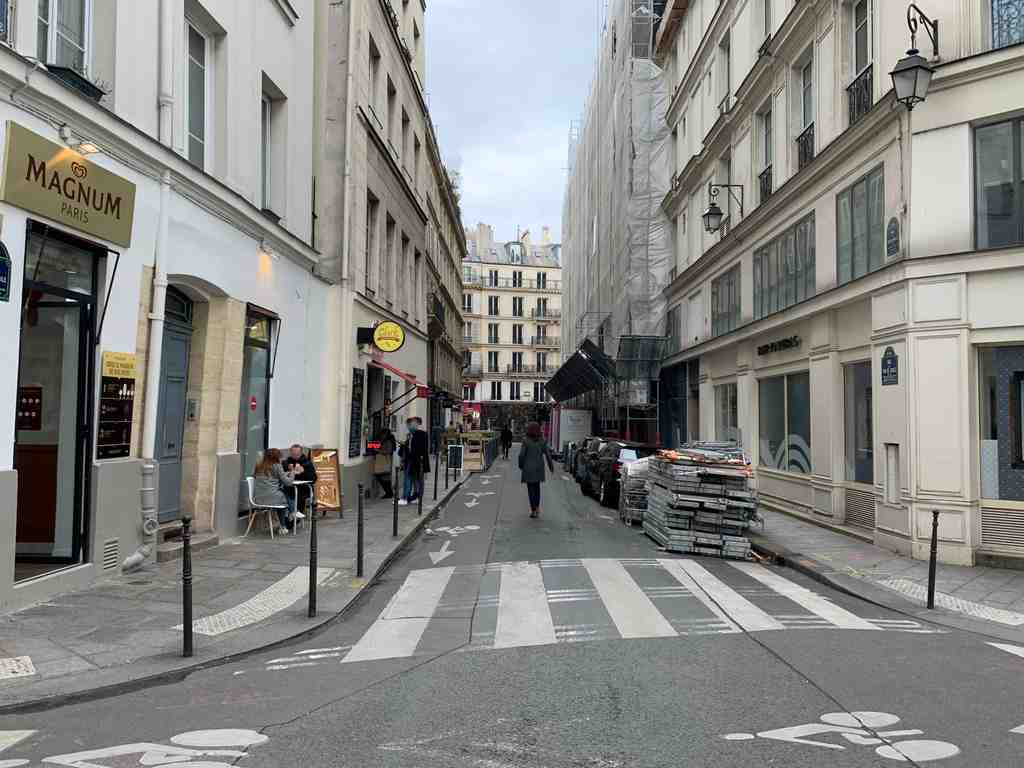
Right in front of you is King of Sicily Street-look for a narrow, winding lane lined with classic Parisian buildings, bustling cafes, and the unmistakable buzz of local city life stretching ahead.
Now, let’s step into the world of King of Sicily Street-don’t worry, you won’t need a crown or a sword, maybe just a good pair of walking shoes! Imagine this street over 700 years ago: no cars zipping by or families savoring ice cream at sidewalk tables. Instead, picture a gritty pathway, echoing with the sounds of horses’ hooves, merchants calling out their wares, and the faint scent of wood fires drifting from open windows. You’re standing on a route so old, it was already bustling back in 1261, making it one of the city’s ancient arteries that stitched together the heartbeat of medieval Paris.
And if the name “King of Sicily Street” sounds like something out of a medieval fairy tale, you’d be right on track. Its name harks back to Charles I, Count of Anjou and Provence, and-just to throw some extra glamour in-brother to the legendary Saint Louis. Charles wasn’t just another noble looking for property with a good view; he became King of Naples and Sicily in 1266, and built a grand hotel right here. Imagine elaborate banquets, golden goblets, and walls thick enough to keep out the Parisian winter. This fabulous residence stood along what was once the wall of the old Philippe-Auguste city fortifications-a stone reminder that Paris was a city always ready for a little drama.
Now, as centuries rolled by, this street wasn’t just a playground for royalty. At number 8 on this very street, you’d have found the legendary Cabaret du Gros-Pavé-a haunt that was famous enough to be captured by the photographer Eugène Atget in 1910. If you ever wondered where Parisians came for a bit of gossip, a glass of wine, and a hearty laugh, this would’ve been the spot. And at number 24, pause and glance upward-the building here, designed by Georges Debrie in 1898, still boasts its contest-winning Haussmannian façade with elegant balconies curling like mustaches above the street. Paris always did love a bit of flair with its architecture!
King of Sicily Street has worn many faces over the years. In the 17th century, it was a key trunk road that sliced east to west across the city, running parallel to the Seine and feeding directly into the famed Rue Saint-Antoine. But don’t let all this grandeur fool you-the street had a wild side, too. By the 18th century, its shadowy corners and twisting alleys had gathered enough criminal tales to fill a detective’s notebook. It popped up frequently in criminal investigations, the background to stories of intrigue that would make even Sherlock Holmes want to peek around the next corner.
And on the corner with Rue Vieille-du-Temple, you’ll find the former Hôtel de Vibraye. Today, it hosts a modern boutique, but if you look closely, you’ll spot a panel of mosaic from its days as a horse butcher shop-yes, with an actual horse on display. Paris might be a city of romance, but it’s never forgotten its carnivorous history! On the other side, at the corner with Rue Malher, once stood the massive prison La Force, a place so notorious that, when the crowds stormed the Bastille during the French Revolution, they didn’t forget to stop here and release debt prisoners for good measure. Later, the prison would echo with fear during the Reign of Terror before finally meeting the wrecking ball in 1845. Only a piece of the wall on Rue Malher remains, like the last page of a dark and gripping novel.
Through all its changes-being renamed Rue des Droits-de-l’Homme during the Revolution, housing hat-makers and artists, or lending its name to a 1950s novel-King of Sicily Street has grown up along with Paris. As you look down its length today, imagine the footsteps of poets, thieves, revolutionaries, royalty, and everyday Parisians before you. The air here isn’t just filled with city sounds; it’s alive with stories, secrets, and-if you listen closely-a lingering whisper from the past.
So go ahead, walk a little slower, glance up at the carved balconies and weathered plaques, and let your imagination fill in the missing centuries. Because on King of Sicily Street, history is just around every corner… and you never know if a king or a cobbler once stood right where you’re standing!
Intrigued by the location and access, origin of the name or the historical? Explore further by joining me in the chat section below.




