
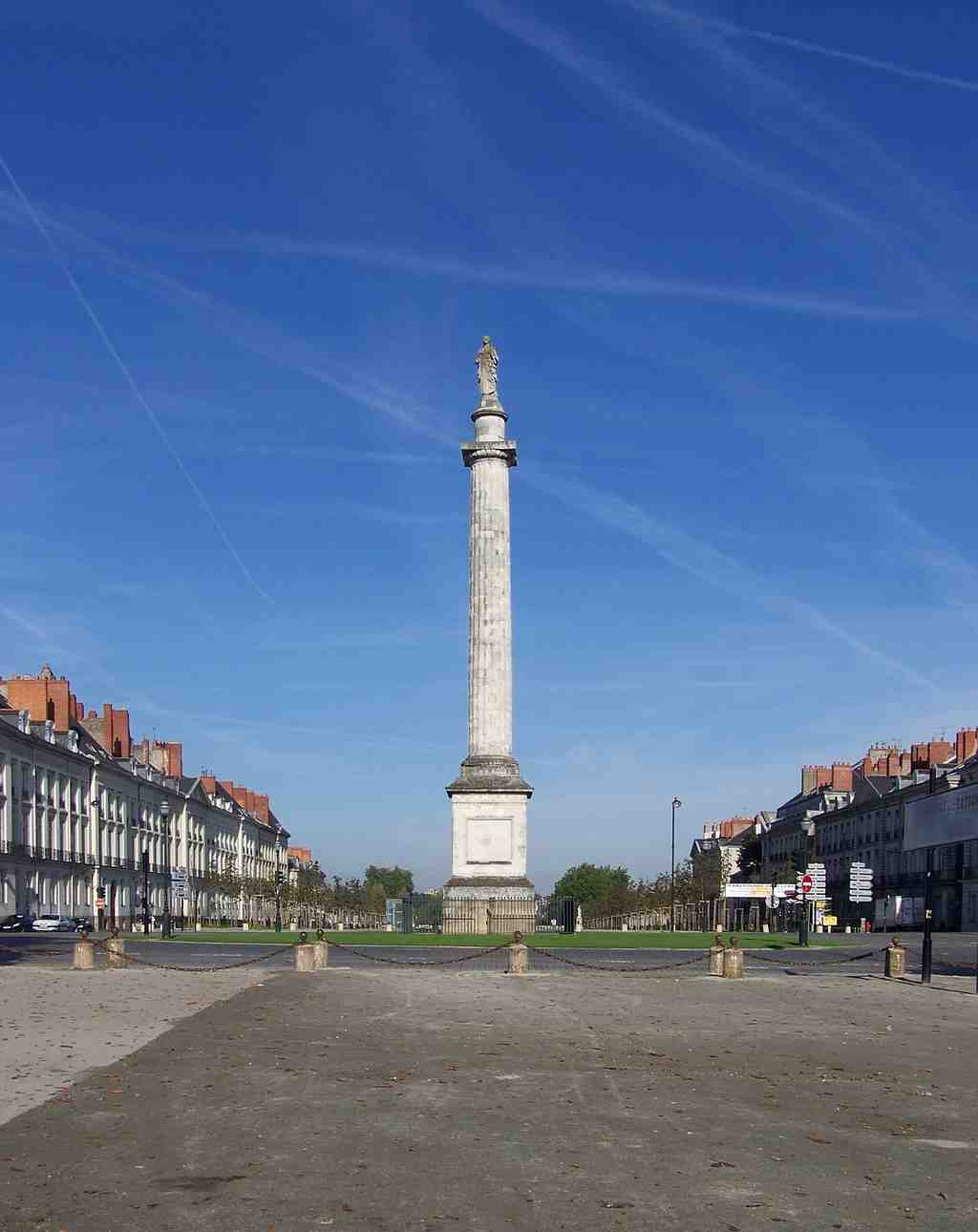
In front of you lies a broad paved square centered on a tall pale stone column, its straight shaft crowned by the unmistakable statue of King Louis the Sixteenth.
This is Maréchal-Foch Square, one of Nantes’ best-known open spaces... but it began as something much harder. You are standing on former defensive ground, the Saint-Pierre bastion - a bastion being a jutting part of a city wall designed to watch, defend, and fire outward. In the late eighteenth century, Nantes tamed that military edge and turned it into a link between the old city and the neighborhoods growing beyond it. So this elegant square is really a piece of fortification taught to behave like a salon.
If you glance at your phone, the aerial view makes that easier to feel: the square sits like a stitched seam between older Nantes and its expansion beyond the walls.
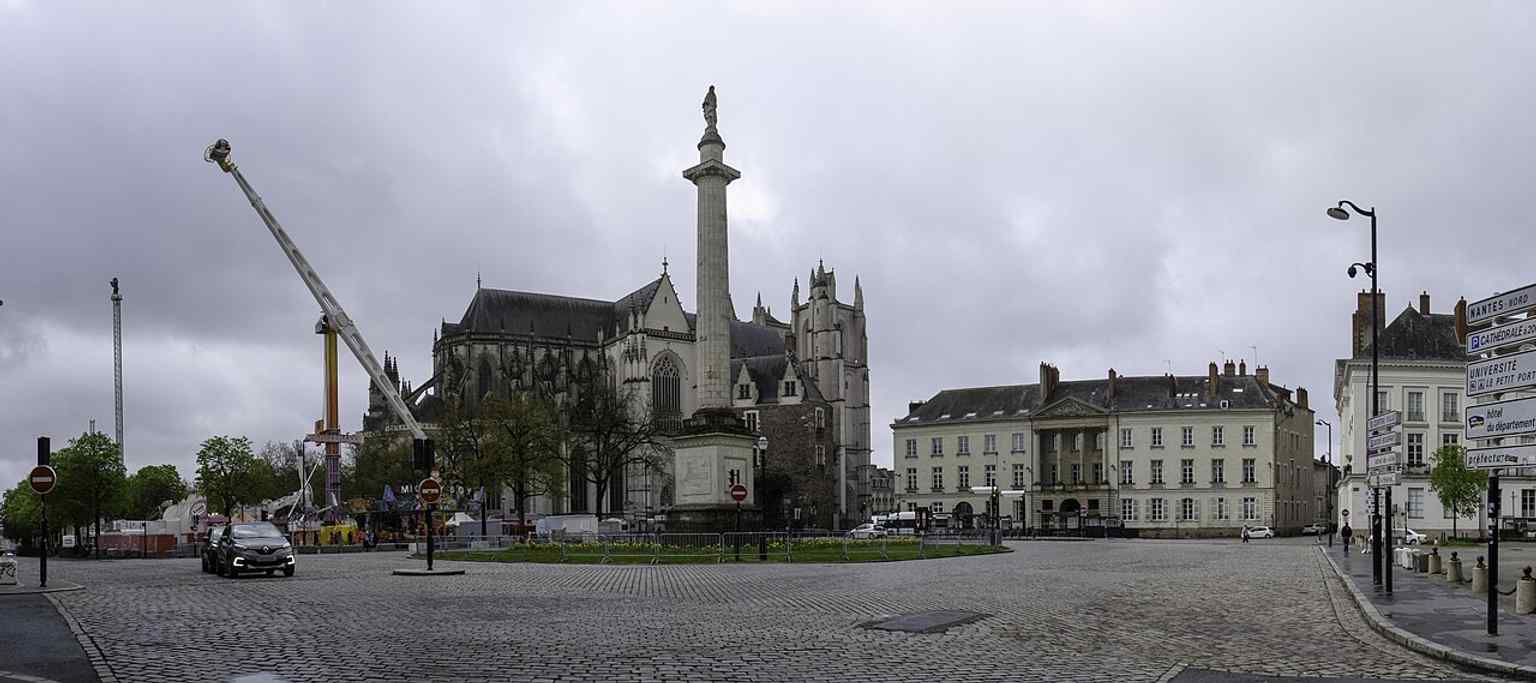
Its names tell an even sharper story. For years, people called it Place d’Armes - literally the parade ground, a military square. Under the Restoration, when the monarchy returned after Napoleon, it became Place Louis the Sixteenth. Then, in nineteen twenty-nine, the city council officially renamed it for Ferdinand Foch, the French marshal. But official names do not always win the heart. Many Nantais, especially older families rooted here for generations, still say Place Louis the Sixteenth without even thinking. Maps change faster than memory.
That tension rises right in the middle of the square, at the column before you. It began in seventeen ninety as a Column of Liberty. Think about that for a moment: a revolutionary monument, planted at the end of the eighteenth century. Then politics turned, and in eighteen twenty-three, under Mayor Louis-Hyacinthe Levesque, the sculptor Dominique Molknecht placed Louis the Sixteenth on top. The same stone stayed put, but its meaning changed completely. One historian called it a kind of palimpsest - a page scraped and written over again. In simpler words, the old message never vanished; a new one was forced on top of it.
People kept fighting over that meaning. Every twenty-first of January, monarchists gathered here to mark the king’s execution. In nineteen ninety-three, royalists and free-thinkers came one after the other to this same spot, almost taking turns in a small war of remembrance.
And the square has known real blood as well as symbolic battles. During the July Revolution of eighteen thirty, ten people from Nantes died here at the foot of the column on the thirtieth of July. A doctor in Paris, Monsieur Martin, felt their loss strongly enough to send the mayor a bronze memorial plaque. He made one strange error in the inscription: instead of honoring workers, it honored ploughmen. It is a tiny mistake, but a human one. Even grief, sent from a distance, can arrive slightly altered.
Look around the edges and the square keeps changing masks. The Hôtel d’Aux began as a private mansion for René-Louis d’Aux, then sheltered the National Institute, then welcomed Napoleon and Josephine in eighteen oh eight, and later served the army. Nearby, the Hôtel de Charette carried a darker burden during the Second World War, when locals knew it as the Gestapo headquarters. Aristocratic facades... terrible memories.
That is what this place does so well: it smooths over rupture without ever quite erasing it.
When you are ready, walk toward Nantes Cathedral, just ahead. There, stone grandeur and human violence meet even more openly than they do here.





