
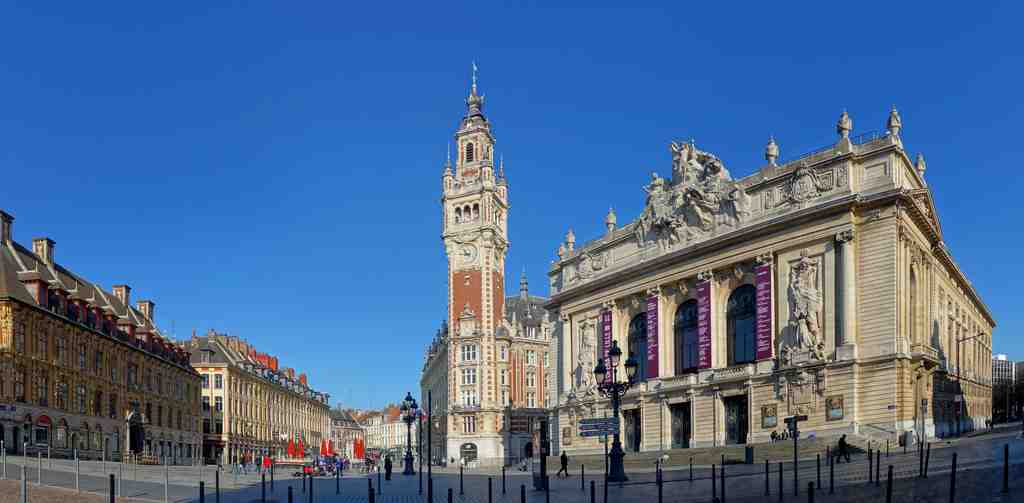
To spot Theater Square in Lille, just look ahead for a grand, cream-colored classical building with dramatic statues atop its façade and a tall, red-and-white clock tower beside it that rises confidently over the square.
Ah, here we are-welcome to Theater Square, smack in the heart of Lille! While the name might have you craning your neck for a classic theater with velvet curtains and grand applause, let me tell you a secret: the real drama here has already unfolded. So, picture this scene-centuries ago, you’d actually be standing in what was once a single sprawling square connected to the famous Grand’Place, right next door, before a quirky twist of urban planning set them apart. Back then, the square you’re standing on was called “Petite Place,” and the boundaries were marked out by clusters of wooden houses, busy medieval markets, and the chaotic shouts of traders hawking their wares.
Fast-forward to the 16th century: the city’s leaders decided to get serious and erected a “halle échevinale”-that’s a fancy way of saying town hall. It stood at the spot where the rue Faidherbe now pours into the square, complete with a stout belfry that must have looked like the Eiffel Tower to 1580s Lille. The city’s rulers migrated to the plush Palais Rihour by the 1660s, leaving the old hall to stand guard over the bustling Petite Place until it was bulldozed in 1870 to make way for the broader rue Faidherbe. But Lille’s not a city to go without a touch of flair-oh no, when the old fountain “au Change” disappeared during building works, they just put in another one. If you had been here in the 1680s, you’d have seen locals gathering for a splash.
The real plot twist came later, in 1785, when Lille got a brand new theater, its grand façade standing where the rue Faidherbe meets the square. Suddenly, the old Petite Place was divided in two-one half connecting to bustling shopping streets, the other reaching out to the future rue de la gare (now rue Faidherbe). This theater became the hub for centuries of entertainment, laughter, and a fair bit of drama-at least until 1903, when, in a scene fit for an opera, the theater burned to the ground in a spectacular fire.
But Lille is never down for long. With a determined spirit (and a taste for the theatrical), the city rebuilt, choosing not just to replace the charred remains but to upstage them. An opulent new opera house rose up nearby, set back to make the square even grander, while the New Stock Exchange joined its side. Picture yourself here in the early 1900s, freshly paved boulevards radiating out, tram bells clanging as the new tracks wound their way right into the square. By 1911, a triangle of tram tracks was at the center-imagine the screech of metal on metal and the lively buzz of passengers going about their day.
So as you gaze up at the soaring clock tower and the opera’s grand façade, take a moment to think of all the layers beneath your feet: medieval markets, vanished fountains, the roar of theater crowds, and the thrill of Lille reinventing itself again and again. Just don’t try reenacting the fire, okay? The city’s had quite enough drama for one square!


