
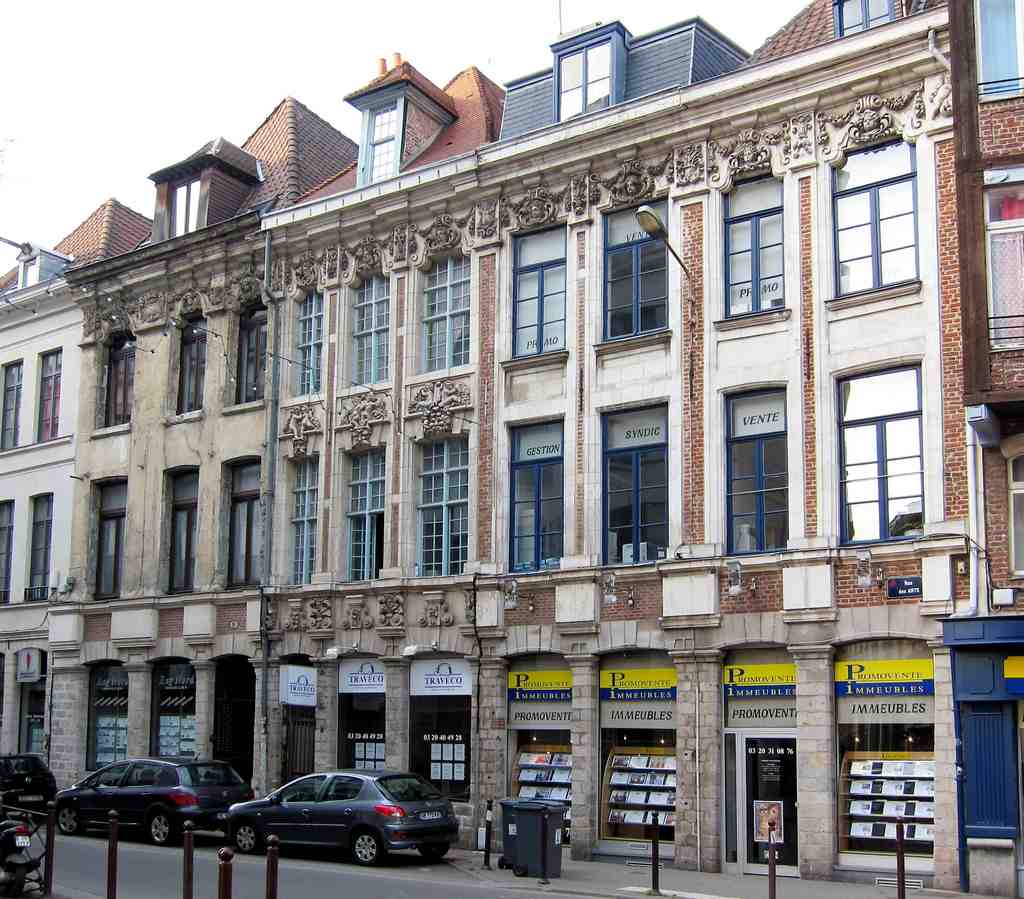
Right ahead, you’ll spot Rue des Arts by its striking row of old brick and stone facades, richly decorated with ornate carvings and tall windows-just look left and right for the elegantly sculpted buildings closely pressed together, some now housing real estate shops underneath.
Welcome to Rue des Arts, a street where history isn't just remembered-it’s practically jam-packed into every brick and window frame! Stand here and take a deep breath; you’re inhaling centuries of art, learning, and even a little bit of revolution.
Imagine it’s the 11th century. Horses' hooves echo against cobblestones, and this street-long before becoming “of the Arts”-is where the city’s wealthiest burgesses lived. The air here once shimmered with the importance of the first forum at Saint-Pierre, the very core of old Lille. The name changed over the centuries-first the Rue des Foulons, then Rue des Récollets, and finally, after the French Revolution, Rue des Arts. Yes, this street has had as many identities as a spy in a thriller!
In 1249, after Saint Francis of Assisi’s death, the first Franciscans arrived with dreams as big as their robes. A generous countess gave them land right here, and soon a brotherhood of nearly 90 Récollets called this street home, building an impressive convent and church. But fortunes can change fast-one minute you’re tucking into a nice communal meal, the next, the Revolution sweeps through. The monks’ land and treasures were seized by the new Republic, and their convent transformed into a depository for books confiscated from the rich and powerful. Years later, the garden of this very convent became the foundation for a new botanical garden-honestly, those monks would never have guessed their former backyard would end up filled with lilies, lectures, and future botanists.
As you walk, notice the school buildings that once lined this road. It wasn’t just monks who made Rue des Arts lively; by the 18th century, it had become a hive for academic achievement. Here, the city set up the pioneering Écoles académiques, teaching art, architecture, and technological wonders to generations and even running courses in things like mechanical steam engines (talk about being ahead of their time). The local school wasn’t just for painting bowls of fruit; they covered everything from geometry and anatomy to chemistry, drawing, and even physics. Some students even took home medals-or, if they were really lucky, a prestigious trip to Rome.
And speaking of science: imagine the excitement when, in 1854, Louis Pasteur himself cased this very corner to teach in the brand-new Faculty of Sciences. Lille’s thirst for discovery was so great, they built an entire additional wing for future faculties, right on the site of the old convent.
The art didn’t leave when the artists did-the Musée des Beaux-Arts, now one of the major museums in France, had its first paintings and statues displayed in the old convent here. You might picture rows of golden frames lined up between flickering candlelight and stacks of books, the air thick with the smell of oil paint and intrigue.
But if you’re looking for grand old houses, you can’t miss the hôtels particuliers. At numbers 4 to 36, keep an eye out for elegant mansions with detailed façades-each one is a silent witness to the swirling dramas of nobles, merchants, monks, and scholars through the ages. Some buildings are so ancient, they’ve barely changed since the 18th century.
Nowadays, the street still hums with life-there’s a modern college, the Collège Carnot, which moved in after the famous Faidherbe school headed for roomier digs. Behind some of these facades, you’ll still find secrets: old gardens, hidden courtyards, maybe even a ghost or two from all those centuries ago.
So, as you stand on Rue des Arts, let your mind wander: from monks chanting at dawn to children learning new inventions, from revolutionary book collectors to famous artists, this street holds stories around every corner. If you listen closely, you might even hear the echo of a 19th-century chemistry class or the rustle of library books lost and found. Rue des Arts isn’t just a street-it’s a time machine, and lucky for you, you’ve got a front-row seat!


