
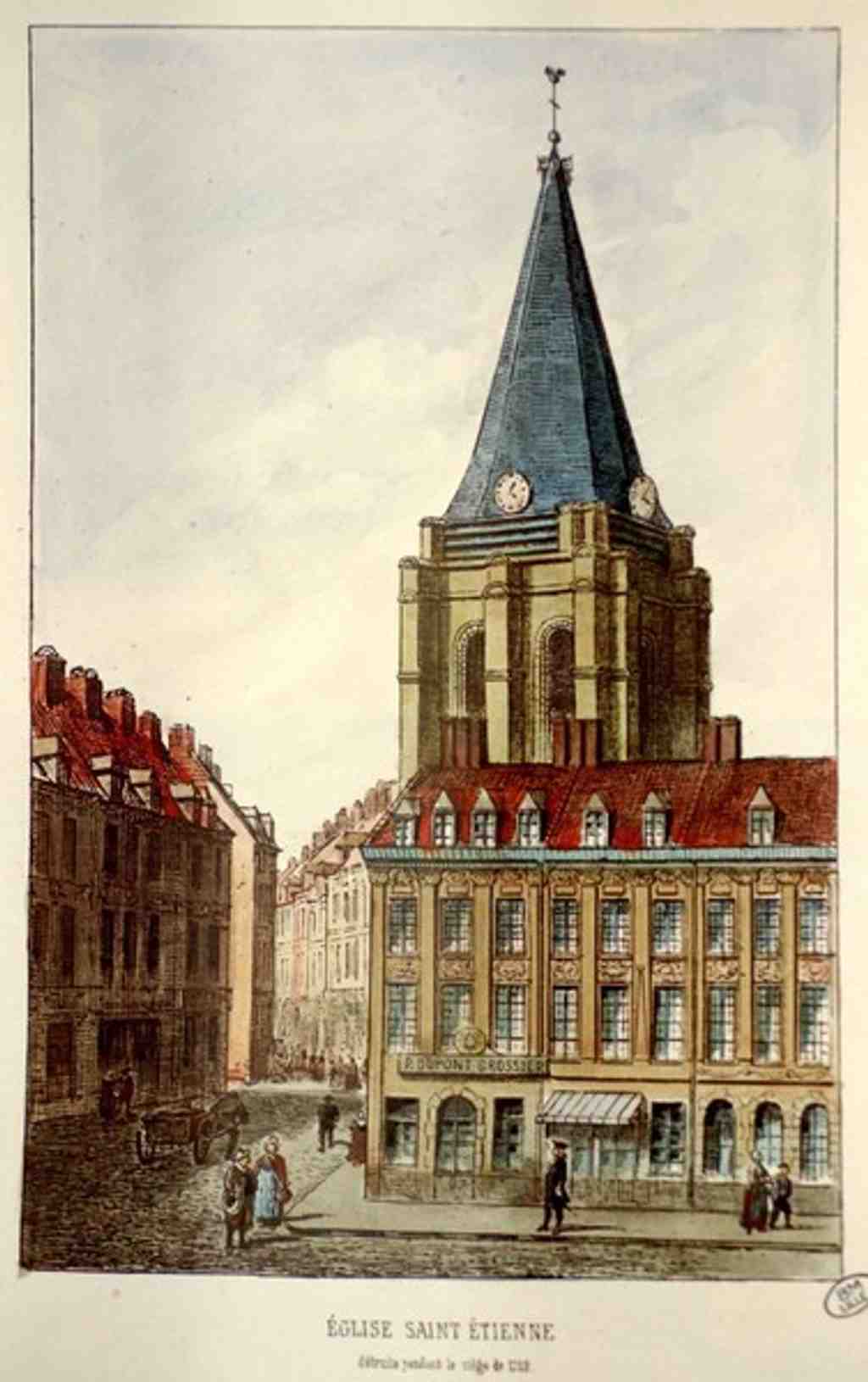
Look for a tall stone church tower with a sharp blue slate steeple and a big clock face, rising above the brick townhouses at the end of the street-if you see a building that looks like it’s keeping time for the whole neighborhood, you’ve spotted the Old Saint-Etienne Church.
Now, let’s travel back a few hundred years, right to this very spot-imagine the echoes of footsteps on ancient cobbles as you approach what was once one of Lille’s grandest halls. Back in the Middle Ages, folks walking here would have seen a massive church, shaped almost like a giant indoor market, with three wide naves running side by side under one soaring, echoing roof. Picture the air thick with incense and the hum of prayer; outside, the sound of horses’ hooves and chatter from the bustling market all around. The locals called it a “hallekerque”-that’s church-market to you and me. Five huge doorways, the main one facing Rue Esquermoise, promised both grandeur and a bit of a draft.
But here’s where things get lively: in 1649, a tapestry showing Saint Stephen’s rather unlucky day-his stoning-was donated by a certain Marguerite de Fourmestraux. Bet holiday services were extra exciting that year! Wealthy families like the Hangouarts, allies of the powerful Dukes of Burgundy, had their fingerprints all over this church like proud parents at a school concert.
The church’s bell tower wasn’t just for decoration-it became the city’s official belfry, with a carillon and a set of mighty bells. When the old city hall tower came crashing down in 1600, the bells moved in here, joined by the famous Emmanuel bell that kept Lillois on time and probably scared a few pigeons. Imagine a dozen bell ringers scurrying about, eight for daily duties and four extra just for the big bell-now that’s teamwork!
But all stories have twists. In 1792, during the Austrian siege, cannonballs thundered through the sky and smashed the great Saint-Etienne Church to ruins, leveling not just the church, but a dozen nearby houses. Just like that, centuries of history were swept away, replaced by rue des Débris-Saint-Etienne-the very street beneath your feet, named for all the bits and pieces left behind.
If you look nearby, some of the church’s columns are still holding up the vaults by the Grand Place, quietly carrying memories of prayers, laughter, and the occasional bit of gossip. So next time you check your watch, think of the tower that kept Lille ticking-until one fateful September changed everything. And to think, all that’s left is the whisper of bells and a street full of stories.


