
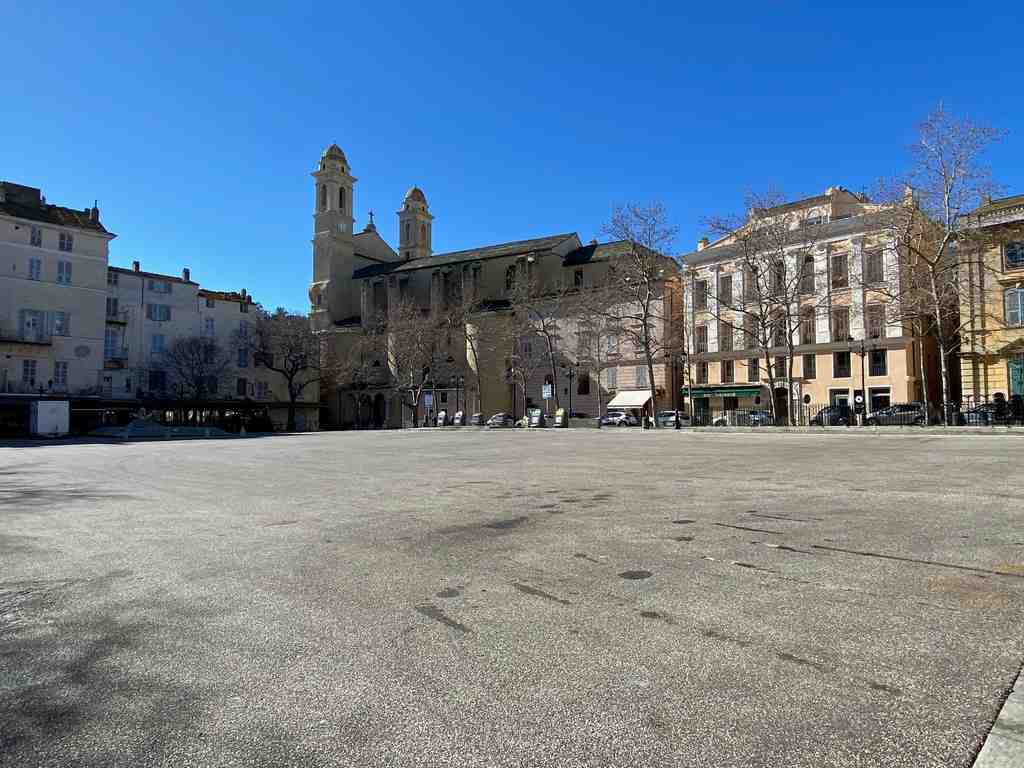
On your left, look for a broad stone-paved square edged by plane trees and pale masonry façades, with the old town hall’s triangular pediment standing out as its most formal marker.
This is Bastia’s old Market Square, known in Corsican as Piazza di u Merca. The word merca is simply a shortened form of mercatu, meaning market, and that plain little name tells you a great deal. For generations, this was one of the city’s busiest hearts, a place of barter, gossip, arguments, greetings, and the sort of news that travelled faster by voice than by letter.
Yet the market did not begin here. Under Genoese rule in the seventeenth century, traders gathered up in the Citadel, at a place called A Chjappa, near what is now the upper part of Rue Saint-Michel. In the eighteenth century, a fish market opened elsewhere. Then, in the nineteenth century, the main market moved again, into the Guadellu district on Rue Vattelapesca, where people called it the New Market. Only in eighteen eighty did the market finally settle here, in this square.
Seven years later, the municipal council planted the plane trees that still give the space its outline. A cast-iron fountain once stood here too, adding a note of ceremony, but that has disappeared. Even so, the square still keeps the feeling of an outdoor room, framed by old stone, civic ambition, and memory.
And memory here has a rather sly streak. Before the market arrived, this ground was not a square at all, but open land and gardens belonging to the Favalelli family. After the French conquest, Count Marbeuf chose this very spot for a wooden theatre in seventeen seventy-four. He did not act from pure love of drama. He had a political purpose. Bastia largely spoke Corsican and leaned warmly toward Italian culture; only a small educated elite used French with ease. Marbeuf hoped French-language performances would teach the language and speed up assimilation. It failed. Bastia’s audiences preferred Italian plays and concerts in other venues, and that preference lingered far into the twentieth century. The Marbeuf theatre finally disappeared in eighteen eighty-one, two years after the opening of the city’s newer theatre.
Around you, the square still reads like a cast of characters. The old town hall, known locally as A Merria Vechja, began life as an army building. The city bought it in eighteen fifty-five, and by the late nineteenth century its façade had acquired the balcony, cornice, and triangular pediment you can see, along with a relief of Bastia’s coat of arms, the little castle that recalls Leonello Lomellini and the fortress that gave the town its name. The building served as the town hall until nineteen eighty-two; now it hosts weddings and civil records. Nearby, Saint-Jean-Baptiste watches over the quarter, and the old Favalelli house still hints at the powerful families who shaped Terra Vechja.
This square reveals Bastia at its most intimate: practical, proud, and quietly theatrical.
When you are ready, continue toward Saint-Jean-Baptiste and let the square’s murmur follow you.




