
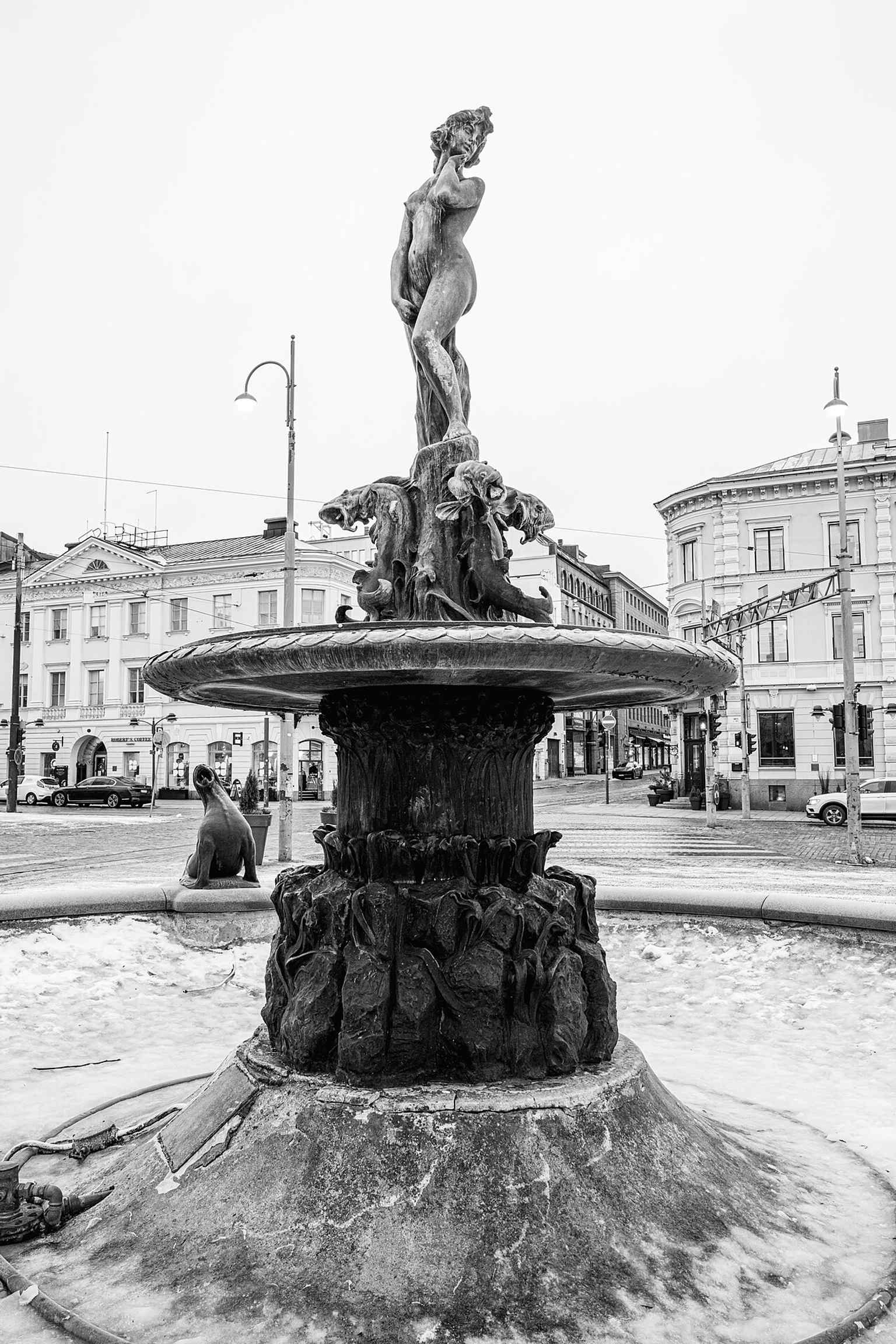
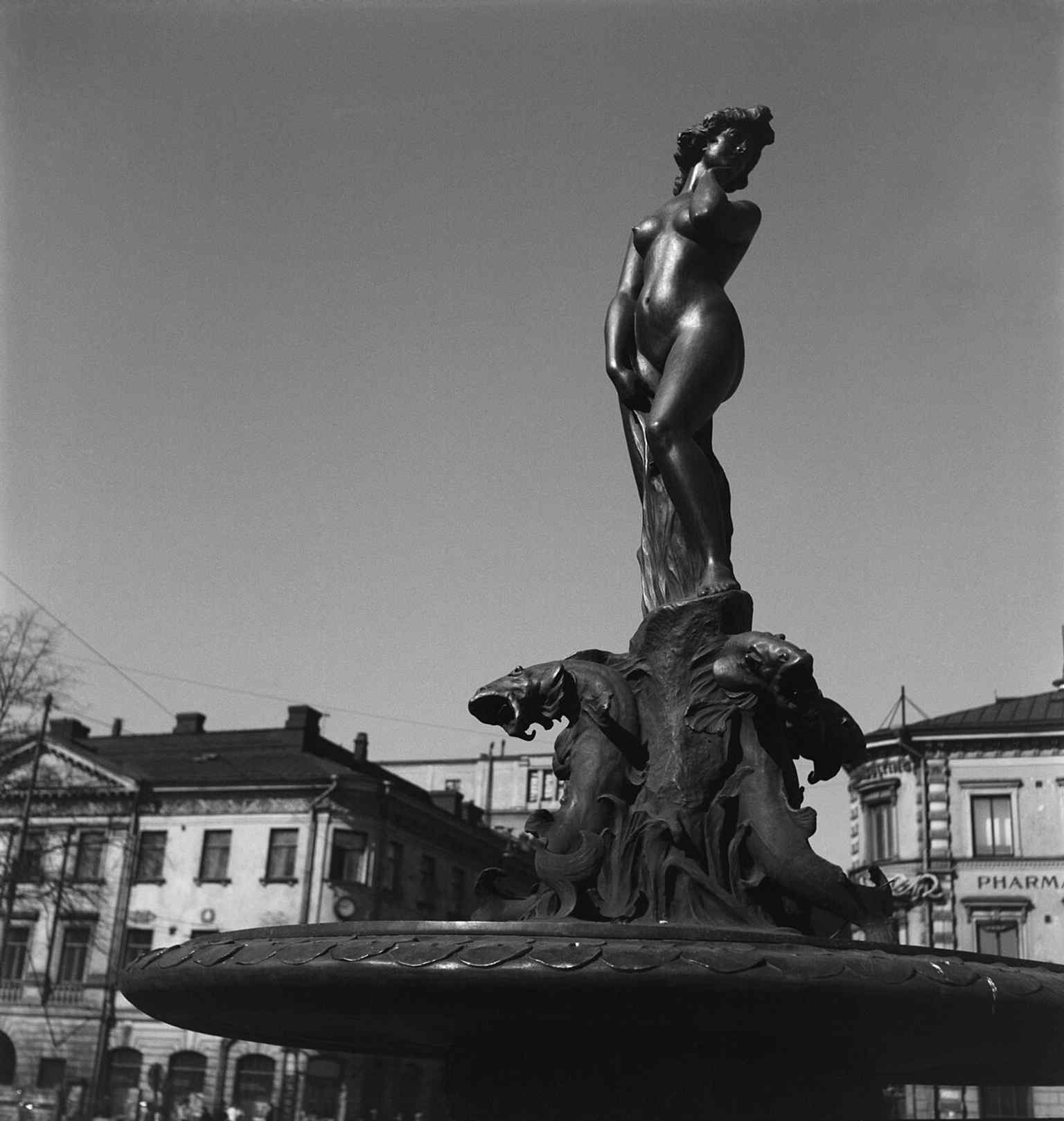
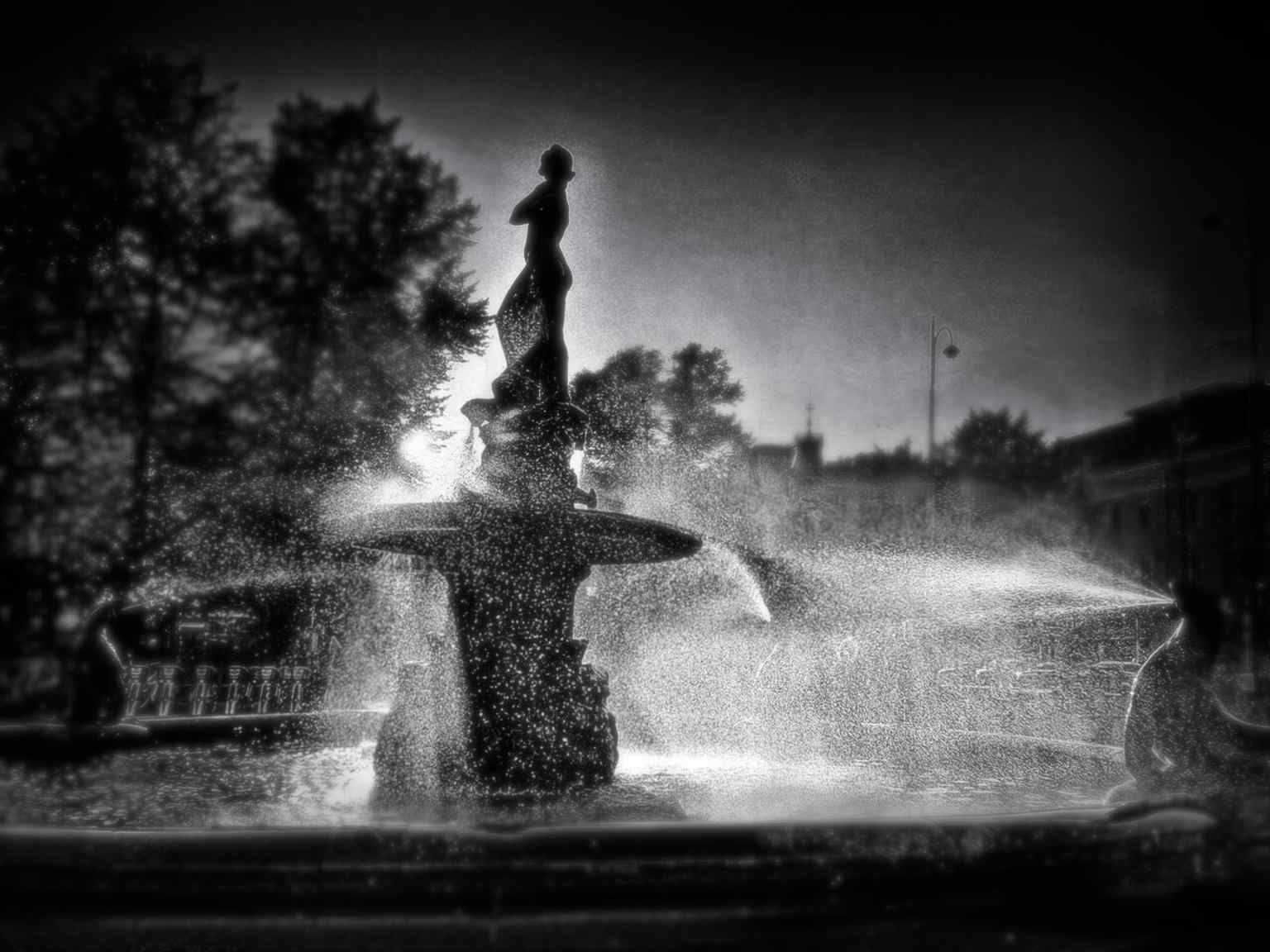
Look for a bronze mermaid-like woman standing on a rough stone pedestal in a circular red-granite fountain, with four sea lions stretching upward around her.
Meet Manta... officially Havis Amanda, the beloved of the sea. Ville Vallgren sculpted her in Paris, cast her in bronze in nineteen oh six, and Helsinki set her here by Market Square in nineteen oh eight. In the contract, the subject was simple and grand: Helsinki rising from the sea. And that is exactly what she does. She stands just over two meters tall, naked, poised on her rock as if she has only just stepped out of the water and decided the city might be worth a look.
Every Vappu, students wash and cap her in a ritual called Mantan lakitus. That is the moment a sculpture stops behaving like a monument and starts acting like a citizen. One oversized white student cap, and suddenly the whole city is in on the joke, the ceremony, and the claim: this place belongs to the people who perform it.
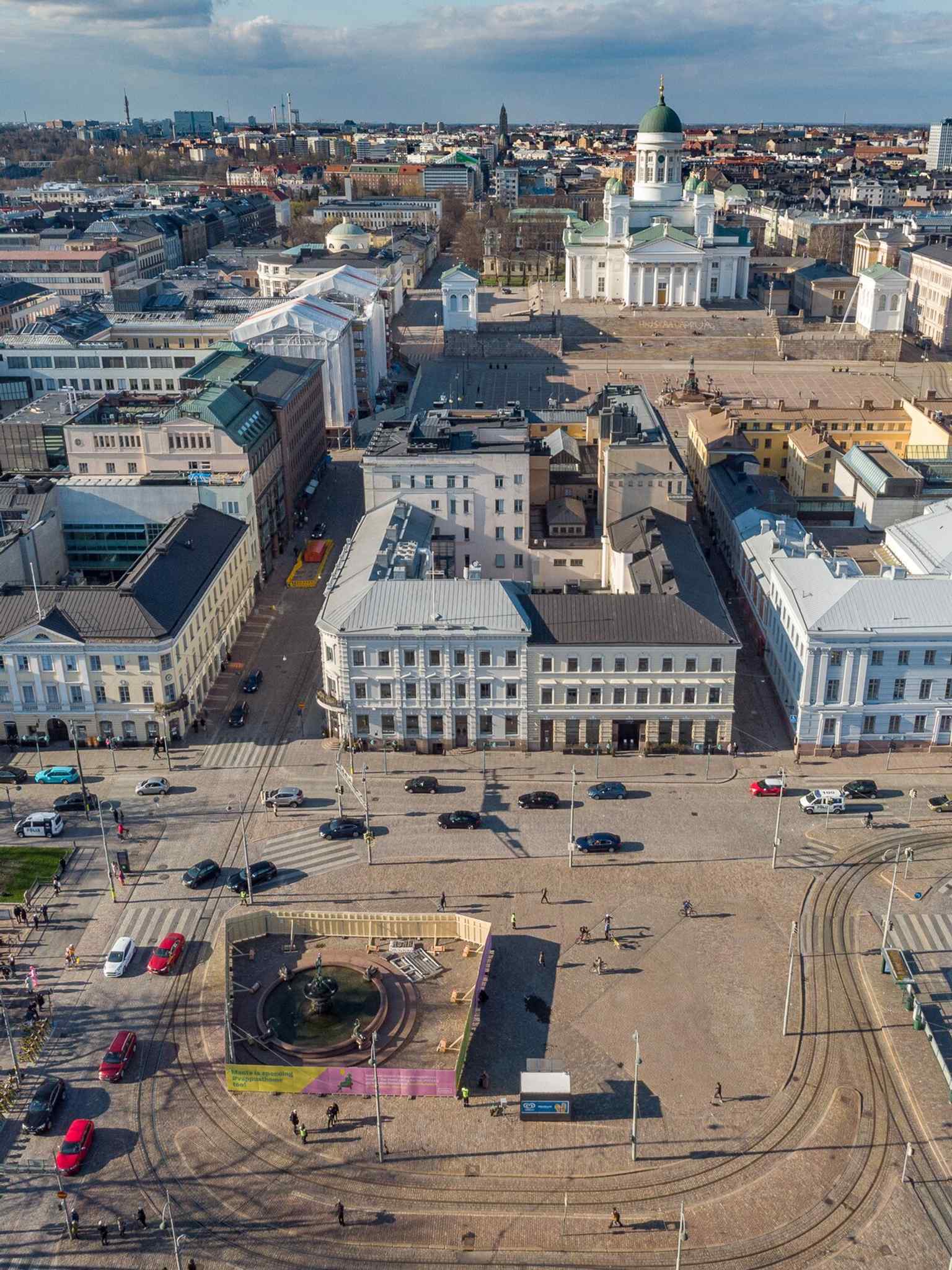
The funny part is that this cheerful symbol began as a scandal. Vallgren, who had built his career in France and even became a French citizen, gave Helsinki a very Parisian figure: sinuous, sensual, art nouveau in style, meaning all flowing lines and elegant movement. He used two nineteen-year-old Parisian models, Marcelle Delquini and Léonie Tavier. He even shipped the work here in pieces from Le Havre on a steamship called Leo. Before the city chose this site, officials tested a wooden mock-up in several spots, including Erottaja. Market Square won because the open space suited her better than a street boxed in by tall buildings.
Then came the uproar. Lucina Hagman and the women of Naisasialiitto Unioni, the women’s rights association, condemned the statue as indecent. Some critics called her too French, too flirtatious, not nearly solemn enough to represent the nation. Vallgren stared at the fuss and basically replied: she is a mermaid leaving the sea... of course she is unclothed. Reasonable enough, though public morality rarely improves when invited to calm down.
And yet the city kept her. Better than that, the city adopted her. The basin beneath her, carved from polished red Balmoral granite from Vehmaa, gives her a proper stage, while the sea lions reaching upward add a bit of theatrical devotion. Vallgren likely studied living sea lions in a Paris park for those. If you want, check the before-and-after slider in the app; it’s a neat way to watch Manta stay herself while Helsinki rearranges its face around her.
Her survival has not been effortless. The bronze is only about five millimeters thick, and celebratory climbing damaged it often enough that the city carried out a major restoration between twenty twenty-three and twenty twenty-four. If you glance at the detail image on your screen, you can see how finely that restored surface still holds Vallgren’s touch.
So here she is: born from official commission, attacked in public, then claimed by ritual. Helsinki has a talent for that. From this rebellious little queen of the harbor, we’ll head toward the National Library, where the city’s arguments trade bronze drama for paper and ink. And fittingly enough, Manta is here all day, every day.





.jpg)
.jpg)

