
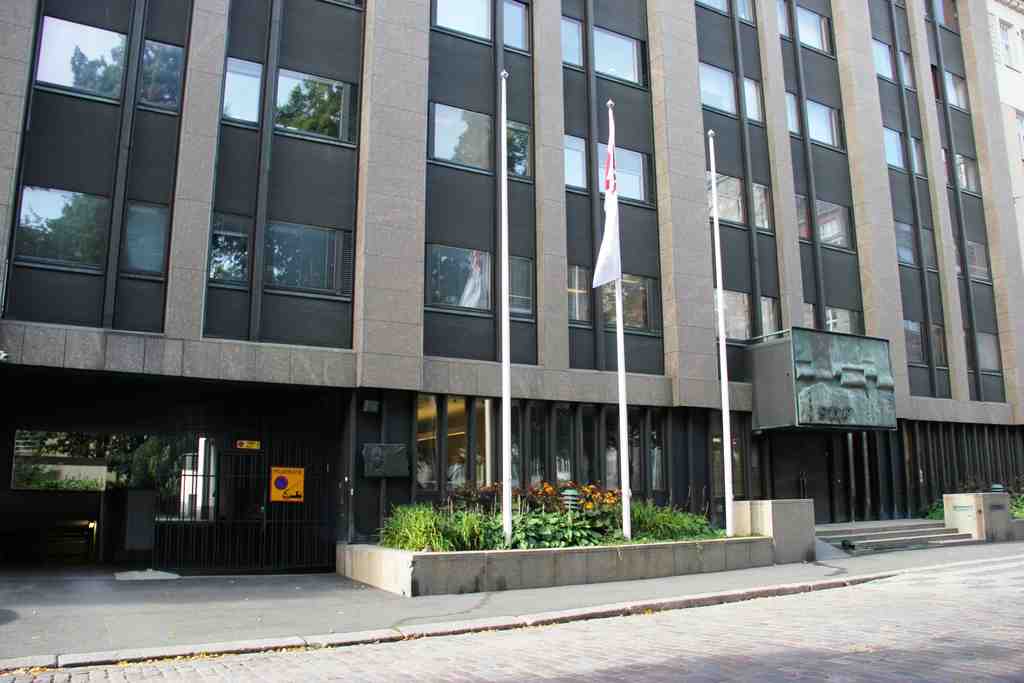
Look for the dark brick block with its broad rectangular windows and the bronze relief fixed above the main entrance.
This is Puoluetalo, the Party House, and it marks a subtle but decisive change in Hakaniemi’s political life. Here, conviction took on an address. The workers’ movement that spoke in halls and gathered in public squares settled into offices, committees, typed letters, and daily administration.
The Social Democratic Party of Finland, S-D-P, chose this site for its headquarters, and architects Jaakko Kontio, Kalle Räike, and Seppo Kilpiä gave it this solid form in nineteen seventy-nine. The party office stayed here until twenty fifteen. After that, the building changed hands and began another life as housing, which is rather fitting, because housing had been part of the plan from the start. The plot required half the spaces to be residential, so the building combined party offices with twenty-four small flats on the upper levels. Even its practical compromises tell you something about Helsinki: ideals here rarely float free of zoning, finance, and negotiation.
And negotiation is exactly how this house came into being. The party had worked from the old Workers’ House across the square, at Paasivuorenkatu three, but by the nineteen seventies that building had grown shabby and expensive to repair. A deal with the Workers’ Savings Bank unlocked this plot instead. The bank took the more valuable office site across the way, the party received this one plus money to build anew, and in May of nineteen seventy-seven the agreement set the whole machinery in motion.
Not everyone admired the result. A city facade committee dismissed the design as artificially monumental and ill at ease with its surroundings. Yet Kalevi Sorsa, the party leader, gathered officials and pressed ahead, and one permit officer replied, with dry Helsinki bluntness, that surely the country’s largest party could build the sort of house it wanted.
Now look above the door. Sculptor Kimmo Pyykkö made that bronze relief, called Interaction, in nineteen seventy-eight. He imagined waves moving before a rock shore on Lake Päijänne. Only later did the S-D-P letters get added on separate pins, so the political badge could come away without harming the artwork beneath. When the party sold the building in twenty fifteen, people watched that relief nervously. It had appeared in news images for decades, and without it, many felt the building might lose its identity altogether.
One more quiet surprise: a plaque here remembers writer Mika Waltari, born on this site in nineteen oh eight, in the earlier house that once stood here.
In a moment, walk into the little park ahead, Paasivuorenpuistikko. There, this larger story of institutions and power narrows again to a single human figure.




