
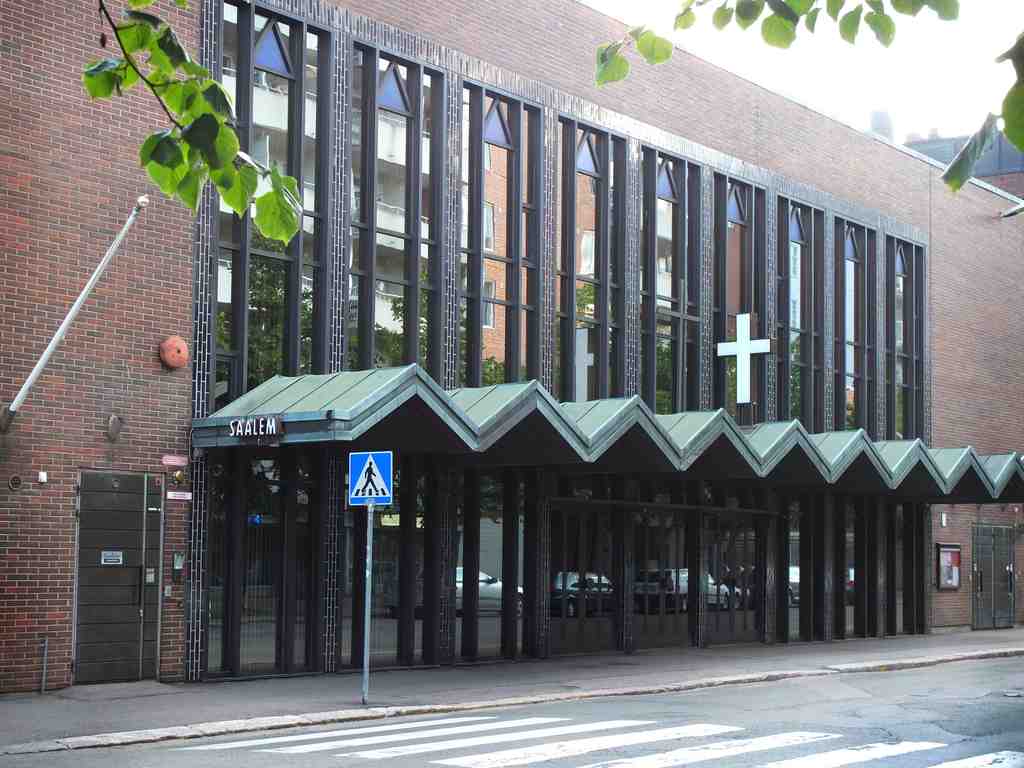
On your right is a broad pale concrete church with crisp angular lines and a recessed entrance, its façade marked by a simple cross set high above the street.
This is the Saalem Temple, home to Helsinki’s Saalem congregation, and it gives Hakaniemi one more identity to hold. Not only trade, not only politics, not only traffic and reclaimed shoreline, but spiritual hunger as well.
Most people notice the scale first. When this temple opened on New Year’s Day in nineteen seventy-eight, it gave the congregation a central home with room for seventeen hundred people in the main hall. Architect Veikko Gröhn drew it for a movement that had grown far beyond rented rooms and smaller prayer houses. Yet the deeper story is quieter, and far older than the concrete in front of you.
This plot matters because, in the early nineteen hundreds, a small prayer group met here in the Hakaniemi area and invited Thomas Ball Barratt, a Norwegian Methodist pastor, to Finland in nineteen eleven. That invitation helped ignite the Finnish Pentecostal revival, a Protestant movement that places special emphasis on direct experience of the Holy Spirit. Barratt’s meetings startled people. Worshippers spoke in tongues, meaning ecstatic prayer in languages unknown to the speaker, and the press spread news of it across the country almost as quickly as the believers did.
The local secret, though, is not only revival. It is administration. Helsinki’s early Pentecostal work gathered in a bilingual congregation called Filadelfia, but practical life in two languages proved difficult. So Eino I. Manninen, a trained forester who had studied in Helsinki and then become a pastor, joined other Finnish-speaking believers and founded Saalem on the fifth of March, nineteen twenty-eight. That intimate split often disappears behind grander headlines, yet it tells you something essential about Hakaniemi: even faith here had to negotiate language, identity, and who exactly belonged in the room.
Manninen led Saalem for nearly forty years. Under him, the congregation grew quickly, survived wartime disruption, and built international ties that brought figures such as Oral Roberts, David Wilkerson, Reinhard Bonnke, and Billy Graham into Finland’s religious life. Wilkerson, the pastor known for working with gang members and drug users in New York, especially shaped Saalem’s response to Helsinki’s own wounded young people. The congregation answered with street outreach and a magazine called Vastaus, meaning “Answer.” So this was never only a preaching hall. It became a place that tried to meet the city where the city was fraying.
Today Saalem is Finland’s largest Pentecostal congregation, with around three thousand six hundred members, part of the Finnish Pentecostal Church, and led since October twenty twenty-two by Stefan Sigfrids. Services and ministries reach families, seniors, children and worshippers in many languages, from Arabic and Persian to Russian, Estonian and English, while mission work stretches outward with Fida International.
That feels right for Hakaniemi. A district can raise market halls and union halls, department stores and round modernist blocks, and still leave room for prayer. In the end, that may be the truest picture of this part of Helsinki: not one creed, one class, or one skyline, but many ways of gathering and remaking a life.




