
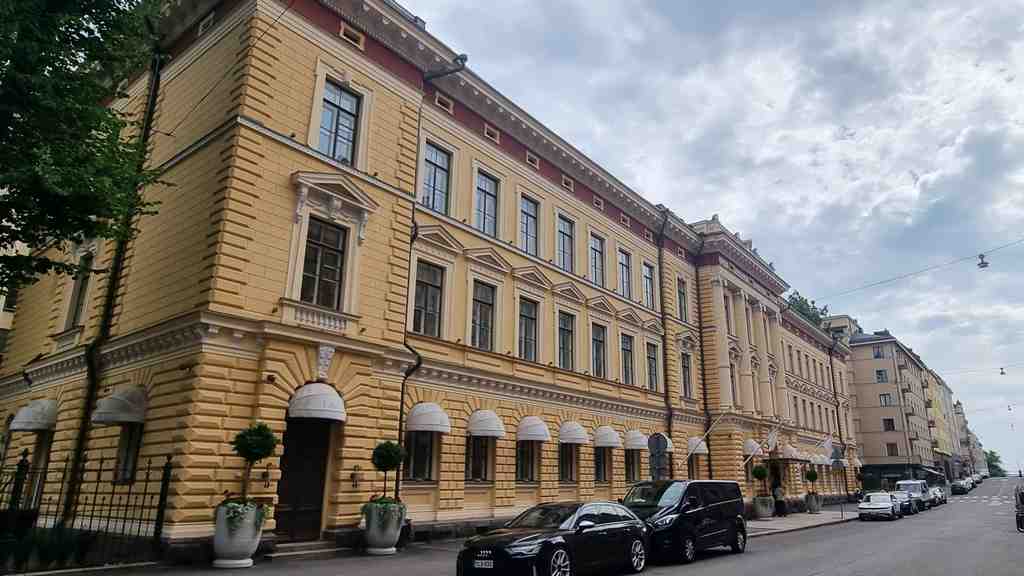
On your right stands a long pale stone-and-stucco complex with tall rectangular windows, a disciplined classical frontage, and discreet Maria lettering at the entrance.
This is Waldorf Astoria Helsinki, long known as Hotel Maria, and it feels like a fitting last stop because so much of Helsinki’s story gathers here under one polished name. What you see as a luxury hotel began, piece by piece, between eighteen eighty-five and nineteen thirty. Architect Evert Lagerspetz drew the oldest part as officers’ barracks for the Uusimaa Battalion. Later, Armas Siitonen pushed the complex toward Liisankatu in the nineteen thirties. After soldiers left, civil servants moved in: the Finnish Agricultural Board, the Seed Inspection Department, the Department of Agricultural Chemistry. Uniforms gave way to paperwork.
But the deeper local memory is sharper than that. Most visitors never realize this address stands in the old Karhu, or Bear, block. From nineteen oh-one to nineteen eighteen, Russian forces occupied these quarters. Then, in nineteen eighteen, troops from the German Baltic Sea Division took them over. And all of this stands on Liisankatu, a street named for a Russian empress, Elizabeth Alexeievna. That is Helsinki in miniature... military pressure, imperial naming, and careful reinvention sharing the same stones.
The hotel’s chosen patron spirit is Grand Duchess Maria Feodorovna, the Danish-born wife of Tsar Alexander the Third. She came to Finland as a kind of refuge from the strain of the Russian court, and the hotel leans into that memory. Inside, designers chose ivory, beige, and taupe, shades linked to her wardrobe and jewelry, as if softness itself could become a brand of authority. It is a tender idea, and also a revealing one: even now, prestige borrows power from old crowns.
The rebirth was immense. Workers restored extensive original plaster mouldings by hand to preserve the nineteenth-century character. Samppa Lajunen’s company, Samla Capital, bought the block in twenty twenty. Fira led construction starting in January of twenty twenty-three, and the Finnish firm Avarc shaped the new work. The hotel opened in late twenty twenty-three, with the full renovation wrapping up in twenty twenty-four. Soon it became the first Waldorf Astoria in the Nordic countries.
And yet even this glamorous chapter carries its own unease. The project cost about one hundred and sixty-six million euros. Financing proved difficult, London investors stepped in, and later the hotel became part of a public scandal when losses and cross-investments shook trust in Samla’s funds. The main lender forced a distress sale, and Singapore-based M and L Hospitality Group took over. So yes, Bruce Springsteen stayed here and drew fans to these quiet streets. Yes, the Emir of Qatar reserved the entire hotel during a state visit. But behind the velvet image sat a very modern struggle over money, risk, and who gets protected when prestige falters.
So here is the thought I want to leave with you: when a former military block becomes one of the city’s most luxurious addresses, are we honoring its history, softening it, or packaging it for comfort?
After this walk, Helsinki no longer reads as a row of handsome facades. It reads like layers of ambition, fear, adaptation, and display... written over each other, never fully erased.




